

Myanmar junta gains hold on jade profits as fighting flares

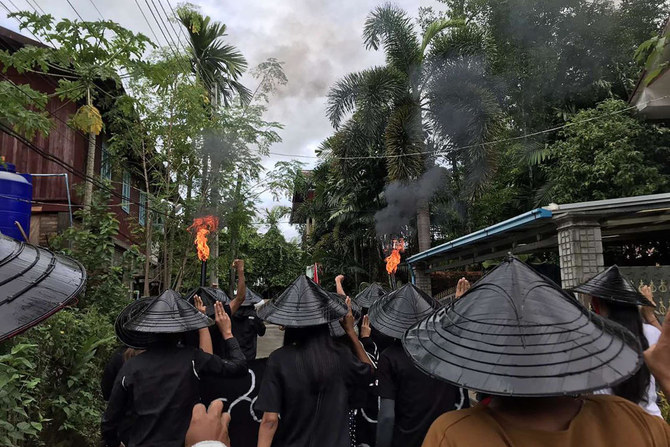
Protesters holding flaming torches during a demonstration against the military coup in Dawei. (File/AFP)
Short Url
Updated 29 June 2021
Follow

Myanmar junta gains hold on jade profits as fighting flares

  • Army and ethnic guerrilla forces cooperated to share in profits from mining of the world’s richest jade deposits
  • Global Witness and other groups are calling for stronger sanctions against the junta to help counter

BANGKOK: The military takeover in Myanmar has given the junta full control of the country’s lucrative and conflict-ridden jade mining, providing it with profits and leverage for consolidating power, researchers said Tuesday.

A flareup in fighting around the mines in Hpakant, in remote Kachin state, also is adding to instability in the border region, independent research group Global Witness said in its report.

Army and ethnic guerrilla forces have been fighting in Kachin for years. But they had largely cooperated to share in profits from mining of the world’s richest jade deposits, making the industry a hotbed for corruption instead of a national asset that could be invested for the public good.

Global Witness estimates the annual losses in the tens of millions of dollars.

It and other experts say the Feb. 1 coup has disrupted the de facto cease-fire that had held around the mines, with fighting breaking out even in the jade-producing zone.

“It’s an extremely unstable situation where the rule of law is just completely broken down,” Keel Dietz, one of the report’s authors, told The Associated Press.

The civilian government of Aung San Suu Kyi made halting progress in cleaning up the industry after taking power in 2016. It suspended issuing or renewing jade mining permits. A new law restricts licenses to a maximum of three years, adding to the incentive to mine illicitly and as quickly as possible.

Now the military, known as the Tatmadaw, controls who can mine and who can’t and can dole out licenses to buy loyalty and try to splinter rival groups, Dietz said.

Global Witness and other groups are calling for stronger sanctions against the junta to help counter what has become a free-for-all rush to dig out as much of the precious stone as possible.

“It is up to the international community to limit the amount of funding the military can receive from selling Myanmar’s natural resources by preventing the import of those resources and blocking financial transactions that pay for them,” the report says.

In an earlier report, Global Witness documented how the industry is dominated by networks of military elites, drug lords and crony companies. The situation has barely changed, those familiar with the region say.

That has created incentives for both sides in the conflict to maximize production, at a huge cost to the environment. Nearly a half-million people migrate into the region to work in the mines or to pick through mine tailings, hunting for stones that might have valuable jade inside. Hundreds of have died from landslides on the unstable slopes of the open-pit mines.

Profits from the industry are seized by those controlling the mines and trade routes.

“Jade probably has been the military’s most lucrative sector except petroleum. Other mining like copper has made them a lot of money too. Rare earths less so, although not insignificant,” said Edith Mirante, director of Project Maje, which researches Myanmar’s environmental issues.

The US government and United Kingdom have imposed sanctions on Myanmar Gems Enterprise, on key military-controlled companies, military leaders, their family members and other companies either controlled by or linked to the army.

The potential impact of sanctions against the gemstone industry is limited, however, since nearly all jade and a large share of other precious stones and pearls produced in Myanmar go to China, often through illicit channels.

Many of the mining operations are conducted by Chinese companies allied with Myanmar partners. Over the decades, the military have often extracted huge revenues from mining while the Kachin have arrangements to tax smuggling routes into China, the destination for most of the jade mined in the region.

Now, with people in Kachin protesting against the coup, antagonisms are deepening, said David Dapice, an expert on Southeast Asia at Harvard University’s Ash Center.

“A lot of fighting is over the share of who gets what,” with none of those involved prepared to trust each other, he said in an email. “The military has circled the wagons anyway and is not in a compromising mood.”

At times in the past, fighting has spilled over the border, killing or injuring Chinese civilians.

But the graver, longer term problem is lawlessness, a breakdown in the rule of law that “has the potential to supercharge other illegal activities, such as narcotics production and animal trafficking, that the Chinese government is likely more concerned about than it is about jade,” Dietz said.

“Instability breeds instability and I think that’s really important especially for the Chinese government to understand. This is a disaster brewing right on their border,” he said.


Starmer arrives in China to defend ‘pragmatic’ partnership

Updated 4 sec ago
Follow

Starmer arrives in China to defend ‘pragmatic’ partnership

  • British Prime Minister Keir Starmer arrived in Beijing on Wednesday to meet with Chinese leader Xi Jinping, hoping to restore long fraught relations

BEIJING: British Prime Minister Keir Starmer arrived in Beijing on Wednesday to meet with Chinese leader Xi Jinping, hoping to restore long fraught relations.
It is the first visit to China by a UK prime minister since 2018 and follows a string of Western leaders courting Beijing in recent weeks, pivoting from a mercurial United States.
Starmer, who is also expected to visit Shanghai on Friday, will later make a brief stop in Japan to meet with Prime Minister Sanae Takaichi.
For Xi, the trip is an opportunity to show Beijing can be a reliable partner at a time when President Donald Trump’s policies have rattled historic ties between Washington and its Western allies.
Starmer is battling record low popularity polls and hopes the visit can boost Britain’s beleaguered economy.
The trip has been lauded by Downing Street as a chance to boost trade and investment ties while raising thorny issues such as national security and human rights.
Starmer will meet with Xi for lunch on Thursday, followed by a meeting with Premier Li Qiang.
The British leader said on Wednesday this visit to China was “going to be a really important trip for us,” vowing to make “some real progress.”
There are “opportunities” to deepen bilateral relations, Starmer told reporters traveling with him on the plane to China.
“It doesn’t make sense to stick our head in the ground and bury in the sand when it comes to China, it’s in our interests to engage and not compromise on national security,” he added.
China, for its part, “is willing to take this visit as an opportunity to enhance political mutual trust,” foreign ministry spokesman Guo Jiakun reiterated Wednesday during a news briefing.
Starmer is the latest Western leader to be hosted by Beijing in recent months, following visits by Canadian Prime Minister Mark Carney and French President Emmanuel Macron.
Faced with Trump’s threats to impose tariffs on Canada for signing a trade agreement with China, and the US president’s attempts to create a new international institution with his “Board of Peace,” Beijing has been affirming its support for the United Nations to visiting leaders.
Reset ties 
UK-China relations plummeted in 2020 after Beijing imposed a sweeping national security law on Hong Kong, which severely curtailed freedoms in the former British colony.
They soured further since with both powers exchanging accusations of spying.
Starmer, however, was quick to deny fresh claims of Chinese spying after the Telegraph newspaper reported Monday that China had hacked the mobile phones of senior officials in Downing Street for several years.
“There’s no evidence of that. We’ve got robust schemes, security measures in place as you’d expect,” he told reporters on Wednesday.
Since taking the helm in 2024, Starmer has been at pains to reset ties with the world’s second-largest economy and Britain’s third-biggest trade partner.
In China, he will be accompanied by around 60 business leaders from the finance, pharmaceutical, automobile and other sectors, and cultural representatives as he tries to balance attracting vital investment and appearing firm on national security concerns.
The Labour leader also spoke to Xi on the sidelines of the G20 summit in Brazil in November 2024.
Jimmy Lai
The prime minister is also expected to raise the case of Hong Kong media mogul and democracy supporter Jimmy Lai, 78, a British national facing years in prison after being found guilty of collusion charges in December.
When asked by reporters about his plans to discuss Lai’s case, Starmer avoided specifics, but said engaging with Beijing was to ensure that “issues where we disagree can be discussed.”
“You know my practice, which is to raise issues that need to be raised,” added Starmer, who has been accused by the Conservative opposition of being too soft in his approach to Beijing.
Reporters Without Borders urged Starmer in a letter to secure Lai’s release during his visit.
The British government has also faced fierce domestic opposition after it approved this month contentious plans for a new Chinese mega-embassy in London, which critics say could be used to spy on and harass dissidents.
At the end of last year, Starmer acknowledged that China posed a “national security threat” to the UK, drawing flak from Chinese officials.
The countries also disagree on key issues including China’s close ties with Russian President Vladimir Putin amid the war in Ukraine, and accusations of human rights abuses in China.