Arab economies jostle for position in $200 billion green hydrogen race

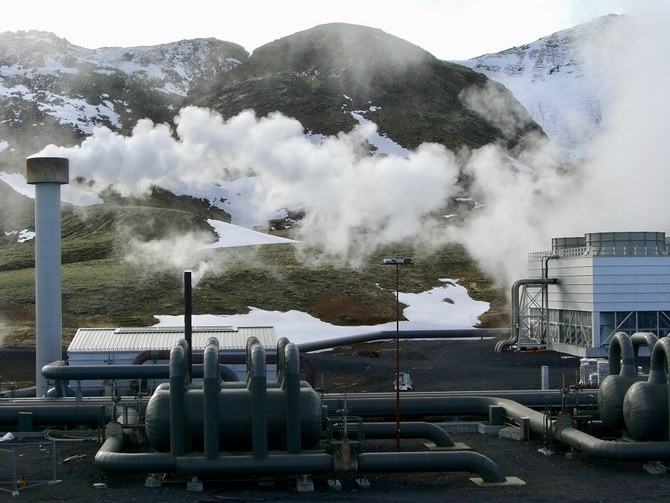
The Gulf alone could create a $200 billion green hydrogen industry by 2050, generating up to one million jobs. (Shutterstock)
Short Url
Updated 19 June 2021
Follow

Arab economies jostle for position in $200 billion green hydrogen race

  • The region has the potential to be one of the most competitive globally for green hydrogen production thanks to its abundant wind and solar resources

RIYADH: Another week, another huge green hydrogen project announcement in the Middle East. This time, it was Egypt’s turn. The most populous Arab nation is planning to invest up to $4 billion in a project to create hydrogen through electrolysis powered by renewable energy, Egyptian Minister of Electricity and Renewable Energy Mohamed Shaker said on June 14.
The disclosure follows a flurry of announcements last month, including Oman’s plan for the biggest green hydrogen plant in the world, to be built over the coming 27 years along with 25 GW of solar and wind power.
Also in May, Dubai launched the region’s first industrial scale solar-powered green hydrogen plant, a demonstration facility built by Siemens Energy and Dubai Electricity and Water Authority (DEWA).
Later in the month, Abu Dhabi got in on the act as it revealed plans for a $1 billion facility with capacity to produce 200,000 tons of green ammonia from 40,000 tons of green hydrogen (hydrogen is turned into ammonia for long-distance transport before being transformed back for use).
As for Saudi Arabia, it unveiled plans in July last year for a green hydrogen facility powered by 4 GW of wind and solar, the world’s largest such project at the time. The $5 billion plant will be built by Air Products, ACWA Power and Neom and will be capable of producing 650 tons of green hydrogen a day, enough to run about 20,000 hydrogen-fueled buses.
“The Middle East has joined the green hydrogen wave with mega project announcements,” said Flor Lucia De la Cruz, a senior research analyst for hydrogen and emerging technologies at Wood Mackenzie. “The Middle East has now positioned itself to become a key player in the green hydrogen economy leveraging its solar and wind capabilities and strategic position in between the European and Asian markets.”
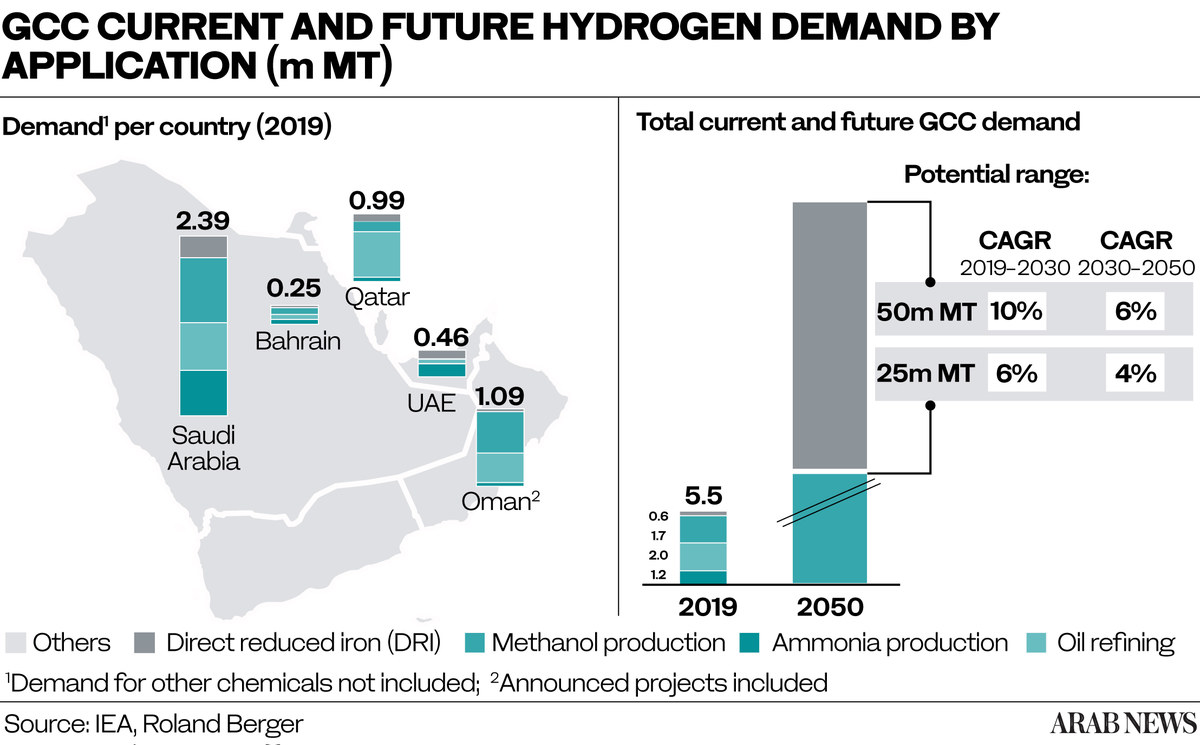

The region has the potential to be one of the most competitive globally for green hydrogen production thanks to its abundant wind and solar resources, industrial infrastructure and its location as an export hub, Dii Desert Energy and Roland Berger said in a report on the industry this month.
The Gulf alone could create a $200 billion green hydrogen industry by 2050, generating up to one million jobs, the report said as it predicted a long-term renewable energy deployment of up to 1,000 GW, 500 GW of electrolyzer capacity producing 100 million megatons of hydrogen.
“The GCC region is on the verge of a new era similar to the discovery of oil decades ago,” Vatche Kourkejian, a partner at Roland Berger, wrote in the report. Green hydrogen could allow the Gulf to continue being the main energy supplier to the world in a sustainable manner, he said.
The majority of the world’s hydrogen today (about 95 percent) is considered brown or gray, in that it is produced by steam reforming of natural gas, partial oxidation of methane or coal gasification. While the end product is a clean fuel, the production process uses huge amounts of energy and creates significant amounts of carbon dioxide.
So-called blue hydrogen uses the same process as gray hydrogen, but captures the carbon. Green hydrogen creates the gas through splitting water into oxygen and hydrogen via electrolysis and powering the process with renewable energy, leaving no dirty byproducts.
As well as allowing for the storage of intermittent wind and solar power, hydrogen can also be used to heat homes and cook as a replacement for natural gas, power vehicles, including planes and ships as well as cars, trucks and trains, and be used in industry to reduce the environmental impact of making metals, chemicals and refining oil.
However, the Middle East is not the only region looking to green hydrogen for future industrial development.
So far, 17 countries, (including Japan, South Korea, Canada and UK) have announced a hydrogen roadmap, strategy or vision, according to Wood Mackenzie.
Last year, the EU’s Green Recovery Package earmarked €150 billion ($178 billion) for green hydrogen, including targets for 6 GW of electrolyzer capacity in the first phase between 2020 and 2024, with 40 GW to be installed by the end of the second phase in 2030.
“The last year has seen a decisive pivot toward decarbonization globally, which is extremely positive for zero-carbon technologies,” said Ben Gallagher, lead analyst, emerging technologies at Wood Mackenzie. “Green hydrogen is a key beneficiary, with this pivot pushing it to the fore ahead of other methods for producing the gas. In fact, electrolysis-based low-carbon production now makes up 67 percent of the overall pipeline for hydrogen.”


AI will never replace human creativity, says SRMG CEO 

Updated 30 January 2026
Follow

AI will never replace human creativity, says SRMG CEO 

  • Speaking to Maya Hojeij, senior business anchor at Asharq with Bloomberg, Jomana R. Alrashid expressed pride in SRMG platforms that had absorbed and adopted AI

RIYADH: Jomana R. Alrashid, CEO of Saudi Research and Media Group, highlighted how AI cannot replace human creativity during a session at The Family Office’s “Investing Is a Sea” summit at Shura Island on Friday. 

“You can never replace human creativity. Journalism at the end of the day, and content creation, is all about storytelling, and that’s a creative role that AI does not have the power to do just yet,” Alrashid told the investment summit. 

“We will never eliminate that human role which comes in to actually tell that story, do the actual investigative reporting around it, make sure to be able to also tell you what’s news or what’s factual from what’s wrong ... what’s a misinformation from bias, and that’s the bigger role that the editorial player does in the newsroom.”

Speaking on the topic of AI, moderated by Maya Hojeij, senior business anchor at Asharq with Bloomberg, the CEO expressed her pride in SRMG platforms that had absorbed and adopted AI in a way that was “transformative.”

“We are now translating all of our content leveraging AI. We are also now being able to create documentaries leveraging AI. We now have AI-facilitated fact-checking, AI facilities clipping, transcribing. This is what we believe is the future.”

Alrashid was asked what the journalist of the future would look like. “He’s a journalist and an engineer. He’s someone who needs to understand data. And I think this is another topic that is extremely important, understanding the data that you’re working with,” she said.

“This is something that AI has facilitated as well. I must say that over the past 20 years in the region, especially when it comes to media companies, we did not understand the importance of data.”


The CEO highlighted that previously, media would rely on polling, surveys or viewership numbers, but now more detailed information about what viewers wanted was available. 

During the fireside session, Alrashid was asked how the international community viewed the Middle Eastern media. Alrashid said that over the past decades it had played a critical role in informing wider audiences about issues that were extremely complex — politically, culturally and economically — and continued to play that role. 

“Right now it has a bigger role to play, given the role again of social media, citizen journalists, content creators. But I also do believe that it has been facilitated by the power that AI has. Now immediately, you can ensure that that kind of content that is being created by credible, tier-A journalists, world-class journalists, can travel beyond its borders, can travel instantly to target different geographies, different people, different countries, in different languages, in different formats.”

She said that there was a big opportunity for Arab media not to be limited to simply Arab consumption, but to finally transcend borders and be available in different languages and to cater to their audiences. 


The CEO expressed optimism about the future, emphasizing the importance of having a clear vision, a strong strategy, and full team alignment. 

Traditional advertising models, once centered on television and print, were rapidly changing, with social media platforms now dominating advertising revenue.

“It’s drastically changing. Ultimately in the past, we used to compete with one another over viewership. But now we’re also competing with the likes of social media platforms; 80 percent of the advertising revenue in the Middle East goes to the social media platforms, but that means that there’s 80 percent interest opportunities.” 

She said that the challenge was to create the right content on these platforms that engaged the target audiences and enabled commercial partnerships. “I don’t think this is a secret, but brands do not like to advertise with news channels. Ultimately, it’s always related with either conflict or war, which is a deterrent to advertisers. 

“And that’s why we’ve entered new verticals such as sports. And that’s why we also double down on our lifestyle vertical. Ultimately, we have the largest market share when it comes to lifestyle ... And we’ve launched new platforms such as Billboard Arabia that gives us an entry into music.” 

Alrashid said this was why the group was in a strong position to counter the decline in advertising revenues across different platforms, and by introducing new products.

“Another very important IP that we’ve created is events attached to the brands that have been operating in the region for 30-plus years. Any IP or any title right now that doesn’t have an event attached to it is missing out on a very big commercial opportunity that allows us to sit in a room, exchange ideas, talk to one another, get to know one another behind the screen.” 

The CEO said that disruption was now constant and often self-driving, adding that the future of the industry was often in storytelling and the ability to innovate by creating persuasive content that connected directly with the audience. 

“But the next disruption is going to continue to come from AI. And how quickly this tool and this very powerful technology evolves. And whether we are in a position to cope with it, adapt to it, and absorb it fully or not.”