Emirates reports $5.5bn loss as group headcount falls by 33,000

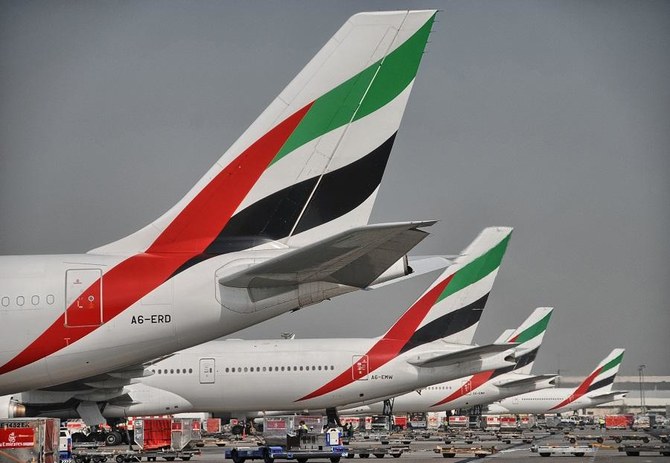
Dubai’s government has stepped in to assist Emirates financially. (Shutterstock)
Short Url
Updated 15 June 2021
Follow

Emirates reports $5.5bn loss as group headcount falls by 33,000

  • Emirates Group revenues fell some 66 percent to $9.7 billion over the year

DUBAI: Emirates reported a full-year loss of $5.5 billion, the first time it has fallen into the red in more than 30 years.
The results highlight the devastating impact of the pandemic on the carrier that has helped Dubai become one of the world’s most important international aviation hubs.

Overall employee numbers for the wider Emirates Group, which includes dnata, fell by more than 33,000 over the year as its headcount fell 31 percent to about 75,000. It carried 6.6 million passengers over the year, down 88 percent on a year earlier.

“No one knows when the pandemic will be over, but we know recovery will be patchy,” said Sheikh Ahmed bin Saeed Al-Maktoum, the chairman and CEO of Emirates Airline and Group. “Economies and companies that entered pandemic times in a strong position, will be better placed to bounce back.”
While the pandemic has had a brutal impact on airlines worldwide, the crisis has impacted carriers and airports differently, depending on their route and passenger profiles. Because Emirates relies heavily on international travel without a domestic network, it has not benefited from the bounce back in domestic airline travel in other parts of the world, such as the US and China.
“It is not surprising that Emirates has reported a substantial loss and as with all airlines recovery will take an extended time,” aviation consultant John Strickland told Arab News. “However short term it has been able to benefit from the cargo capabilities of its 777-300ER’s. It is already evaluating options for the future shape of its fleet and network as new aircraft types enter its fleet and will extend the close partnership with flydubai which also increases its flexibility for network development options.”
Emirates Group revenues fell some 66 percent to $9.7 billion over the year. The company said it had received a capital injection of 11.3 billion dirhams ($3.1 billion) from its ultimate shareholder, the government of Dubai. Its dnata unit, which includes ground handling, travel services and catering, also received 800 million dirhams in relief, it said.
Emirates has cut costs across the group by renegotiating contracts and restructuring financial obligations which resulted in estimated savings of 7.7 billion dirhams for the year, it said.
Sheikh Ahmed said the airline aimed to recover its full operating capacity as quickly as possible.
“Together with Dubai’s undiminished ambitions to grow economic activity and build a city for the future, I am confident that Emirates and dnata will recover and be stronger than before,” he said.
Emirates’ total passenger and cargo capacity declined by 58 percent. It received three new A380 aircraft during the financial year and phased out 14 older aircraft comprising of 9 Boeing 777-300ERs and 5 A380s, leaving its total fleet count at 259 at the end of March.
Its order book for 200 aircraft remains unchanged.


First EU–Saudi roundtable on critical raw materials reflects shared policy commitment

Updated 16 January 2026
Follow

First EU–Saudi roundtable on critical raw materials reflects shared policy commitment

RIYADH: The EU–Saudi Arabia Business and Investment Dialogue on Advancing Critical Raw Materials Value Chains, held in Riyadh as part of the Future Minerals Forum, brought together senior policymakers, industry leaders, and investors to advance strategic cooperation across critical raw materials value chains.

Organized under a Team Europe approach by the EU–GCC Cooperation on Green Transition Project, in coordination with the EU Delegation to Saudi Arabia, the European Chamber of Commerce in the Kingdom and in close cooperation with FMF, the dialogue provided a high-level platform to explore European actions under the EU Critical Raw Materials Act and ResourceEU alongside the Kingdom’s aspirations for minerals, industrial, and investment priorities.

This is in line with Saudi Vision 2030 and broader regional ambitions across the GCC, MENA, and Africa.

ResourceEU is the EU’s new strategic action plan, launched in late 2025, to secure a reliable supply of critical raw materials like lithium, rare earths, and cobalt, reducing dependency on single suppliers, such as China, by boosting domestic extraction, processing, recycling, stockpiling, and strategic partnerships with resource-rich nations.

The first ever EU–Saudi roundtable on critical raw materials was opened by the bloc’s Ambassador to the Kingdom, Christophe Farnaud, together with Saudi Deputy Minister for Mining Development Turki Al-Babtain, turning policy alignment into concrete cooperation.

Farnaud underlined the central role of international cooperation in the implementation of the EU’s critical raw materials policy framework.

“As the European Union advances the implementation of its Critical Raw Materials policy, international cooperation is indispensable to building secure, diversified, and sustainable value chains. Saudi Arabia is a key partner in this effort. This dialogue reflects our shared commitment to translate policy alignment into concrete business and investment cooperation that supports the green and digital transitions,” said the ambassador.

Discussions focused on strengthening resilient, diversified, and responsible CRM supply chains that are essential to the green and digital transitions.

Participants explored concrete opportunities for EU–Saudi cooperation across the full value chain, including exploration, mining, and processing and refining, as well as recycling, downstream manufacturing, and the mobilization of private investment and sustainable finance, underpinned by high environmental, social, and governance standards.

From the Saudi side, the dialogue was framed as a key contribution to the Kingdom’s industrial transformation and long-term economic diversification agenda under Vision 2030, with a strong focus on responsible resource development and global market integration.

“Developing globally competitive mineral hubs and sustainable value chains is a central pillar of Saudi Vision 2030 and the Kingdom’s industrial transformation. Our engagement with the European Union through this dialogue to strengthen upstream and downstream integration, attract high-quality investment, and advance responsible mining and processing. Enhanced cooperation with the EU, capitalizing on the demand dynamics of the EU Critical Raw Materials Act, will be key to delivering long-term value for both sides,” said Al-Babtain.

Valere Moutarlier, deputy director-general for European industry decarbonization, and directorate-general for the internal market, industry, entrepreneurship and SMEs at European Commission, said the EU Critical Raw Materials Act and ResourceEU provided a clear framework to strengthen Europe’s resilience while deepening its cooperation with international partners.

“Cooperation with Saudi Arabia is essential to advancing secure, sustainable, and diversified critical raw materials value chains. Dialogues such as this play a key role in translating policy ambitions into concrete industrial and investment cooperation,” she added.