

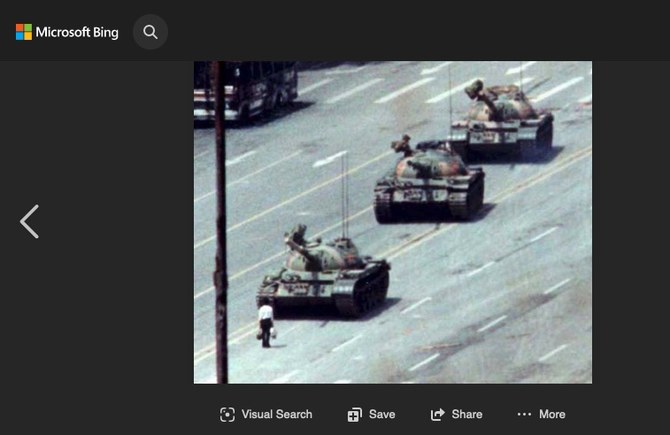
Microsoft blames ‘error’ for no matching Bing images of Tiananmen ‘tank man’

Images of the Tiananmen Square "tank man" started showing in Microsoft's Bing search engineer hours after critics raised concern over the disappearing images.
Short Url
Updated 05 June 2021
Follow

Microsoft blames ‘error’ for no matching Bing images of Tiananmen ‘tank man’

  • Search engine leader Google showed many results for the famous image when the “tank man” search was performed on Friday
  • A significant percentage of the Microsoft employees who work on Bing are based in China, according to a former employee

Microsoft Corp. on Friday blamed “accidental human error” for its Bing search engine not showing results for the query “tank man” in the United States and elsewhere after users raised concerns about possible censorship around the Tiananmen Square crackdown anniversary.
Users, including in Germany and Singapore, reported Friday that when they performed the search Bing returned the message, “There are no results for tank man.”
Hours after Microsoft acknowledged the issue, the same search returned only pictures of tanks elsewhere in the world.
“Tank man” is often used to describe an unidentified person famously pictured standing before tanks in China’s Tiananmen Square during pro-democracy demonstrations in June 1989.
Microsoft said the issue was “due to an accidental human error and we are actively working to resolve this.”
Smaller search engines such as DuckDuckGo that license results from Microsoft faced similar issues around “tank man” searches and said they expected a fix soon.
Rival Google showed many results for the famous image when the “tank man” search was performed on Friday.
A significant percentage of the Microsoft employees who work on Bing are based in China, including some who work on image-recognition software, according to a former employee.
China is known to require search engines operating in its jurisdiction to censor results, but those restrictions are rarely applied elsewhere.


Pioneering Asharq Al-Awsat journalist Mohammed al-Shafei dies at 74

Updated 08 January 2026
Follow

Pioneering Asharq Al-Awsat journalist Mohammed al-Shafei dies at 74

  • Egyptian was known for his fearless coverage of terrorist, extremist groups
  • One of handful of reporters to interview Taliban leader Mullah Omar in 1970s

LONDON: Mohammed al-Shafei, one of Asharq Al-Awsat’s most prominent journalists, has died at the age of 74 after a 40-year career tackling some of the region’s thorniest issues.

Born in Egypt in 1951, al-Shafei earned a bachelor’s degree from Cairo University in 1974 before moving to the UK, where he studied journalism and translation at the University of Westminster and the School of Oriental and African Studies.

He began his journalism career at London-based Arabic papers Al-Muslimoon and Al-Arab — both of which are published by Saudi Research & Publishing Co. which also owns Arab News — before joining Al-Zahira after Iraq’s 1990 invasion of Kuwait.

Al-Shafei joined Asharq Al-Awsat in 1991 and spent 15 years on the sports desk before shifting to reporting on terrorism. He went on to pioneer Arab press coverage in the field, writing about all aspects of it, including its ideologies and ties to states like Iran.

His colleagues knew him for his calm demeanor, humility and meticulous approach, marked by precise documentation, deep analysis and avoidance of sensationalism.

Al-Shafei ventured fearlessly into terrorist strongholds, meeting senior terrorist leaders and commanders. In the 1970s he was one of only a handful of journalists to interview Mullah Omar, the leader of the Taliban, and conducted exclusive interviews with senior figures within Al-Qaeda.

He also tracked post-Al-Qaeda groups like Daesh, Hay’at Tahrir al-Sham and Boko Haram, offering pioneering analysis of Sunni-Shiite extremism and how cultural contexts shaped movements across Asia and Africa.

During the war on Al-Qaeda, he visited US bases in Afghanistan, embedded with international forces, and filed investigative reports from active battlefields — rare feats in Arab journalism at the time.

He interviewed Osama bin Laden’s son, highlighting a humanitarian angle while maintaining objectivity, and was among the few Arab journalists to report from Guantanamo, where his interviews with Al-Qaeda detainees shed light on the group’s operations.

Al-Shafei married a Turkish woman in London in the late 1970s, with whom he had a son and daughter. He was still working just hours before he died in London on Dec. 31.