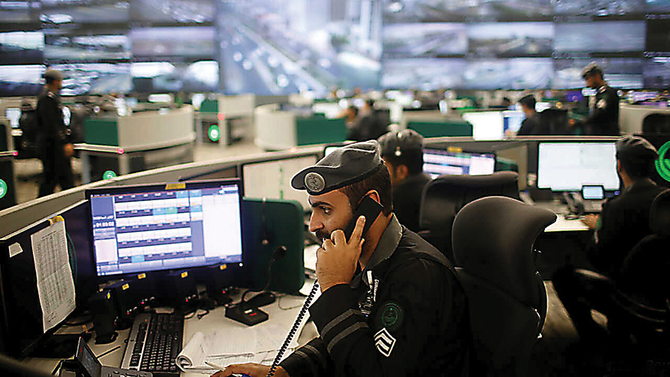
Saudi Arabia implements cybersecurity framework

The Kingdom has made notable progress in international indicators. KSA’s cybersecurity professionals are getting a boost through training initiatives to meet the growing threat of cyberattacks. (Reuters)
Short Url
Updated 30 May 2021
Follow

Saudi Arabia implements cybersecurity framework

  • The regulations contain a comprehensive set of control to boost online security in the Kingdom

RIYADH: Saudi Arabia’s Communications and Information Technology Commission (CITC) on Saturday announced the implementation of a regulatory framework to beef up cybersecurity in the Kingdom.
The “cybersecurity regulatory framework” for service providers in the communications, IT, and postal (services) sector aims to raise the security levels of service providers.
It seeks to ensure the implementation of adequate cybersecurity measures following the best international practices.
In a statement, CITC said the regulatory framework contains a comprehensive set of cybersecurity requirements and controls that will contribute to regulating the communications, IT, and postal service sectors.
The framework ensures an increase in the level of confidence in the integrity of the infrastructure of service providers, and the application of best practices to develop appropriate cybersecurity measures.
This regulatory framework also requires the adoption of a risk management methodology and the fulfillment of all cybersecurity requirements by service providers to enable them to deal with cyber threats effectively.
Saudi Arabia’s Vision 2030 and the National Transformation Program are accelerating primary and digital infrastructure projects intending to raise living standards.
The Kingdom has made notable progress in international indicators. It was ranked the most advanced and reform-driven country according to the World Bank’s “Doing Business” report. It also ranked third globally in terms of 5G networks.
Saudi Arabia’s cybersecurity professionals are also getting a boost through training initiatives to meet the growing threat of cyberattacks.
Dr. Muhammad Khurram Khan, a professor of cybersecurity at King Saud University and founder of the Global Foundation for Cyber Studies and Research, in Washington, DC, earlier told Arab News: “After the Saudi Aramco incident (Shamoon cyberattack) in 2012, the (Saudi) government embarked on a journey to bootstrap its resources toward building a resilient cybersecurity ecosystem to address the cyber risks from internal and external hostile adversaries.
“During the last few years, several local universities have commenced degree programs in cybersecurity to prepare skilled and professional experts to cater for the demand of the local public and private organizations,” he said.


Saudi minister at Davos urges collaboration on minerals

Global collaboration on minerals essential to ease geopolitical tensions and secure supply, WEF hears. (Supplied)
Updated 20 January 2026
Follow

Saudi minister at Davos urges collaboration on minerals

  • The reason of the tension of geopolitics is actually the criticality of the minerals

LONDON: Countries need to collaborate on mining and resources to help avoid geopolitical tensions, Saudi Arabia’s minister of industry and mineral resources told the World Economic Forum on Tuesday.

“The reason of the tension of geopolitics is actually the criticality of the minerals, the concentration in different areas of the world,” Bandar Alkhorayef told a panel discussion on the geopolitics of materials.

“The rational thing to do is to collaborate, and that’s what we are doing,” he added. “We are creating a platform of collaboration in Saudi Arabia.”

Bandar Alkhorayef, Saudi Minister of Industry and Mineral Resources 

The Kingdom last week hosted the Future Minerals Forum in Riyadh. Alkhorayef said the platform was launched by the government in 2022 as a contribution to the global community. “It’s very important to have a global movement, and that’s why we launched the Future Minerals Forum,” he said. “It is the most important platform of global mining leaders.”

The Kingdom has made mining one of the key pillars of its economy, rapidly expanding the sector under the Vision 2030 reform program with an eye on diversification. Saudi Arabia has an estimated $2.5 trillion in mineral wealth and the ramping up of extraction comes at a time of intense global competition for resources to drive technological development in areas like AI and renewables.

“We realized that unlocking the value that we have in our natural resources, of the different minerals that we have, will definitely help our economy to grow to diversify,” Alkhorayef said. The Kingdom has worked to reduce the timelines required to set up mines while also protecting local communities, he added. Obtaining mining permits in Saudi Arabia has been reduced to just 30 to 90 days compared to the many years required in other countries, Alkhorayef said.

“We learned very, very early that permitting is a bottleneck in the system,” he added. “We all know, and we have to be very, very frank about this, that mining doesn’t have a good reputation globally.

“We are trying to change this and cutting down the licensing process doesn’t only solve it. You need also to show the communities the impact of the mining on their lives.”

Saudi Arabia’s new mining investment laws have placed great emphasis on the development of society and local communities, along with protecting the environment and incorporating new technologies, Alkhorayef said. “We want to build the future mines; we don’t want to build old mines.”