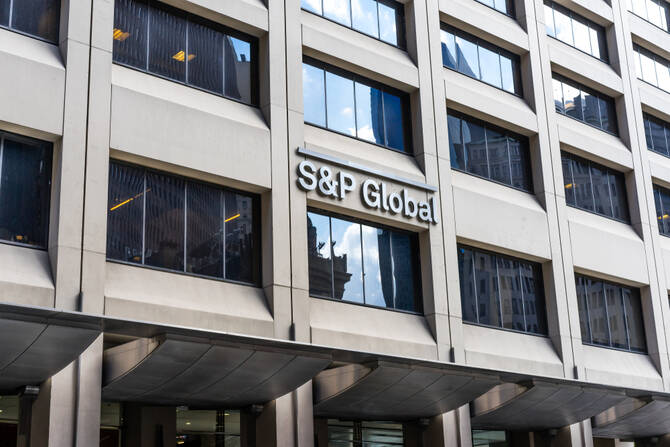

RIYADH: Banks operating in the Gulf region are expected to remain resilient in the short term due to strong financial buffers, even as the Middle East grapples with heightened geopolitical tensions, according to an analysis.
In its latest report, S&P Global warned that prolonged disruptions stemming from the conflict involving the US-Israel alliance and Iran could increase pressure on weaker issuers.
Earlier this month, Fitch Ratings offered a similar assessment, saying banks operating in the Gulf Cooperation Council region face limited short-term credit risks from the regional conflict, supported by strong financial buffers and sovereign backing.
In its latest report, the agency stated: “S&P Global Ratings’ base-case scenario is that the most intense part of the conflict will last around two to four weeks, although we recognize that broader spillovers and intermittent security incidents could extend beyond this period.”
It added: “Financial buffers should protect banks’ credit quality for now, but longer disruptions would increase pressures on weaker issuers.”
Despite regional banks’ resilience to operational disruptions, limited funding outflows, and stable asset quality indicators, S&P expects the ongoing tensions to weigh on banks’ financial performance in 2026.
Following reported drone strikes that damaged data centers, some banks experienced temporary disruptions to basic services, including access to digital applications. Several lenders in the region rely on multiple data centers, allowing them to switch operations in the event of disruptions.
“We understand that a few banks also have data centers and backups outside the region, where permitted by regulators. Finally, we note that some banks we consulted have already returned to their offices or have not switched to remote working in areas where the security situation permits,” added S&P Global.
According to the report, major outflows of foreign or domestic funding have not yet occurred among banks in the GCC region.
S&P Global, however, warned that a prolonged conflict could trigger external or local funding outflows.
“In our stress test scenarios, we assume both external and local capital outflows. However, under our assumptions, banks’ external liquidity can absorb significant hypothetical external outflows without government or external support in all countries except Bahrain and Qatar,” added the report.
According to S&P Global, banks in the UAE are the most resilient to external liquidity outflows, while lenders in Bahrain appear more vulnerable due to recent increases in external debt.
However, Bahrain’s vulnerability is partly mitigated by the fact that a significant share of external debt is held by regional creditors with an interest in preserving financial stability and avoiding broader contagion.
Banks in Qatar face potential shortfalls in the event of significant outflows, but the amounts appear manageable and equivalent to a fraction of support extended during previous episodes of heightened geopolitical risk.
S&P Global said the war is likely to affect key sectors including logistics, transportation, tourism, and consumer-facing industries such as real estate, retail, and hospitality, though the full impact on banks’ asset quality indicators will take time to emerge.
Although the conflict is expected to weaken bank performance in 2026, the scale of the impact will depend on the duration of the war and its effect on local economies.
“During previous shocks, such as COVID-19, regulators intervened with forbearance measures, enabling banking systems to absorb potential loan impairments over time. We anticipate regulators would take similar action should a comparable shock occur,” concluded S&P Global.