

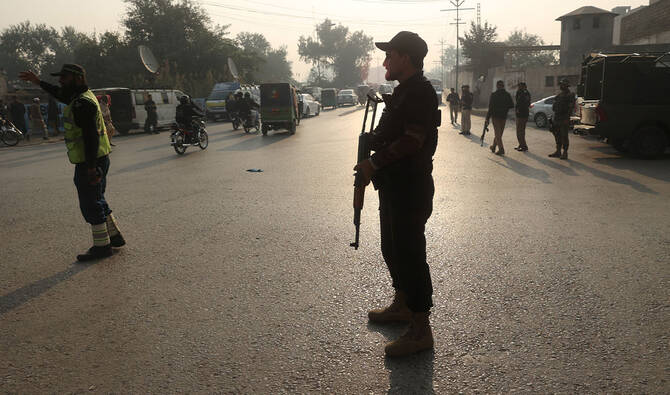

PESHAWAR: At least one suspected militant was killed and several others wounded after authorities foiled two attacks on checkpoints in Pakistan’s restive northwestern Khyber Pakhtunkhwa province, police said on Tuesday.
Pakistan has struggled in recent years to contain a surge in militancy in Khyber Pakhtunkhwa, which borders Afghanistan, with groups such as the Pakistani Taliban or Tehreek-e-Taliban Pakistan (TTP) frequently targeting security forces, law enforcement personnel and government officials in the region. Islamabad accuses neighbors Afghanistan and India of backing militant groups that carry out cross-border attacks. Kabul and New Delhi deny this.
According to the police, both overnight attacks targeted police checkpoints in Bannu.
“The attacks, carried out by terrorists, were repelled by the swift response of police, who engaged the assailants in intense gunbattles lasting 45 minutes and one hour, respectively,” Aamir Khan, spokesman for the Regional Police Officer (RPO) Bannu, said.
“One militant was killed in the exchange of fire, while several others are believed to have been injured,” he added. “Police recovered a Kalashnikov rifle, a hand grenade, and a walkie-talkie from the slain militant.”
He said police and security forces launched a joint clearance operation in the area to kill or arrest any remaining militants.
No group has claimed responsibility for the attacks in Bannu which come as Pakistan and Afghanistan are engaged in their worst fighting in years.
Over the last three weeks, both countries have launched air and drone strikes against each other and also engaged in ground firing across their 2,600-km (1,600-mile) border, with each claiming to have inflicted heavy damage and killed hundreds of opposition troops, without providing evidence.
Kabul says an air strike by Pakistan on Monday targeted a drug rehabilitation hospital in the capital Kabul, killing at least 408 people and injuring 265 more.
Pakistan has rejected the claim, saying the strike targeted military installations and terrorist support infrastructure, and was carefully undertaken to ensure there was no collateral damage.


