

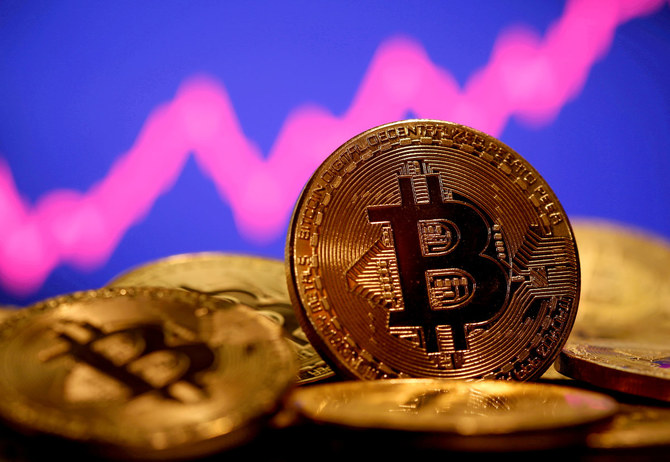
Bitcoin drops after report Binance under US probe, Tesla move

Cryptocurrency fans have counted Tesla boss Elon Musk as among their champions, but this week he rocked their world by criticizing carbon emissions from bitcoin, causing bitcoin's price to drop. (AFP)
Short Url
Updated 14 May 2021
Follow

Bitcoin drops after report Binance under US probe, Tesla move

  • Bitcoin dropped to $45,700, the lowest since March 1, then steadied at $49,312 in Asia morning trade on Friday
  • The world’s largest cryptocurrency fell 17 percent on Wednesday following Elon Musk’s remarks

NEW YORK/LONDON/TOKYO: Bitcoin slid to a 2-1/2-month low on Thursday after a regulatory probe into crypto exchange Binance added to pressure from Tesla Inc. chief Elon Musk’s reversing his stance on accepting the digital currency.
Bloomberg reported on Thursday that as part of the Binance inquiry, the US Justice Department and the Internal Revenue Service have sought information from individuals with insight into its business.
Bitcoin dropped to $45,700, the lowest since March 1, then steadied at $49,312 in Asia morning trade on Friday.
The world’s largest cryptocurrency fell 17 percent on Wednesday following Musk’s remarks that Tesla would stop accepting the digital token as payment for its electric cars for environmental reasons.
“Environmental matters are an incredibly sensitive subject right now, and Tesla’s move might serve as a wake-up call to businesses and consumers using bitcoin, who hadn’t hitherto considered its carbon footprint,” Laith Khalaf, an analyst at AJ Bell, said.
Bitcoin remains about 70 percent higher for the year and is more than 1,000 percent higher than its 2020 low of $3,850.
Binance did not immediately respond to a request for comment. A Binance spokeswoman told Bloomberg that the company doesn’t comment on specific inquiries but takes its legal obligations seriously and engages with regulators in a collaborative fashion.
Ethereum, the second-largest cryptocurrency, dropped to a session low of $3,543.62 and last changed hands at $3,656, down about 4 percent. On Wednesday, ethereum hit a record high of $4,380.64.
Tesla’s announcement on Feb. 8 that it had bought $1.5 billion of bitcoin and would accept it as payment for its electric vehicles has been one factor behind the digital currency’s surge this year.
Musk has faced pressure over bitcoin’s environmental impact. The cryptocurrency relies on computers competing to solve elaborate math problems, which use huge amounts of electricity.
“We are concerned about rapidly increasing use of fossil fuels for Bitcoin mining and transactions, especially coal, which has the worst emissions of any fuel,” Musk tweeted.
Musk’s comments roiled markets even though he said Tesla would not sell any bitcoin and would resume accepting it as soon as “mining” for it transitioned to more sustainable energy.
In a second tweet on Thursday, Musk denounced the “insane” amount of energy used to produce bitcoin, which pushed bitcoin lower.
Jeffrey Wang, Vancouver-based head of Americas at Amber Group, a cryptocurrency service provider, said broader selling of risk assets in traditional markets was another factor behind Wednesday’s bitcoin plunge.
“I don’t think everything is selling off just because of this news. This was kind of the straw that broke the camel’s back in terms of adding to the risk sell-off,” Wang said.
Bitcoin has struggled since hitting a record $64,895.22 in mid-April, dropping to the cusp of $47,000 just 11 days later before hovering around $58,000 since the start of May.

Environmental concerns
At current rates, bitcoin mining devours about the same amount of energy annually as the Netherlands did in 2019, data from the University of Cambridge and the International Energy Agency showed.
Tesla shares were down 2.4 percent, while the biggest US cryptocurrency exchange, Coinbase, tumbled nearly 9 percent. Smaller cryptocurrencies were less affected by the news.
“The reason given in the tweet is fossil fuel use for the mining of BTC, but most cryptocurrencies have already found more efficient ways to do that and therefore outperformed.”
Cryptocurrency dogecoin lost more than a third of its price on Sunday after Musk, whose tweets had stoked demand for the token earlier this year, called it a “hustle” on the “Saturday Night Live” comedy show.
By Tuesday, however, he was asking his followers on Twitter if they wanted Tesla to accept dogecoin and it jumped on Friday in Asia after Musk tweeted about it again and said he was working on improvements to its transaction systems.
Dogecoin rose 20 percent to 52 cents on Friday according to Binance and last traded at $0.4825.


First EU–Saudi roundtable on critical raw materials reflects shared policy commitment

Updated 16 January 2026
Follow

First EU–Saudi roundtable on critical raw materials reflects shared policy commitment

RIYADH: The EU–Saudi Arabia Business and Investment Dialogue on Advancing Critical Raw Materials Value Chains, held in Riyadh as part of the Future Minerals Forum, brought together senior policymakers, industry leaders, and investors to advance strategic cooperation across critical raw materials value chains.

Organized under a Team Europe approach by the EU–GCC Cooperation on Green Transition Project, in coordination with the EU Delegation to Saudi Arabia, the European Chamber of Commerce in the Kingdom and in close cooperation with FMF, the dialogue provided a high-level platform to explore European actions under the EU Critical Raw Materials Act and ResourceEU alongside the Kingdom’s aspirations for minerals, industrial, and investment priorities.

This is in line with Saudi Vision 2030 and broader regional ambitions across the GCC, MENA, and Africa.

ResourceEU is the EU’s new strategic action plan, launched in late 2025, to secure a reliable supply of critical raw materials like lithium, rare earths, and cobalt, reducing dependency on single suppliers, such as China, by boosting domestic extraction, processing, recycling, stockpiling, and strategic partnerships with resource-rich nations.

The first ever EU–Saudi roundtable on critical raw materials was opened by the bloc’s Ambassador to the Kingdom, Christophe Farnaud, together with Saudi Deputy Minister for Mining Development Turki Al-Babtain, turning policy alignment into concrete cooperation.

Farnaud underlined the central role of international cooperation in the implementation of the EU’s critical raw materials policy framework.

“As the European Union advances the implementation of its Critical Raw Materials policy, international cooperation is indispensable to building secure, diversified, and sustainable value chains. Saudi Arabia is a key partner in this effort. This dialogue reflects our shared commitment to translate policy alignment into concrete business and investment cooperation that supports the green and digital transitions,” said the ambassador.

Discussions focused on strengthening resilient, diversified, and responsible CRM supply chains that are essential to the green and digital transitions.

Participants explored concrete opportunities for EU–Saudi cooperation across the full value chain, including exploration, mining, and processing and refining, as well as recycling, downstream manufacturing, and the mobilization of private investment and sustainable finance, underpinned by high environmental, social, and governance standards.

From the Saudi side, the dialogue was framed as a key contribution to the Kingdom’s industrial transformation and long-term economic diversification agenda under Vision 2030, with a strong focus on responsible resource development and global market integration.

“Developing globally competitive mineral hubs and sustainable value chains is a central pillar of Saudi Vision 2030 and the Kingdom’s industrial transformation. Our engagement with the European Union through this dialogue to strengthen upstream and downstream integration, attract high-quality investment, and advance responsible mining and processing. Enhanced cooperation with the EU, capitalizing on the demand dynamics of the EU Critical Raw Materials Act, will be key to delivering long-term value for both sides,” said Al-Babtain.

Valere Moutarlier, deputy director-general for European industry decarbonization, and directorate-general for the internal market, industry, entrepreneurship and SMEs at European Commission, said the EU Critical Raw Materials Act and ResourceEU provided a clear framework to strengthen Europe’s resilience while deepening its cooperation with international partners.

“Cooperation with Saudi Arabia is essential to advancing secure, sustainable, and diversified critical raw materials value chains. Dialogues such as this play a key role in translating policy ambitions into concrete industrial and investment cooperation,” she added.