Afghan president says Pakistan will not support return of Taliban

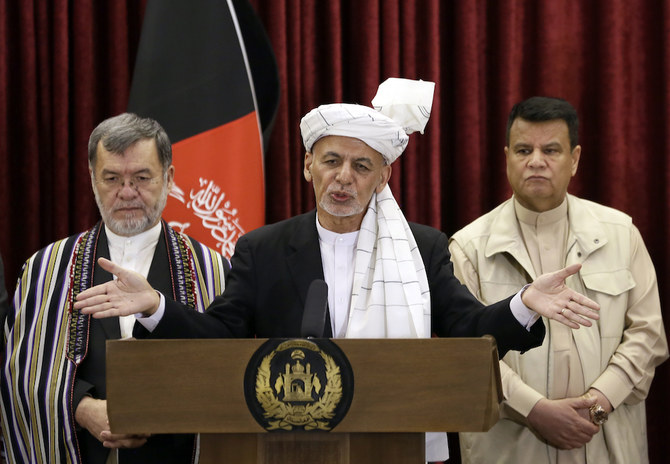
Afghanistan’s President Ashraf Ghani, center, makes an address during Eid Al-Fitr at the presidential palace in Kabul, Afghanistan, Thursday, May 13, 2021. (AP Photo)
Short Url
Updated 13 May 2021
Follow

Afghan president says Pakistan will not support return of Taliban

  • Ghani’s remarks come days after the Pakistan army chief visits Kabul despite stalled negotiations
  • Ties between Kabul and Islamabad have been historically tense but have soured even more in the past 20 years

KABUL: Afghanistan President Ashraf Ghani said on Thursday that Pakistan, which Kabul has long seen as a supporter of the Taliban, is not in favor of the group’s return to power in his war-battered country.

Concerns are mounting among the current Afghan administration because the complete US troop withdrawal, expected by September, could leave the country vulnerable to a Taliban takeover 20 years after it was ousted from power in a US-led invasion.

Ghani’s remarks came days after a visit from Pakistan’s army chief, Gen. Qamar Javed Bajwa, to Kabul.

“Pakistan’s army, in utter clarity, announced that the revival of Islamic Emirate is not in Pakistan’s national interest,” Ghani said in a televised speech after Eid Al-Fitr prayers, marking the end of Ramadan.

The Islamic Emirate of Afghanistan was the country’s name during Taliban rule from 1996-2001.

“Afghanistan’s peace and stability means peace and stability in the region,” the president said, adding the Pakistani general expressed his support for “the republic” — which is understood as Ghani’s government.

The Pakistani military did not immediately comment on Ghani’s statement. Its spokesperson also was not available when contacted by Arab News.

Ties between Kabul and Islamabad have been historically tense but have soured even more in the past 20 years. The Afghan government accused Pakistan of backing the Taliban which has been fighting to drive foreign troops out of the country and return to power.

While Pakistan has denied supporting the Taliban, its influence has been crucial in persuading the militants to join ongoing US-sponsored negotiations for a permanent ceasefire and power-sharing arrangement in Afghanistan.

Gen. Bajwa’s visit to Kabul came as the negotiations have stalled for months and violent attacks in Afghanistan have been on the rise since the US missed a May 1 deadline to withdraw its soldiers under last year’s agreement between Washington and the Taliban.

“Pakistan is also not keen on seeing an extremist ideology taking root in Afghanistan. It represents a risk for the generals and Pakistan’s democracy as well,” Toreq Farhadi, a former adviser to the Afghan government, told Arab News.

“Pakistan wants a political settlement in Afghanistan where Taliban can be part of the governing structure and opposes a total takeover of power by the Taliban.”


WHO chief says reasons US gave for withdrawing ‘untrue’

Updated 25 January 2026
Follow

WHO chief says reasons US gave for withdrawing ‘untrue’

  • US Secretary of State Marco Rubio and US Health Secretary Robert F. Kennedy Jr. announced in a joint statement Thursday that Washington had formally withdrawn from the WHO
  • And in a post on X, Tedros added: “Unfortunately, the reasons cited for the US decision to withdraw from WHO are untrue”

GENEVA: The head of the UN’s health agency on Saturday pushed back against Washington’s stated reasons for withdrawing from the World Health Organization, dismissing US criticism of the WHO as “untrue.”
Tedros Adhanom Ghebreyesus warned that US announcement this week that it had formally withdrawn from the WHO “makes both the US and the world less safe.”
And in a post on X, he added: “Unfortunately, the reasons cited for the US decision to withdraw from WHO are untrue.”
He insisted: “WHO has always engaged with the US, and all Member States, with full respect for their sovereignty.”
US Secretary of State Marco Rubio and US Health Secretary Robert F. Kennedy Jr. announced in a joint statement Thursday that Washington had formally withdrawn from the WHO.
They accused the agency, of numerous “failures during the Covid-19 pandemic” and of acting “repeatedly against the interests of the United States.”
The WHO has not yet confirmed that the US withdrawal has taken effect.

- ‘Trashed and tarnished’ -

The two US officials said the WHO had “trashed and tarnished” the United States, and had compromised its independence.
“The reverse is true,” the WHO said in a statement.
“As we do with every Member State, WHO has always sought to engage with the United States in good faith.”
The agency strenuously rejected the accusation from Rubio and Kennedy that its Covid response had “obstructed the timely and accurate sharing of critical information that could have saved American lives and then concealed those failures.”
Kennedy also suggested in a video posted to X Friday that the WHO was responsible for “the Americans who died alone in nursing homes (and) the small businesses that were destroyed by reckless mandates” to wear masks and get vaccinated.
The US withdrawal, he insisted, was about “protecting American sovereignty, and putting US public health back in the hands of the American people.”
Tedros warned on X that the statement “contains inaccurate information.”
“Throughout the pandemic, WHO acted quickly, shared all information it had rapidly and transparently with the world, and advised Member States on the basis of the best available evidence,” the agency said.
“WHO recommended the use of masks, vaccines and physical distancing, but at no stage recommended mask mandates, vaccine mandates or lockdowns,” it added.
“We supported sovereign governments to make decisions they believed were in the best interests of their people, but the decisions were theirs.”

- Withdrawal ‘raises issues’ -

The row came as Washington struggled to dislodge itself from the WHO, a year after US President Donald Trump signed an executive order to that effect.
The one-year withdrawal process reached completion on Thursday, but Kennedy and Rubio regretted in their statement that the UN health agency had “not approved our withdrawal and, in fact, claims that we owe it compensation.”
WHO has highlighted that when Washington joined the organization in 1948, it reserved the right to withdraw, as long as it gave one year’s notice and had met “its financial obligations to the organization in full for the current fiscal year.”
But Washington has not paid its 2024 or 2025 dues, and is behind around $260 million.
“The notification of withdrawal raises issues,” WHO said Saturday, adding that the topic would be examined during WHO’s Executive Board meeting next month and by the annual World Health Assembly meeting in May.
“We hope the US will return to active participation in WHO in the future,” Tedros said Saturday.
“Meanwhile, WHO remains steadfastly committed to working with all countries in pursuit of its core mission and constitutional mandate: the highest attainable standard of health as a fundamental right for all people.”