

Families of Iran massacre victims urge world leaders to protect graves

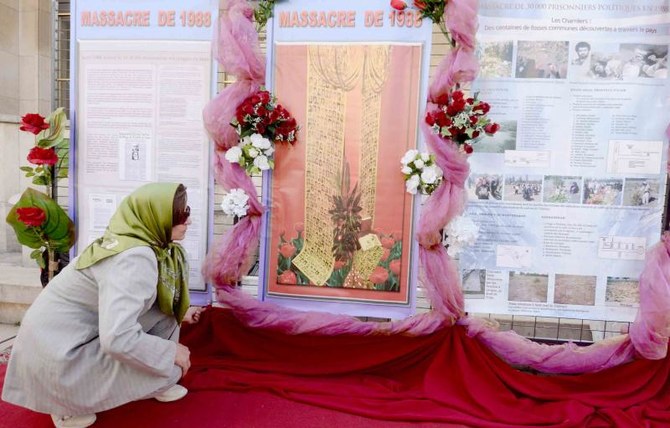
A woman looks at a memorial marking the 25th anniversary of the 1988 massacre of Iranian political prisoners, Paris, France, 17 August, 2013. (AFP)
Short Url
Updated 10 May 2021
Follow

Families of Iran massacre victims urge world leaders to protect graves

  • In 1988, security forces executed tens of thousands of political prisoners
  • ‘It’s time for the UN to hold the regime’s leaders to account,’ opposition figure tells Arab News

LONDON: The families of thousands of Iranians executed and buried in mass graves have written to the UN and world leaders urging them to prevent Tehran’s ongoing destruction of their last resting place.

In 1988, Tehran executed thousands of political prisoners aligned with the People’s Mojahedin Organization of Iran (PMOI), a political group that had participated in the 1979 revolution but was later targeted by the regime.

At the time, Amnesty International said the executions were “a premeditated and coordinated policy which must have been authorized at the highest level of government.”

Estimates for the exact number of people killed range from 4,500 in just one summer to as many as 30,000.

Now, more than 1,100 families of those executed have petitioned the UN and world leaders as their loved ones’ graves are now being destroyed or used as mass graves for religious minorities.

In a letter to UN Secretary-General Antonio Guterres, the National Council of Resistance of Iran (NCRI), an umbrella opposition group incorporating the PMOI, said: “Most of us have forgotten where exactly our loved ones are buried, many of them in mass graves. Paranoid of the repercussions of international scrutiny into this horrific atrocity, the Iranian regime has embarked on erasing the traces of the evidence on the massacre by destroying the mass graves where they are buried.”

The NCRI has published a list of over 5,000 names of people it says were executed during the 1988 massacre.

It said the ongoing destruction and repurposing of the mass graves represents another abuse against a people already suffering from the loss of loved ones — many of whom were tortured before their death.

“Previously, (Tehran) destroyed or damaged the mass graves of the 1988 victims in Ahvaz, Tabriz, Mashhad, and elsewhere. These actions constitute the collective torture of thousands of survivors and families of martyrs. It is another manifest case of crime against humanity,” the NCRI said.

The letter urged Guterres, relevant UN bodies and international human rights organizations “to prevent the regime from destroying the mass graves, eliminating the evidence of their crime, and inflicting psychological torture upon thousands of families of the victims throughout Iran.”

Ali Safavi, a member of the PMOI and the NCRI’s foreign affairs committee, told Arab News: “The mass executions of tens of thousands of dissidents in the 1980s, in particular the 1988 massacre of 30,000 political prisoners … is without doubt one of the greatest crimes against humanity since World War II.” 

He lamented the international community’s “appeasement” of the regime. Whenever countries ignore Tehran’s human rights abuses, it only serves to embolden the regime, said Safavi.

“It’s time for the UN, as the highest world authority entrusted with upholding human rights, to break its silence, launch an international inquiry into this heinous crime and hold the regime’s leaders to account,” he added.


Sudanese nomads trapped as war fuels banditry and ethnic splits

Updated 4 sec ago
Follow

Sudanese nomads trapped as war fuels banditry and ethnic splits

  • War disrupts nomads’ traditional routes and livelihoods
  • Nomads face threats from bandits as well as ethnic tensions
NEAR AL-OBEID: Gubara Al-Basheer and his family used ​to traverse Sudan’s desert with their camels and livestock, moving freely between markets, water sources, and green pastures. But since war erupted in 2023, he and other Arab nomads have been stuck in the desert outside the central Sudanese city of Al-Obeid, threatened by marauding bandits and ethnic tensions. The war between the Sudanese army and the paramilitary Rapid Support Forces (RSF) has left nearly 14 million people displaced, triggered rounds of ethnic bloodshed, and spread famine ‌and disease. It ‌has also upset the delicate balance of ‌land ⁠ownership ​and livestock routes ‌that had maintained the nomads’ livelihoods and wider relations in the area, local researcher Ibrahim Jumaa said. Al-Obeid is one of Sudan’s largest cities and capital of North Kordofan state, which has seen the war’s heaviest fighting in recent months. Those who spoke to Reuters from North Kordofan said they found themselves trapped as ethnic hatred, linked to the war and fueled largely online, spreads.
“We used to be ⁠able to move as we wanted. Now there is no choice and no side accepts you,” ‌al-Basheer said. “In the past there were a ‍lot of markets where we ‍could buy and sell. No one hated anyone or rejected anyone. Now ‍it’s dangerous,” he said.
RISK OF ROBBERY
As well as the encroaching war, the nomads — who Jumaa said number in the millions across Sudan — face a threat from bandits who steal livestock.
“There are so many problems now. We can’t go anywhere and if we ​try we get robbed,” said Hamid Mohamed, another shepherd confined to the outskirts of Al-Obeid. The RSF emerged from Arab militias known ⁠as the Janjaweed, which were accused of genocide in Darfur in the early 2000s. The US and rights groups have accused the RSF of committing genocide against non-Arabs in West Darfur during the current conflict, in an extension of long-running violence stemming from disputes over land. The RSF has denied responsibility for ethnically charged killings and has said those responsible for abuses will be held to account. Throughout the war the force has formed linkages with other Arab tribes, at times giving them free rein to loot and kidnap.
But some Arab tribes, and many tribesmen, have not joined the fight.
“We require a national program to counter ‌hate speech, to impose the rule of law, and to promote social reconciliation, as the war has torn the social fabric,” said Jumaa.