

Syria’s Idlib to get first batch of COVID-19 vaccines

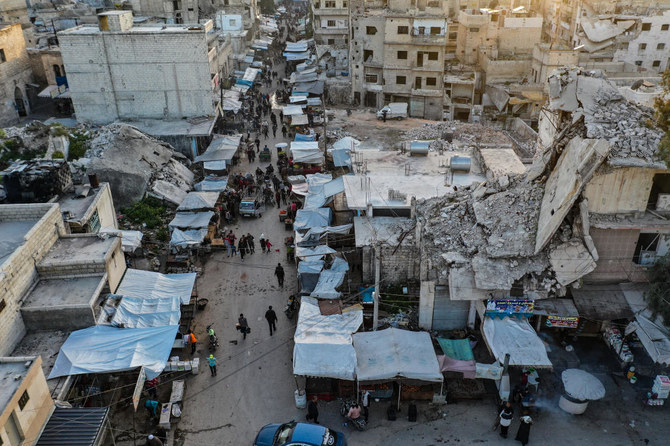
Syrians buying produce at a market ahead of iftar, the evening meal that ends the daily fast at sunset, in the war-ravaged city of Ariha in the Idlib province on the second day of Ramadan, April 15, 2021. (File/AFP)
Short Url
Updated 21 April 2021
Follow

Syria’s Idlib to get first batch of COVID-19 vaccines

  • The delivery will be the first to Syria as part of the Covax program
  • 912,000 doses have been allocated to Syria for a first phase of vaccination

BAB AL-HAWA: A first batch of COVID-19 vaccine doses was expected to arrive Wednesday in war-torn northwestern Syria, where millions of people live in dire humanitarian conditions, a UN official said.

The 53,800 doses of the AstraZeneca vaccine were dispatched to the rebel-dominated region as part of the Covax facility, which ensures the world’s poorest economies get access to jabs for free.

“Once the vaccines arrive, we are prepared to start vaccination to priority groups through our implementing partners,” said Mahmoud Daher, a senior official with the UN’s World Health Organization (WHO).

The delivery will be the first to Syria as part of the Covax program, which has already sent vaccine doses to more than 100 different territories worldwide.

The vaccine doses are intended for the extended northwestern Syrian region, which includes the jihadist-dominated Idlib enclave.

The first categories of people to be vaccinated in the coming days in the Idlib region will be medical personnel involved in the battle against the pandemic and first aid responders.

The next group will be people above the age of 60, followed by people from younger age groups with chronic diseases, said Daher, who is based in the Turkish city of Gaziantep.

Much of the Idlib enclave is controlled by Hayat Tahrir Al-Sham, a jihadist organization that includes ex-members of Syria’s former Al-Qaeda franchise.

Other regions of Syria will also receive vaccine doses through Covax, under which 92 countries are eligible.

Imad Zahran, a media officer for the Idlib region’s health department, told AFP that the vaccination campaign was expected to begin early next month and would last approximately three weeks.

According to the WHO, a separate 912,000 doses have been allocated to Syria for a first phase of vaccination in regime controlled and semi-autonomous Kurdish areas.

The aim is to vaccinate 20 percent of the population by year’s end.

Vaccination for health workers has started in government-controlled areas but not with doses received as part of the Covax program.

The official COVID-19 death toll in Syria is low compared to some other countries in the region but credible data collection across the conflict-ravaged country is almost impossible.

Syria’s war has killed more than 388,000 people since it started in 2011 with the repression of anti-government protests.


Iran unrest persists, top judge warns protesters

Updated 08 January 2026
Follow

Iran unrest persists, top judge warns protesters

  • Demonstrations sparked by soaring inflation
  • Western provinces worst affected

DUBAI: Iran’s top judge warned protesters on Wednesday there would be “no ​leniency for those who help the enemy against the Islamic Republic,” while accusing Israel and the US of pursuing hybrid methods to disrupt the country.
The current protests, the biggest wave of dissent in three years, began last month in Tehran’s Grand Bazaar by shopkeepers condemning the currency’s free fall. 
Unrest has since spread nationwide amid deepening distress over economic hardships, including rocketing inflation driven by mismanagement and Western sanctions, and curbs on political and ‌social freedoms.
“Following announcements ‌by Israel and the US president, there is no excuse for those coming ‌to the ​streets for ‌riots and unrest, chief justice Gholamhossein Mohseni Ejei, the head of Iran’s judiciary, was quoted as saying by state media.
“From now on, there will be no leniency for whoever helps the enemy against the Islamic Republic and the calm of the people,” Ejei said.
Iranian authorities have not given ‌a death toll for protesters, but have said at least two members of the security services have died and more than a dozen have been injured.
Iran’s western provinces have witnessed the most violent protests.
“During the funeral of two people ​in Malekshahi on Tuesday, a number of attendees began chanting harsh, anti-system slogans,” said Iran’s Fars, news agency.
After the funeral, Fars said, “about 100 mourners went into the city and trashed three banks ... Some started shooting at the police trying to disperse them.”
The semi-official Mehr news agency said protesters stormed a food store and emptied bags of rice, which has been affected by galloping inflation that has made ordinary staples increasingly unaffordable for many Iranians.