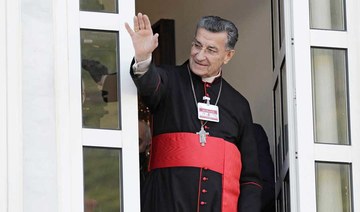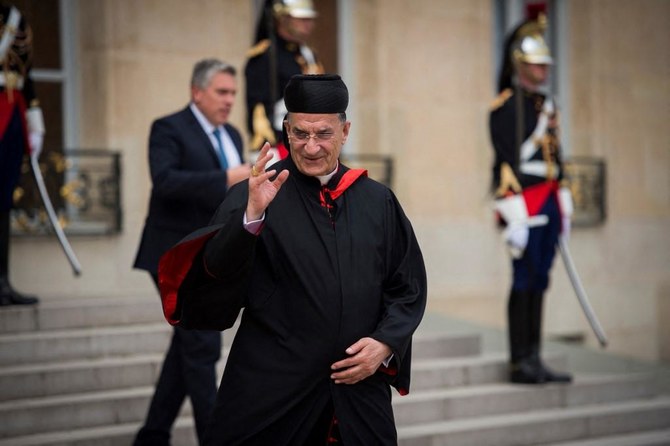
BEIRUT: Maronite Patriarch Bechara Boutros Al-Rahi has made unusually direct comments criticizing the Hezbollah movement, accusing it of harming Lebanon by dragging it into regional conflicts.
Addressing the Lebanese in the Eparchy of Saint Maron of Brooklyn, Al-Rahi asked Hezbollah in a hypothetical dialogue: “Why are you standing against neutrality? Do you want to force me to go to war? Do you want to keep Lebanon in a state of war? Would you ask for my opinion when you do go to war? Did you ask for my approval to go to Syria, Iraq and Yemen? Would you ask for the government’s opinion when declaring war and peace with Israel? Although the constitution says that declaring war and peace is upon the decision of two-thirds of the government’s votes.”
"You’re not looking out for (our) interests, nor the interests of your people," he said, apparently addressing Hezbollah.
Al-Rahi said he had received visits from Hezbollah supporters who were privately critical of the group as they felt the effects of Lebanon’s financial collapse.
He said: “Delegations from Hezbollah are visiting me in Bkerke to complain that they are also suffering . . . and this means that they, in Hezbollah, are hungry like us.”
The patriarch's comments come at a time when domestic and foreign pressure continues on those accused of obstructing the formation of the Lebanese government.
Al-Rahi’s progressive stance has previously received support from Lebanese groups.
His comments coincided with a speech by Hezbollah’s Secretary-General Hassan Nasrallah on Wednesday evening, when he warned that “the country has run out of time, and the time has come to put everything aside and go for a real solution to the situation in the country.”
Nasrallah spoke about the “complications” in the formation of the government.
On Thursday, there was a discussion of an initiative led by Parliament Speaker Nabih Berri to abandon a government of 18 ministers and form a de facto government of 22 to 24 ministers to manage internal affairs pending a comprehensive solution in the region.
The seriousness of the efforts made reflected on the dollar exchange rate on the black market, reducing it to 11,300 Lebanese pounds for purchase and 11,400 Lebanese pounds for sale.
A political source close to the prime minister-designate told Arab News: “The essence of Berri’s initiative is based on the French initiative, and this means that there is no blocking third in the government, and the ministers should be non-partisan.”
Regarding the possibility of Hariri agreeing to a government of more than 18 ministers, as he demands, the political source said: “Regardless of the number, if the president of the republic says that he approves a government without a blocking third and a government of specialists, it will be formed quickly.”
Meanwhile, the Banque du Liban announced its cooperation “with Alvarez & Marsal, putting accounts related to all state accounts and bank accounts at the disposal of the minister of finance” for forensic audit.
A virtual meeting will be held on April 6, bringing together the company, the Banque du Liban and the Ministry of Finance.
In a statement on Thursday, the Banque du Liban stressed its “readiness to secure the facilities that would allow the concerned company to start the audit process.”
However, the optimistic outlook promoted on Thursday was doubted by protesters on the streets.
Groups of them returned to blocking roads in Beirut and some areas.
Bechara Al-Asmar, leader of the General Labor Union, highlighted that preparations will continue for a wave of protests aimed at forming a rescue government to save the country from its accumulated crises.
He said that the first protest would take place on Wednesday.