Pakistani tribesmen plan Islamabad sit-in after murder of four teenage boys

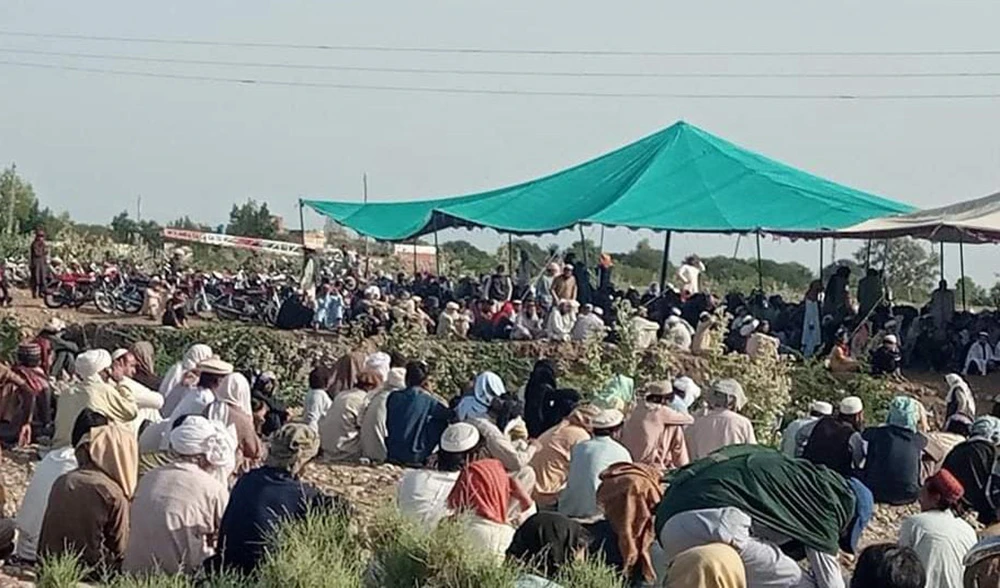
Members of Pakistan's Janikhel tribe can be seen at a sit-in on March 23, 2021, in the Janikhel area of Bannu Subdivision, Pakistan, after the murder of four teenage boys belonging to their clan. (Picture courtesy: Rufin Khan)
Short Url
Updated 25 March 2021
Follow

Pakistani tribesmen plan Islamabad sit-in after murder of four teenage boys

  • Members of Pashtun Janikhel tribe recently found bodies of four boys who had gone missing three weeks ago
  • Relatives of slain boys deny personal enmities, blame authorities for allowing criminals to operate with impunity

PESHAWAR: Members of Pakistan's Janikhel tribal community said on Thursday they would move their protest demonstration over the killing of four teenage boys from a northwestern town to the federal capital. 

The four boys, aged between 13 and 17, had gone out bird hunting when they went missing about three weeks ago. Their bodies were found last Sunday buried in a field by a shepherd grazing his cattle.

Tribal elder Latif Wazir told Arab News the killings had sparked public outrage in the area, prompting people to stage a sit-in near a military check post in the Janikhel area of Bannu Subdivision in Pakistan's Khyber Pakhtunkhwa province.

Provincial authorities on Wednesday sent transportation minister Malik Shah Mohammad Khan along with local administration officials to negotiate with the tribesmen and request them to end the sit-in which has now gone on for five days. The clan has refused.

Wazir said thousands of Janikhel tribesmen had collected cash donations to arrange about 400 vehicles to move the sit-in to Islamabad on Friday if their main demands were not met by Thursday evening.

The demands include action against an official in the Janikhel area in whose jurisdiction the murders  took place, a "ban on a display of arms and compensation for the bereaved families of the slain boys," Wazir said.

Earlier this week, a local daily, Dawn, quoted relatives of the boys as saying that they did not have any personal enmities and the murders showed that authorities were allowing criminals to operate freely. 


Pakistan organizes second phase of Hajj training for 2026 pilgrims in Islamabad

Updated 4 sec ago
Follow

Pakistan organizes second phase of Hajj training for 2026 pilgrims in Islamabad

  • Training sessions held to inform pilgrims of various stages of Hajj, precautionary measures, obligatory acts, says state media 
  • Pilgrims told to improve their physical fitness, keep essential travel documents and vaccination cards ready ahead of Hajj 2026

ISLAMABAD: Pakistan’s Ministry of Religious Affairs organized the second phase of Hajj training for 2026 pilgrims in Islamabad today, Sunday, state media reported. 

Pakistan’s religion ministry kicked off the first phase of the mandatory Hajj trainings last Sunday in Islamabad and other cities. The ministry said the trainings were made mandatory to ensure that intending pilgrims are fully aware of Hajj rituals and administrative procedures. 

“Ministry of Religious Affairs and Interfaith Harmony organized second phase of Hajj training session for pilgrims in Islamabad today,” state broadcaster Radio Pakistan reported. 

It said the primary objective of the program was to provide awareness about the various stages of the pilgrimage, necessary precautionary measures and the obligatory acts of both Hajj and Umrah.

“Pilgrims were advised to improve their physical fitness by walking 2 to 3 kilometers daily and keep essential travel documents including original passport, CNIC, flight ticket, visa copies and vaccination cards ready,” the state media said. 

Intending pilgrims were strictly warned against carrying prohibited items such as narcotics, naswar (smokeless tobacco), cigarettes and unverified medicines.

Saudi Arabia has allocated Pakistan a quota of 179,210 pilgrims for Hajj 2026, of which around 118,000 seats have been reserved under the government scheme while the remainder will be allocated to private tour operators.

Under Pakistan’s Hajj scheme, the estimated cost of the government package ranges from Rs1,150,000 to Rs1,250,000 ($4,049.93 to $4,236), subject to final agreements with service providers.