

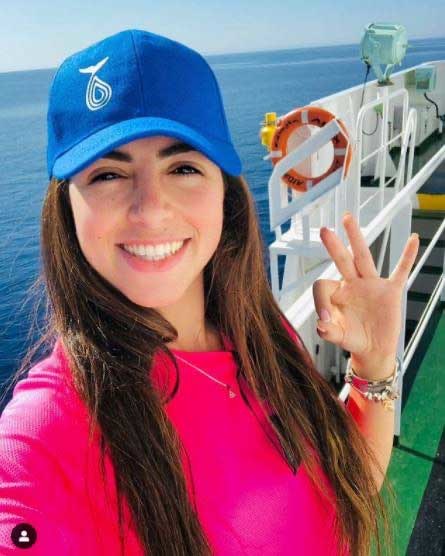
Marwa Elselehdar: Egypt’s first female sea captain is riding waves of success

1 / 3
Marwa Elselehdar. (Supplied)
2 / 3
Marwa Elselehdar. (Supplied)
3 / 3
Marwa Elselehdar. (Supplied)
Short Url
Updated 22 March 2021
Follow

Marwa Elselehdar: Egypt’s first female sea captain is riding waves of success

  • Captain tells how she overcame challenges of a male-dominated profession
  • Elselehdar is working on a ship for the Egyptian Authority for Maritime Safety

CAIRO: Marwa Elselehdar has become the first woman to work as a sea captain in Egypt.

As a little girl, Elselehdar always loved the sea and enjoyed swimming.

She enrolled in the Arab Academy for Science, Technology and Maritime Transport in Egypt and joined the International Transport and Logistics Department, but she was more drawn to the curriculum that was being taught to her brother in the Department of Maritime Transport and Technology.

The department was limited to men, but she still submitted an application to join and was eventually accepted, becoming the first Egyptian woman to study in this department.

Elselehdar’s brother and mother supported her dream of becoming the first female captain in Egypt. Her father, while more apprehensive because of the difficulties in the field, did not object to her studies. She thus began the formalities to join the department, and her unique request was submitted to the president of the academy for consideration.

The president called for research in maritime law to verify the possibility of issuing a captain’s license to her, since it was the first case of its kind. After making sure that the law did not pose restrictions, examinations began.

Elselehdar passed the physical and medical tests, as well as personal interviews, proving her ability to be in control and manage diverse situations, and she joined the department like any other student.

I faced difficulties in adapting, especially during the first year, but the encouragement from those around me — and my own ability to believe in my dream — helped me overcome these challenges.

Marwa Elselehdar

“I started my journey in the department as the only woman among 1,200 students. I faced difficulties in adapting, especially during the first year, but the encouragement from those around me — and my own ability to believe in my dream — helped me overcome these challenges, and I graduated in 2013,” she said.
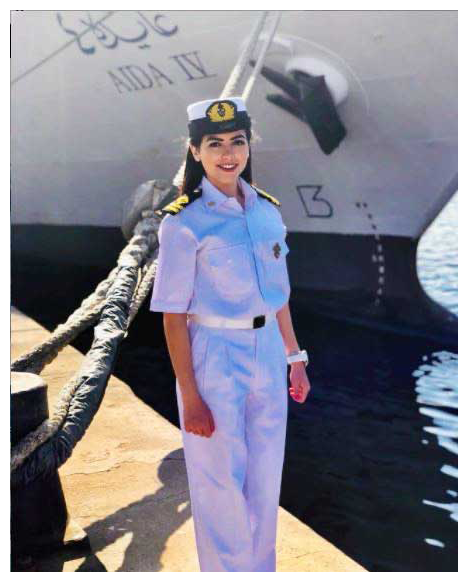
After her graduation, Elselehdar joined the crew of the AIDA IV ship, with the rank of the second officer.

At the time of the opening ceremony of the new Suez Canal, she applied to register as part of the crew that would lead the AIDA IV in the celebrations. Her request was accepted, and she prepared with her colleagues for the ceremony.

On the day of the ceremony, she led the AIDA IV — the first ship to cross the new shipping route — as the youngest and first Egyptian female captain to cross the Suez Canal.

Elselehdar has been working in the field for 10 years. She explained that the percentage of women in similar maritime positions does not exceed 2 percent worldwide, adding that being the first Egyptian woman in this regard was a great honor for her and noting that many girls followed her example and entered the field after her.

In 2017, Elselehdar was honored on Women’s Day by President Abdel Fattah El-Sisi.

She expressed her pride in this honor, seeing it not only as a form of appreciation from the state for what she has done but also as a demonstration of the state’s interest in empowering Egyptian women and placing them in leadership positions. Recently, Egyptian women have started participating in many occupations that were traditionally male-dominated.

The Encyclopedia of Arab-African Economic Integration chose Elselehdar among the top 20 Arab women in terms of achievement.

Elselehdar said that the boat she is now working on is owned by the Egyptian Authority for Maritime Safety, affiliated with the Egyptian government and managed by the Arab Academy for Science, Technology and Maritime Transport.

“Unlike fast flights, cruises can be long and arduous and can take up to a month or more. Of course, on these trips, I am the only woman among my fellow men.

“In the beginning, it was somewhat difficult, but we later became one team, and we split tasks equally. And because of the length of these trips, we all become like siblings,” she added.

Now almost 30 years old, Elselehdar dreams of obtaining a master’s degree and a Ph.D. She also hopes that marriage and having a family will not hinder her career.


As an uncertain 2026 begins, virtual journeys back to 2016 become a trend

Updated 30 January 2026
Follow

As an uncertain 2026 begins, virtual journeys back to 2016 become a trend

  • Over the past few weeks, millions have been sharing throwback photos to that time on social media, kicking off one of the first viral trends of the year

LONDON: The year is 2016. Somehow it feels carefree, driven by Internet culture. Everyone is wearing over-the-top makeup.
At least, that’s how Maren Nævdal, 27, remembers it — and has seen it on her social feeds in recent days.
For Njeri Allen, also 27, the year was defined by the artists topping the charts that year, from Beyonce to Drake to Rihanna’s last music releases. She also remembers the Snapchat stories and an unforgettable summer with her loved ones. “Everything felt new, different, interesting and fun,” Allen says.
Many people, particularly those in their 20s and 30s, are thinking about 2016 these days. Over the past few weeks, millions have been sharing throwback photos to that time on social media, kicking off one of the first viral trends of the year — the year 2026, that is.
With it have come the memes about how various factors — the sepia hues over Instagram photos, the dog filters on Snapchat and the music — made even 2016’s worst day feel like the best of times.
Part of the look-back trend’s popularity has come from the realization that 2016 was already a decade ago – a time when Nævdal says she felt like people were doing “fun, unserious things” before having to grow up.
But experts point to 2016 as a year when the world was on the edge of the social, political and technological developments that make up our lives today. Those same advances — such as developments under US President Donald Trump and the rise of AI — have increased a yearning for even the recent past, and made it easier to get there.
2016 marked a year of transition
Nostalgia is often driven by a generation coming of age — and its members realizing they miss what childhood and adolescence felt like. That’s certainly true here. But some of those indulging in the online journeys through time say something more is at play as well.
It has to do with the state of the world — then and now.
By the end of 2016, people would be looking ahead to moments like Trump’s first presidential term and repercussions of the United Kingdom leaving the EU after the Brexit referendum. A few years after that, the COVID-19 pandemic would send most of the world into lockdown and upend life for nearly two years.
Janelle Wilson, a professor of sociology at the University of Minnesota-Duluth, says the world was “on the cusp of things, but not fully thrown into the dark days that were to come.”
“The nostalgia being expressed now, for 2016, is due in large part to what has transpired since then,” she says, also referencing the rise of populism and increased polarization. “For there to be nostalgia for 2016 in the present,” she added, “I still think those kinds of transitions are significant.”
For Nævdal, 2016 “was before a lot of the things we’re dealing with now.” She loved seeing “how embarrassing everyone was, not just me,” in the photos people have shared.
“It felt more authentic in some ways,” she says. Today, Nævdal says, “the world is going downhill.”
Nina van Volkinburg, a professor of strategic fashion marketing at University of the Arts, London, says 2016 marked the beginning of “a new world order” and of “fractured trust in institutions and the establishment.” She says it also represented a time of possibility — and, on social media, “the maximalism of it all.”
This was represented in the bohemian fashion popularized in Coachella that year, the “cut crease” makeup Nævdal loved and the dance music Allen remembers.
“People were new to platforms and online trends, so were having fun with their identity,” van Volkinburg says. “There was authenticity around that.”
And 2016 was also the year of the “boss babe” and the popularity of millennial pink, van Volkinburg says, indications of young people coming into adulthood in a year that felt hopeful.
Allen remembers that as the summer she and her friends came of age as high school graduates. She says they all knew then that they would remember 2016 forever.
Ten years on, having moved again to Taiwan, she said “unprecedented things are happening” in the world. “Both of my homes are not safe,” she said of the US and Taiwan, “it’s easier to go back to a time that’s more comfortable and that you felt safe in.”
Feelings of nostalgia are speeding up
In the last few days, Nævdal decided to hide the social media apps on her phone. AI was a big part of that decision. “It freaks me out that you can’t tell what’s real anymore,” she said.
“When I’ve come off of social media, I feel that at least now I know the things I’m seeing are real,” she added, “which is quite terrifying.”
The revival of vinyl record collections, letter writing and a fresh focus on the aesthetics of yesterday point to nostalgia continuing to dominate trends and culture. Wilson says the feeling has increased as technology makes nostalgia more accessible.
“We can so readily access the past or, at least, versions of it,” she said. “We’re to the point where we can say, ‘Remember last week when we were doing XYZ? That was such a good time!’”
Both Nævdal and Allen described themselves as nostalgic people. Nævdal said she enjoys looking back to old photos – especially when they show up as “On This Day” updates on her phone, She sends them to friends and family when their photos come up.
Allen wished that she documented more of her 2016 and younger years overall, to reflect on how much she has evolved and experienced since.
“I didn’t know what life could be,” she said of that time. “I would love to be able to capture my thought process and my feelings, just to know how much I have grown.”