

WEEKLY ENERGY RECAP: Global oil prices reach pre-pandemic levels at a one-year high

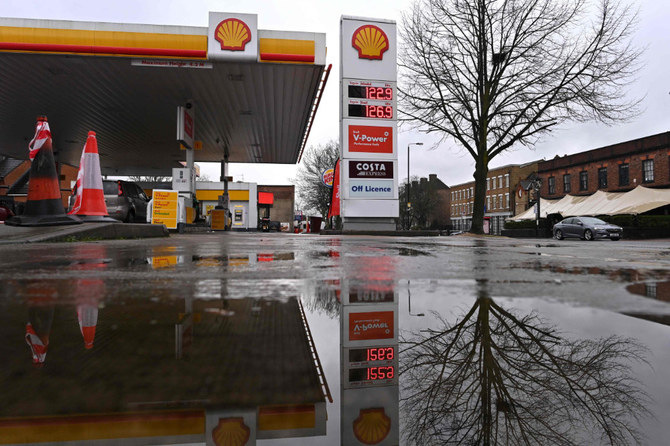
A Shell service station is reflected in a puddle in London on February 4, 2021. Royal Dutch Shell dived into a net loss of $21.7 billion in 2020 as the coronavirus pandemic slashed global energy demand. (AFP / JUSTIN TALLIS)
Short Url
Updated 07 February 2021
Follow

WEEKLY ENERGY RECAP: Global oil prices reach pre-pandemic levels at a one-year high

  • The declining crude oil inventories in the world’s two largest oil consuming nations and largest economies, the US and China, have led to an outlook of a tightening market

Oil prices made their biggest weekly gain this year, reaching pre-pandemic levels at a one-year high. The price of Brent crude is about to breach the important psychological mark of $60, closing the week at $59.34 per barrel. The price of West Texas Intermediate (WTI) crude closed the week at $56.85 per barrel.

The declining crude oil inventories in the world’s two largest oil consuming nations and largest economies, the US and China, have led to an outlook of a tightening market.

China’s crude oil stocks fell to their lowest level in nearly a year amid a global drawdown in inventories that is being driven by tighter supply strategies from OPEC+, which has read the market very well.

Prices have reached a year high — the market never imagined that the price of WTI would breach $55 per barrel after going below zero 9 months ago or that Brent crude would reach nearly $60 per barrel after touching $16 per barrel. The credit goes to the successful market management of OPEC and its leadership role in implementing medium-term strategies to balance the market while maintaining the principle of global energy security.

Tighter supplies from OPEC+ have successfully turned the Brent future curve to backwardation, which encourages oil traders to take oil out of storage, signaling a stronger market.

In January this year, OPEC+ achieved high compliance in maintaining oil output cuts; an upward momentum in oil prices did not alter its output cuts of 7.2 million barrels per day (bpd).

The price surge is due to OPEC’s effective market leadership despite the fragile market and uncertain oil demand recovery.

Also, the outlook for a tightening physical crude market amid continuing stock draws, helped by colder weather, has led crude’s futures curve to further strengthening, offsetting the challenging short-term demand recovery amid concern that the new virus variants will lead to more lockdowns and that some countries are facing vaccine rollouts issues.

It might be too early for oil demand recovery to do a U-turn. It might also be too early for OPEC+ output cuts to tighten the oil market to be in a deficit this year. Asia and Europe are setting back a fragile recovery in transport fuels with renewed lockdowns, and worldwide commercial flights have fallen back to less than 60 percent of comparable 2019 levels. In addition, the US Energy Information Administration (EIA) expects that energy consumption in the US will return to pre-pandemic levels by 2025 as the expectations of oil demand recovery depend greatly on the pace of the economic recovery.

The latest figures from the Commodity Futures Trading Commission (CFTC) on Feb. 2, 2021 show crude futures “long positions” on the New York Mercantile Exchange (NYMEX) at 676,260 contracts, decreased by 3,569 contracts from the previous week (1,000 barrels for each contract).


Faisal Faeq is an energy and oil marketing adviser. He was formerly with OPEC and Saudi Aramco. Twitter:@faisalfaeq


Oman money supply rises 6.4% to $68.6bn in November 

Updated 4 sec ago
Follow

Oman money supply rises 6.4% to $68.6bn in November 

JEDDAH: Oman’s money supply climbed 6.4 percent to 26.4 billion Omani rials ($68.6 billion) in November, signaling solid liquidity conditions and continued growth in bank deposits, official data showed.  

The increase in broad money — a measure that includes cash in circulation and bank deposits — was driven by a 12.2 percent rise in cash and demand deposits, alongside a 4.1 percent increase in savings and time deposits, the Oman News Agency reported. 

The latest reading follows steady gains earlier in 2025, with money supply up 6.1 percent in the three months through August. This was supported by a 6.9 percent rise in narrow money and a 5.8 percent increase in quasi-money. The trend reflects sustained liquidity conditions and stronger deposit growth across the banking system. 

The expansion in monetary aggregates points to continued liquidity and policy support for private-sector lending, as Oman advances fiscal and economic reforms under its Vision 2040 strategy. 

“During the same period, currency in circulation increased 1.9  percent, while demand deposits rose 14.1 percent,” the ONA report stated. 

At conventional commercial banks, the weighted average deposit rate in Omani rials declined to 2.50 percent in November from 2.73 percent a year earlier, while the weighted average lending rate eased to 5.45 percent from 5.67 percent over the same period. 

The overnight interbank lending rate averaged 3.92 percent in November, down from 4.56 percent a year earlier, reflecting a decline in the weighted average repo rate to 4.5 percent from 5.30 percent, influenced by US Federal Reserve policy shifts. 

Meanwhile, total assets of Islamic banks and windows reached about 9.3 billion Omani rials by the end of November, accounting for 19.4 percent of the Gulf state’s total banking sector assets.  

“This marks a 12.3 percent increase compared with the same period in 2024,” ONA reported, citing data from the Central Bank of Oman. 

Total financing by Islamic banking units rose 10.3 percent to around 7.5 billion rials, while deposits increased 10.9 percent to approximately 7.3 billion rials by the end of November. 

The November data follows the International Monetary Fund’s 2025 Article IV consultation report, released earlier this month, which highlighted the continued resilience of Oman’s economy amid global uncertainty. 

The IMF cited steady growth in non-hydrocarbon sectors, low inflation, and broadly sound fiscal and external positions, underscoring the effectiveness of Oman’s coordinated economic and financial policies.