

Nigeria negotiates terms with major oil firms to keep investments

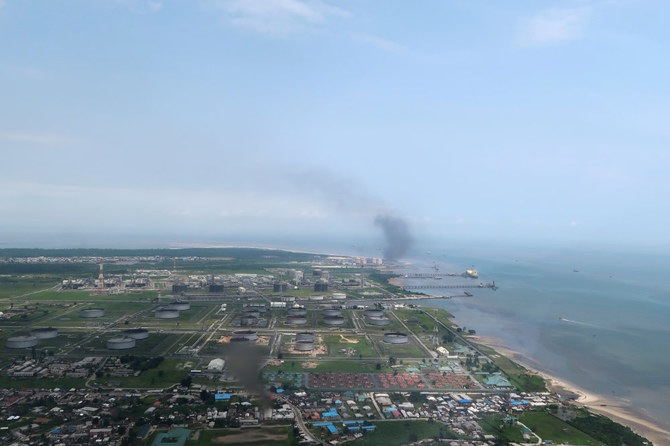
A view shows the Bonny oil terminal in the Niger delta which is operated by Royal Dutch Shell in Port Harcourt, Nigeria, on August 1, 2018. (REUTERS/File Photo)
Short Url
Updated 06 February 2021
Follow

Nigeria negotiates terms with major oil firms to keep investments

  • Oil companies are cutting billions in spending after taking hits to their profits

LAGOS: Nigeria’s state oil company is renegotiating commercial contract terms with major oil firms, its chief said, in a move that it hopes will keep investment flowing into a sector crucial for its economy at a time when spending is being slashed.

Africa’s largest oil exporter and biggest economy relies on the oil sector for half of its budget and 90 percent of its foreign exchange. It wants to raise revenue but also attract investment.

Oil companies, meanwhile, including Royal Dutch Shell, ExxonMobil, Total and Eni, are cutting billions in spending after taking hits to their profits, shifting money to renewable fuels and focusing only on the most cost-effective markets.

Mele Kyari, group managing director of the Nigerian National Petroleum Corporation (NNPC), said in an interview that new commercial terms were being negotiated and would be finalized before a pending oil overhaul bill is passed.

“No company will invest where they cannot get the appropriate margin,” Kyari said in a video interview, declining to say specifically what was being renegotiated.

“We’re very conscious of the fact that people have choices, companies will make choices to leave countries when they have to.”

BACKGROUND

Oil companies including Royal Dutch Shell, ExxonMobil, Total and Eni, are cutting billions in spending after taking hits to their profits, shifting money to renewable fuels and focusing only on the most cost-effective markets.

Nigeria’s parliament has promised to pass the long-awaited oil overhaul bill by May.

It will define the sector for decades to come, but companies have criticized the draft for not doing enough to attract development dollars.

They have raised issues over taxation, royalties and local community obligations.

Kyari said companies would have the option of the newly negotiated commercial terms or moving to the updated terms outlined under the new law.

By the end of June the NNPC is planning to have found $2 billion of financing to overhaul its Warri and Kaduna refineries, Kyari said.

Talks are underway on financing repairs to the Port Harcourt refinery after a pre-finance bid for more than $1 billion was oversubscribed, he said.

The money will be repaid in profits and fuel cargoes from the refineries, rather than in oil cargoes, Kyari said.

While the refineries have not operated at full capacity for years, NNPC had to shut all of them completely last year as they await much-needed maintenance, repair and upgrades, leaving it with a hefty fuel import bill.


Saudi Arabia opens 3rd round of Exploration Empowerment Program

Updated 01 February 2026
Follow

Saudi Arabia opens 3rd round of Exploration Empowerment Program

RIYADH: Saudi Arabia’s Ministry of Industry and Mineral Resources, in collaboration with the Ministry of Investment, has opened applications for the third round of the Exploration Empowerment Program, part of ongoing efforts to accelerate mineral exploration in the Kingdom, reduce early-stage investment risks, and attract high-quality investment from local and international mining companies.

The third round of the Exploration Empowerment Program offers a comprehensive support package targeting exploration companies and mineral prospecting license holders.

The initiative aims to lower investment risks for projects and support a faster transition from prospecting to development.

"The program provides coverage of up to 70 percent of the total salaries of Saudi technical staff, such as geologists, during the first two years, increasing to 100 percent thereafter, in line with program requirements.

This support aims to develop talent, build national capabilities in mineral exploration, promote job localization, and facilitate the transfer of geological knowledge.

The application for the third round opened on Jan. 14, allowing participants to benefit from the Kingdom’s attractive investment environment, its stable legal framework, and streamlined regulatory structures, as well as integrated infrastructure that supports the transition from mineral resources to operational mines.

The ministry has set the timeline for the third round, with the application period running from Jan. 14 to March 31.

This will be followed by the evaluation, approval, and signing of agreements from April 1 to May 31, with the eligible projects set to be announced between June 1 and July 31 of the same year.

The program stages include submitting exploration data during the reimbursement and payment phase from Sept. 1 to Nov. 30, followed by technical and financial verification of work programs and approval of the disbursement of support funds in January 2027.

The exploration data will then be published on the National Geological Database in April 2027.

The ministry emphasized that the EEP focuses on supporting the exploration of strategically important minerals with national priority. It also contributes to enhancing geological knowledge by providing up-to-date data that meets international standards, helping investors make informed decisions and supporting the growth of national companies and local supply chains.

The ministry urged companies to apply early to benefit from the program’s third round, which coincided with the fifth edition of the International Mining Conference, which was held from Jan. 13 to 15.