Fans bid farewell to Japan’s only pandas

1 / 3
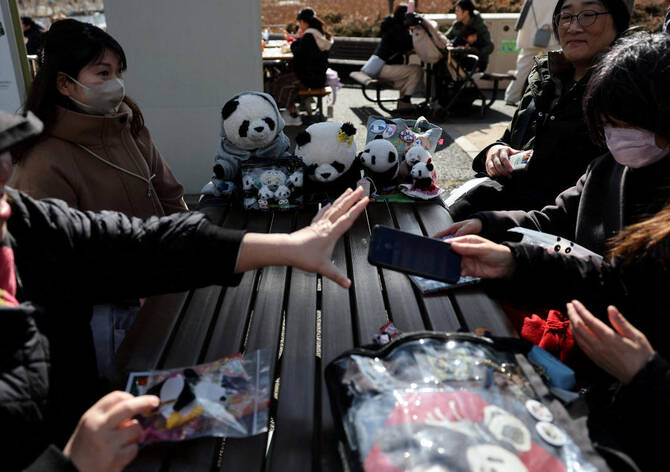
Visitors display fan merchandise of four-year-old giant pandas Xiao Xiao and Lei Lei at Ueno Zoo during the last viewing day before the planned return of the twin giant pandas to China, in Tokyo, Japan, January 25, 2026. (Reuters)
2 / 3
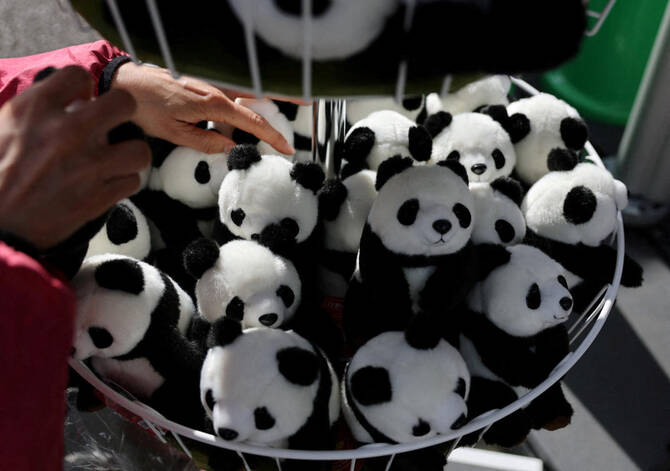
A staff restocks panda plush toys at a souvenir shop at Ueno Zoo during the last viewing day before the planned return of twin giant pandas Xiao Xiao and Lei Lei to China, in Tokyo, Japan, January 25, 2026. (Reuters)
3 / 3
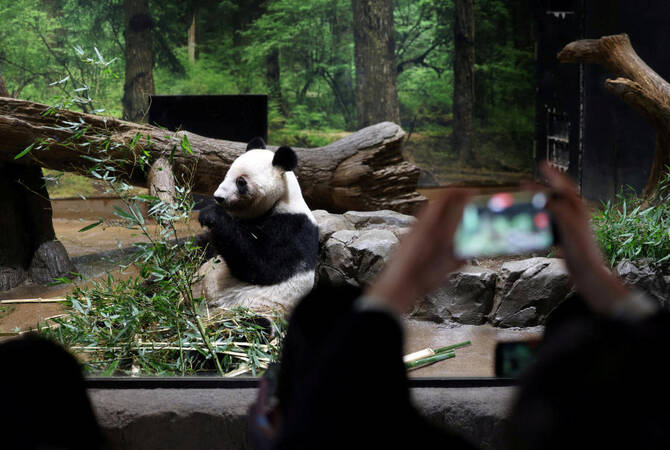
FILE PHOTO: Visitors flock to see four-year-old female giant panda Lei Lei at Ueno Zoo during the last viewing day before the planned return of twin giant pandas Xiao Xiao and Lei Lei to China, in Tokyo, Japan, January 25, 2026. (Reuters)
Short Url
Updated 25 January 2026
Follow

Fans bid farewell to Japan’s only pandas

TOKYO: Panda lovers in Tokyo said goodbye on Sunday to a hugely popular pair of the bears that are set to return to China, leaving Japan without the beloved animals for the first time in half a century.
Loaned out as part of China’s “panda diplomacy” program, the distinctive black-and-white animals have symbolized friendship between Beijing and Tokyo since the normalization of diplomatic ties in 1972.
Some visitors at Ueno Zoological Gardens were left teary-eyed as they watched Japan’s only two pandas Lei Lei and Xiao Xiao munch on bamboo.
The animals are expected to leave for China on Tuesday following a souring of relations between Asia’s two largest economies.
“I feel like seeing pandas can help create a connection with China too, so in that sense I really would like pandas to come back to Japan again,” said Gen Takahashi, 39, a Tokyo resident who visited the zoo with his wife and their two-year-old daughter.
“Kids love pandas as well, so if we could see them with our own eyes in Japan, I’d definitely want to go.”
The pandas’ abrupt return was announced last month after Japan’s conservative premier Sanae Takaichi hinted Tokyo could intervene militarily in the event of any attack on Taiwan.
Her comment provoked the ire of Beijing, which regards the island as its own territory.
The 4,400 lucky winners of an online lottery took turns viewing the four-year-old twins at Ueno zoo while others gathered nearby, many sporting panda-themed shirts, bags and dolls to celebrate the moment.
Mayuko Sumida traveled several hours from the central Aichi region in the hope of seeing them despite not winning the lottery.
“Even though it’s so big, its movements are really funny-sometimes it even acts kind of like a person,” she said, adding that she was “totally hooked.”
“Japan’s going to be left with zero pandas. It feels kind of sad,” she said.
Their departure might not be politically motivated, but if pandas return to Japan in the future it would symbolize warming relations, said Masaki Ienaga, a professor at Tokyo Woman’s Christian University and expert in East Asian international relations.
“In the future...if there are intentions of improving bilateral ties on both sides, it’s possible that (the return of) pandas will be on the table,” he told AFP.


US climber scales Taiwan’s tallest building Taipei 101 without ropes

Updated 25 January 2026
Follow

US climber scales Taiwan’s tallest building Taipei 101 without ropes

  • ‘Free solo’ ascent organized and shown live by Netflix
  • Taipei 101 was once tallest building in the world

TAIPEI: US climber Alex Honnold scaled the Taipei 101 skyscraper without ropes or safety netting on Sunday, watched by thousands of cheering and waving fans as he clambered up one of the world’s tallest buildings.
“Sick,” Honnold said as he got to the top spire of Taiwan’s tallest building after his 91-minute “free solo” ascent, which was organized and broadcast live by Netflix.
“What a beautiful way to see Taipei,” he told reporters after his mission, which ‌was postponed by ‌a day due to wet weather.
The 508-meter (1,667-foot) ‌Taipei ⁠101, which dominates ‌the city’s skyline and is a major tourist attraction, was the tallest building in the world from 2004 to 2010, a crown currently held by the Burj Khalifa in Dubai.
The climb, with no safety equipment, took place with the full support and permission of Taipei 101 and the city government.
Honnold said he had once thought of climbing the structure without permission.
“But then ⁠out of respect for the building and respect for all the people on the team ‌who’d allowed me access to look ‍at it, I was like, well ‍obviously I’m not going to poach this, I’m going to respect the ‍people and just see if it ever comes together.”
Executive Producer James Smith said it was rare for a building to trust a climber and allow such an event to take place, calling Taipei 101 “a real icon of this country.”
Taiwanese politicians took to social media to thank Honnold and Netflix for putting Taiwan — more accustomed to featuring in global ⁠headlines for its semiconductor prowess or Chinese military threats — in the international spotlight with such a different perspective.
“Congratulations to the brave, fearless Alex for completing the challenge,” President Lai Ching-te wrote on his Facebook page.
“Through Netflix’s live broadcast cameras, the world didn’t just see Taipei 101 — it also saw the warmth and passion of the Taiwanese people, and the beautiful hills and scenery of this land,” he added.
This is not the first time Taipei 101 has been scaled.
In 2004, French climber Alain Robert, dubbed “Spiderman” for his ropeless ascents of some of the world’s highest skyscrapers, climbed the ‌building, though did so with a safety rope in a time of four hours.