NEW DELHI: The digital platform anchoring India’s massive COVID-19 vaccination drive will be able to handle up to 10 million shots daily to meet the country’s target of covering 300 million people by July-August, a government official told Reuters.
India, which has the world’s second-highest number of coronavirus cases, is relying on CoWIN to link beneficiaries with vaccines in what the government touts as the biggest inoculation campaign anywhere.
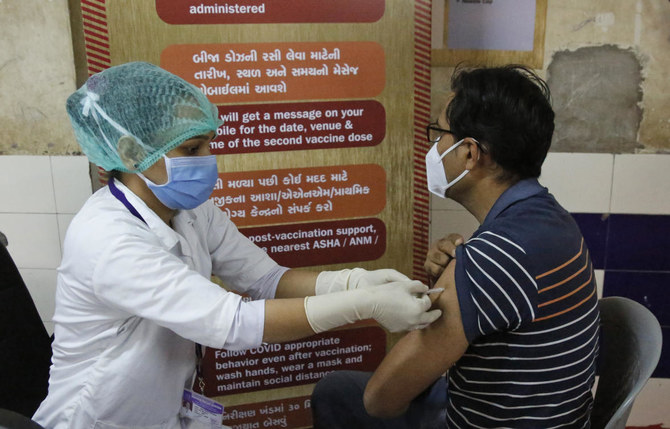
The world’s most populous country after China has vaccinated around three million health care workers in the first two weeks of the campaign, at a rate of just over 200,000 a day on average, but this will have to be raised many times over if India is to meet its summer coverage target.
Though initial glitches in the software slowed the immunization program, which began on Jan. 16 with frontline workers, the government says modifications have been made to ensure there is no such repeat.
“Big numbers won’t be a problem for us,” R.S. Sharma, who chairs a government group overseeing CoWIN, said in a Zoom interview. “We will be able to do 10 million vaccinations per day.”
Sharma said CoWIN would be integrated into government contact-tracing app “Aarogya Setu,” or Health Bridge, which has been downloaded by around 150 million people.
It is using a vaccine developed at home by Bharat Biotech and the Indian Council of Medical Research, and another licensed from Oxford University and AstraZeneca.
In the coming months, India is expected to approve two more vaccines, Russia’s Sputnik V and Cadila Healthcare’s ZyCov-D.
Sharma said individuals would be able to choose vaccination slots and get QR-coded certificates once they have taken their shots through CoWIN, allowing them to carry a proof that can be used for, say, air or foreign travel.
“It’s not a fad,” he said, “It cannot be done without technology.”
India, the world’s biggest vaccine maker, is also gifting or selling shots to more than a dozen countries, and Sharma said there had already been some international interest in using the CoWIN platform, including from South Africa.
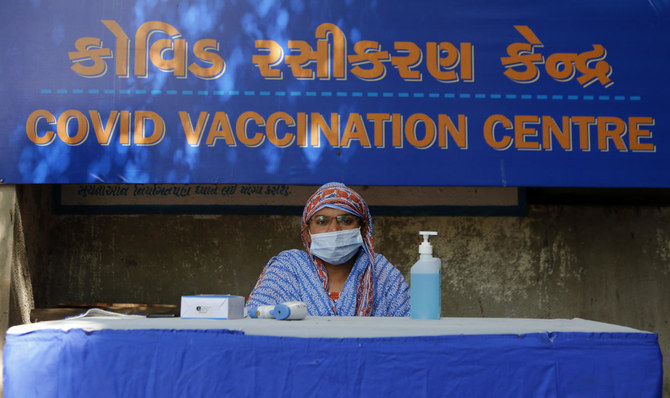
At home, Sharma said CoWIN would use online and offline systems to register beneficiaries, including through telephone help lines and walk-in centers.
“There will be millions of registrations every day and the system should be able to handle it effortlessly,” he said.
Discussions were still underway on how to inoculate such large numbers of people, including possibly using a combination of government and private health facilities, said Sharma, who is also part of a national expert group on vaccine administration.
With 10.7 million confirmed COVID-19 infections, India, with a total population of nearly 1.4 billion, trails only the United States’ tally.
It reported 18,855 new cases in the past 24 hours, the highest in three weeks, while deaths rose by 163 to a total of 154,000.


India’s vaccination platform readied to handle 10m shots daily
https://arab.news/8f5xf
India’s vaccination platform readied to handle 10m shots daily

- In the coming months, India is expected to approve two more vaccines, Russia’s Sputnik V and Cadila Healthcare’s ZyCov-D
- India, the world’s biggest vaccine maker, is also gifting or selling shots to more than a dozen countries


Spain eyes full service on train tragedy line in 10 days
- The Jan. 18 disaster in the southern region of Andalusia partially shut the line linking Madrid and Seville
- “After the replacement, the whole of the Madrid-Seville line will resume service,” said Puente
MADRID: Spain aims to restart within 10 days full service on a key high-speed railway line where a collision between two trains killed 45 people, the transport minister said on Wednesday.
The January 18 disaster in the southern region of Andalusia — one of Europe’s deadliest such accidents this century — partially shut the line linking Madrid and the city of Seville as investigators cleared the wreckage and collected evidence.
“Today we have received legal permission to proceed with the replacement of the infrastructure in the section of the accident,” Transport Minister Oscar Puente wrote on X.
“Our aim is that it is completed in a timeframe of approximately 10 calendar days. After the replacement, the whole of the Madrid-Seville line will resume service,” he added.
The line was Spain’s first high-speed rail connection when it opened in 1992, with the network expanding to become the world’s second-largest after China’s and a source of national pride.
But the accident has raised doubts about the safety of rail travel in the country.
A preliminary report released last week suggested the track was cracked before a train run by private firm Iryo derailed and smashed into an oncoming service operated by state company Renfe.


