WHO warns ‘too early to ease up’ from COVID-19 lockdowns in Europe

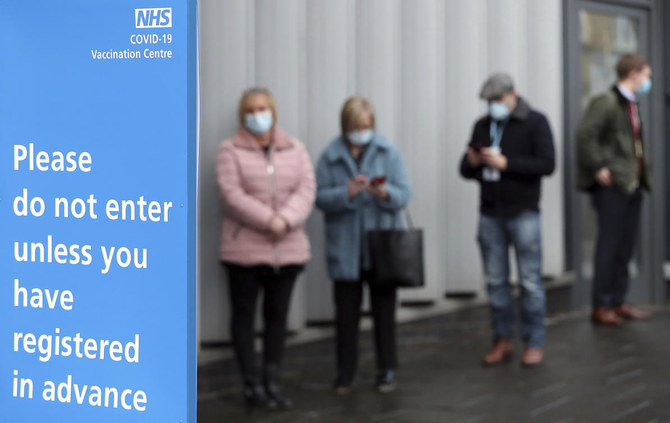
Continued high rates of transmission and emerging variants of the coronavirus made it urgent to vaccinate priority groups, a WHO official said. (AP)
Short Url
Updated 28 January 2021
Follow

WHO warns ‘too early to ease up’ from COVID-19 lockdowns in Europe

  • ‘We need to be patient, it will take time to vaccinate’
  • ‘Pushing transmission down requires a sustained, consistent effort’

GENEVA: The World Health Organization’s European director Hans Kluge said on Thursday COVID-19 transmission rates in Europe remained too high, putting health services under severe strain, and therefore it was “too early to ease up.”
“We need to be patient, it will take time to vaccinate,” he told an online briefing. “We have learned harsh lessons — opening and closing, and reopening (societies) rapidly is a poor strategy” in seeking to curb coronavirus contagion, he said.
“Transmission rates across Europe are still very high, impacting health systems and straining services, making it too early to ease up,” Kluge said. “Pushing transmission down requires a sustained, consistent effort. Bear in mind that just over 3 percent of people in the region have had a confirmed COVID-19 infection. Areas hit badly once can be hit again.”
Kluge said a total of 35 countries in Europe had launched vaccination programs with 25 million does administered so far.
“These vaccines have shown the efficacy and safety we all hoped they would...This monumental undertaking will release pressure on our health systems and undoubtedly save lives.”
He said continued high rates of transmission and emerging variants of the virus made it urgent to vaccinate priority groups, but said the rate of vaccine production and distribution was not yet meeting expectations.
“This paradox, where communities sense an end is in sight with the vaccine but, at the same time, are called to adhere to restrictive measures in the face of a new threat, is causing tension, angst, fatigue, and confusion. This is completely understandable in these circumstances.”


‘New progress’ on North Korea possible in coming days, Seoul official says

Updated 3 sec ago
Follow

‘New progress’ on North Korea possible in coming days, Seoul official says

  • Senior official says Seoul has made considerable efforts to bring North Korea to dialogue
  • Trump administration has decided to lift sanctions for humanitarian aid projects to North Korea
SEOUL: A senior South Korean official said Friday “new progress” on North Korea could come within days, with a local report saying the Trump administration has decided to approve humanitarian sanctions exemptions for Pyongyang.
In a meeting with reporters in the United States, the senior official said Seoul has made considerable efforts to bring North Korea to dialogue.
“There could be some new progress in the coming days” on North Korea, the government official said on condition of anonymity.
Washington has long demanded that Pyongyang give up its banned nuclear weapons program, with the country under successive rounds of UN sanctions over it.
The South Korean senior official’s comments came while addressing US President Donald Trump’s scheduled trip to China in April.
Trump last year made repeated overtures to Pyongyang’s leader Kim Jong Un during his barnstorming tour of Asia, saying he was “100 percent” open to a meeting and even bucking decades of US policy by conceding that North Korea was “sort of a nuclear power.”
North Korea did not respond to Trump’s offer, and has repeatedly said it will never give up its nuclear weapons.
South Korea’s daily Dong-A Ilbo reported on Friday, citing Seoul’s unnamed government sources, that the Trump administration has decided to lift sanctions for humanitarian aid projects to North Korea, at the UN Security Council’s 1718 Committee.
Analysts say the move would allow South Korea’s NGOs to provide humanitarian assistance — such as nutritional supplements, medical equipment and water purification systems — to North Korea, an improverished state that has struggled to provide for its people.
Trump met North Korea’s Kim three times. The US leader once famously declared they were “in love” during his first term, in efforts to reach a denuclearization deal.
But since a summit in Hanoi in 2019 fell through over differences about what Pyongyang would get in return for giving up its nuclear weapons, no progress has been made between the two countries.
Seoul and Washington earlier this week reaffirmed their commitment to North Korea’s “complete denuclearization” and cooperation on Seoul’s nuclear-powered submarine plan, a move that has previously drawn an angry response from Pyongyang.
North Korea is set to hold a landmark congress of its ruling party soon, its first in five years.
Ahead of that conclave, Kim ordered the “expansion” and modernization of the country’s missile production.