

India’s Muslims ‘living in fear’ amid temple funding drive

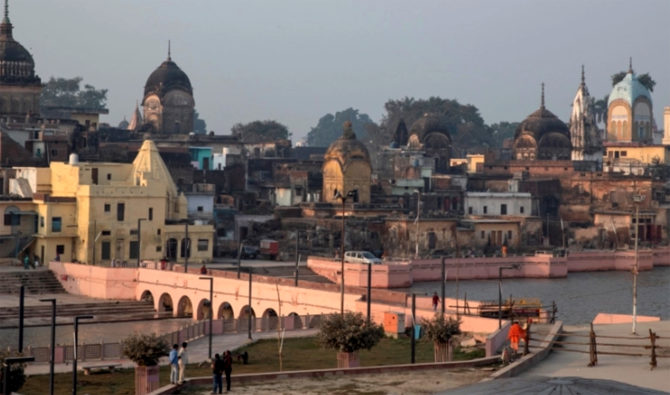
A general view of Ayodhya. (Reuters/File)
Short Url
Updated 21 January 2021
Follow

India’s Muslims ‘living in fear’ amid temple funding drive

  • The destruction of the mosque sparked nationwide violence that claimed the lives of more than 2,000 people, mostly Muslims

NEW DELHI: Muslims in India fear a new wave of sectarian tension amid a controversial fundraising campaign to build a Hindu temple in place of a centuries-old mosque in the eastern city of Ayodhya in Uttar Pradesh.

The 16th-century Babri Mosque was claimed by both Hindus and Muslims. After decades of conflict, the Supreme Court ruled in favor of Hindus in 2019, allowing them to build a temple on the site where the mosque had stood.

The mosque was torn down by mobs mobilized by the now-ruling Bharatiya Janata Party (BJP) in 1992, which claimed that it was built at the birthplace of Ram, a major Hindu deity.

The destruction of the mosque sparked nationwide violence that claimed the lives of more than 2,000 people, mostly Muslims, and set the tone for sectarian tensions that continue today.

Last week, the World Hindu Organization, known locally as Viswa Hindu Parishad (VHP) — an affiliate of the BJP — launched a 45-day nationwide campaign to collect donations for the Hindu temple, including the Muslim community in its efforts.

“There is a palpable sense of anxiety among Muslims in the region,” social activist Abrar ul Haq, from the Basti area of Uttar Pradesh, told Arab News on Tuesday.

“Experience tells us that Hindu activists rally in a Muslim locality in the name of a campaign and shout provocative slogans to incite people. This leads to tension and violence,” he said.

“Muslims want to forget the temple debate, but the divisive campaign by Hindu groups makes them anxious.”

Before the VHP’s official fundraising campaign, smaller efforts to collect donations for the temple led to clashes in the Indore district of neighboring Madhya Pradesh in late December.

Saddam Patel, a resident of the mainly Muslim Chandan Kheri village in Indore, was injured in the violence along with his four brothers.

“We were inside our house, but the mob torched our other house. When we went there to save a sleeping child, they attacked us,” he told Arab News.

“They were armed with firearms and swords.”

Indore-based social activist Zaidi Pathan said that Muslim-dominated villages in the region are living in fear.

“Muslims have moved beyond the temple controversy, but the BJP cannot survive without religious polarization and tension. This is a deliberate strategy to keep communal tensions alive,” Pathan said.

However, the VHP blames Muslims for the violence.

“It is unfortunate that Muslims attacked the people who went inside the village to collect funds,” Surendra Kumar Jain, VHP general secretary, told Arab News on Sunday.

“Why are Muslims opposing the construction of a temple being built after the apex court’s order?” he asked. “It is the responsibility of the Muslim community to ensure that no such incident takes place anywhere in the country.”

Political analysts said that the BJP is using the temple issue for electoral purposes.

“There is a conscious attempt to politicize the issue and make sure that the Ram temple remains a relevant electoral issue,” Hilal Ahmed, of the New Delhi-based Center for the Study of Developing Societies, said.

Prof. Afroz Alam, of the Hyderabad-based Maulana Azad National Urdu University, believes that political mobilization regarding the temple would have happened regardless of the court’s ruling.

“I have always maintained that the temple campaign is more a political project than a spiritual one,” he said. “Whatever may have been the court’s judgment, political mobilization was bound to happen.”

New Delhi-based political analyst and writer Nilanjan Mukhopadhyay said that the fundraising campaign “demonstrates the BJP’s over-reliance on majoritarian campaigns to retain support.”

“At a time when pandemic-induced uncertainty is raging, the economy is virtually stagnant, and millions of Indians have little idea what future the future holds, what sense does it make to launch such a drive?” he asked.

“In 1989, the temple agitation got a new push and the BJP’s parliamentary tally went up from two to 85,” Mukhopadhyay said. “The temple controversy has played a major role in the rise of the BJP.”


Afghan returnees in Bamiyan struggle despite new homes

Updated 58 min 44 sec ago
Follow

Afghan returnees in Bamiyan struggle despite new homes

  • More than five million Afghans have returned home since September 2023, according to the International Organization for Migration

BAMIYAN, Afghanistan: Sitting in his modest home beneath snow-dusted hills in Afghanistan’s Bamiyan province, Nimatullah Rahesh expressed relief to have found somewhere to “live peacefully” after months of uncertainty.
Rahesh is one of millions of Afghans pushed out of Iran and Pakistan, but despite being given a brand new home in his native country, he and many of his recently returned compatriots are lacking even basic services.
“We no longer have the end-of-month stress about the rent,” he said after getting his house, which was financed by the UN refugee agency on land provided by the Taliban authorities.
Originally from a poor and mountainous district of Bamiyan, Rahesh worked for five years in construction in Iran, where his wife Marzia was a seamstress.
“The Iranians forced us to leave” in 2024 by “refusing to admit our son to school and asking us to pay an impossible sum to extend our documents,” he said.
More than five million Afghans have returned home since September 2023, according to the International Organization for Migration (IOM), as neighboring Iran and Pakistan stepped up deportations.
The Rahesh family is among 30 to be given a 50-square-meter (540-square-foot) home in Bamiyan, with each household in the nascent community participating in the construction and being paid by UNHCR for their work.
The families, most of whom had lived in Iran, own the building and the land.
“That was crucial for us, because property rights give these people security,” said the UNHCR’s Amaia Lezertua.
Waiting for water
Despite the homes lacking running water and being far from shops, schools or hospitals, new resident Arefa Ibrahimi said she was happy “because this house is mine, even if all the basic facilities aren’t there.”
Ibrahimi, whose four children huddled around the stove in her spartan living room, is one of 10 single mothers living in the new community.
The 45-year-old said she feared ending up on the street after her husband left her.
She showed AFP journalists her two just-finished rooms and an empty hallway with a counter intended to serve as a kitchen.
“But there’s no bathroom,” she said. These new houses have only basic outdoor toilets, too small to add even a simple shower.
Ajay Singh, the UNHCR project manager, said the home design came from the local authorities, and families could build a bathroom themselves.
There is currently no piped water nor wells in the area, which is dubbed “the dry slope” (Jar-e-Khushk).
Ten liters of drinking water bought when a tanker truck passes every three days costs more than in the capital Kabul, residents said.
Fazil Omar Rahmani, the provincial head of the Ministry of Refugees and Repatriation Affairs, said there were plans to expand the water supply network.
“But for now these families must secure their own supply,” he said.
Two hours on foot
The plots allocated by the government for the new neighborhood lie far from Bamiyan city, which is home to more than 70,000 people.
The city grabbed international attention in 2001, when the Sunni Pashtun Taliban authorities destroyed two large Buddha statues cherished by the predominantly Shia Hazara community in the region.
Since the Taliban government came back to power in 2021, around 7,000 Afghans have returned to Bamiyan according to Rahmani.
The new project provides housing for 174 of them. At its inauguration, resident Rahesh stood before his new neighbors and addressed their supporters.
“Thank you for the homes, we are grateful, but please don’t forget us for water, a school, clinics, the mobile network,” which is currently nonexistent, he said.
Rahmani, the ministry official, insisted there were plans to build schools and clinics.
“There is a direct order from our supreme leader,” Hibatullah Akhundzada, he said, without specifying when these projects will start.
In the meantime, to get to work at the market, Rahesh must walk for two hours along a rutted dirt road between barren mountains before he can catch a ride.
Only 11 percent of adults found full-time work after returning to Afghanistan, according to an IOM survey.
Ibrahimi, meanwhile, is contending with a four-kilometer (2.5-mile) walk to the nearest school when the winter break ends.
“I will have to wake my children very early, in the cold. I am worried,” she said.