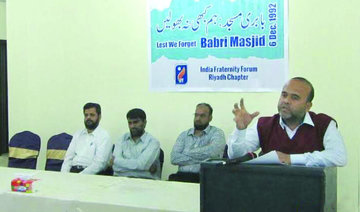
NEW DELHI: Muslims in India have criticized the Supreme Court’s refusal on Thursday to revisit its 1994 ruling that said mosques are not essential to Islam.
Dr. Mohammad Manzoor Alam, chairman of the New Delhi-based Institute of Objective Studies, said the court had ignored abundant Islamic literature on the necessity of mosques in Islam.
“Hindu religious extremists may use this verdict as a ruse to trouble us in the future,” he told Arab News.
New Delhi-based academic Dr. Anwar Sadat said mosques are “where we understand religion and its interpretation. It’s a place where we form associations. The court hasn’t done justice to us.” Thursday’s ruling paves the way for determining ownership of the disputed Babri mosque site in Ayodhya, a town in the eastern Indian state of Uttar Pradesh. Ayodhya’s mostly Hindu population believe that their supreme deity Ram was born at the site. They wish to build a huge temple there, but the Muslim community opposes this.
The court has set Oct. 29 as the start date for the hearing on ownership of the site.
“The court has refused to examine whether essentiality of any practice of any religion can be decided without examining the religious texts of that religion,” said Dr. Faizan Mustafa, a constitutional expert and vice chancellor of the NALSAR University of Law in the city of Hyderabad. Sadat said: “By declaring mosques as not integral to Islam, the court has given a broad hint as to which way the verdict in the title suit will go.” He added: “Leaders of the Bharatiya Janata Party (BJP) and other Hindu organizations are celebrating the ruling.” After Thursday’s verdict, Uma Bharati, a BJP leader and a minister in the current government, said: “It is an important day for me.”
Bharati, allegedly one of the leaders of a mob that demolished the Babri mosque in 1992, added: “Ayodhya is an important religious place for Hindus because it is the birthplace of Lord Ram.”
He said: “For Muslims, it is not a religious place. For them it is Makkah, just like Vatican City is for Christians.”

Indian Muslims irked by top court ruling on mosques
- The court has refused to examine whether essentiality of any practice of any religion can be decided without examining the religious texts of that religion
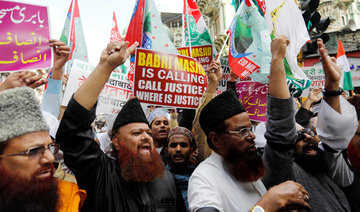
Bangladesh police say student leader’s killers fled to India
DHAKA: Bangladesh police on Sunday said the alleged killers of popular student leader Sharif Osman Hadi had fled to India, in comments likely to further strain relations with its neighbor.
Hadi, a vocal India critic who took part in last year’s mass uprising, was shot by masked assailants in Dhaka earlier this month and later succumbed to his injuries at a hospital in Singapore.
His death set off violent protests with angry mobs torching several buildings, including two major newspapers deemed to favor India as well as a prominent cultural institution.
With protests being held across the country almost daily, pressure has been growing on Bangladesh’s interim government to arrest the killers of Hadi, who was set to contest general elections in February next year.
“The killing was premeditated. Those behind it have been identified,” SN Nazrul Islam, a senior Dhaka Metropolitan Police officer, said at a news conference.
Suspects Faisal Karim Masud and Alamgir Sheikh left Bangladesh through the Haluaghat border with India shortly after attacking Hadi on December 12, Islam said.
They were received at the border by two Indian citizens, who escorted them into the northeastern state of Meghalaya before handing them over to two accomplices.
Bangladeshi investigators were in contact with their Indian counterparts who had arrested the two suspected accomplices, Islam said.
“We are communicating with Meghalaya police, who have confirmed the arrest of two Indian nationals,” he added.
Two senior Meghalaya police officers however did not comment when contacted by AFP.
The Indian foreign ministry had earlier said it rejects “false narratives” about New Delhi’s involvement in Hadi’s killing.
Ties between the neighbors have deteriorated since ousted prime minister Sheikh Hasina fled the pro-democracy uprising and sought refuge in India.
India says it is still considering Dhaka’s requests to extradite Hasina, who was sentenced to death in absentia for orchestrating a deadly crackdown on the uprising.
The lynching of a Hindu garment worker by a mob on December 18 has also hit ties.
Amid the deteriorating security situation in the Muslim-majority country, Khuda Baksh Chowdhury, special assistant to interim leader Muhammad Yunus overseeing the home department, stepped down on Wednesday.
Hadi, a vocal India critic who took part in last year’s mass uprising, was shot by masked assailants in Dhaka earlier this month and later succumbed to his injuries at a hospital in Singapore.
His death set off violent protests with angry mobs torching several buildings, including two major newspapers deemed to favor India as well as a prominent cultural institution.
With protests being held across the country almost daily, pressure has been growing on Bangladesh’s interim government to arrest the killers of Hadi, who was set to contest general elections in February next year.
“The killing was premeditated. Those behind it have been identified,” SN Nazrul Islam, a senior Dhaka Metropolitan Police officer, said at a news conference.
Suspects Faisal Karim Masud and Alamgir Sheikh left Bangladesh through the Haluaghat border with India shortly after attacking Hadi on December 12, Islam said.
They were received at the border by two Indian citizens, who escorted them into the northeastern state of Meghalaya before handing them over to two accomplices.
Bangladeshi investigators were in contact with their Indian counterparts who had arrested the two suspected accomplices, Islam said.
“We are communicating with Meghalaya police, who have confirmed the arrest of two Indian nationals,” he added.
Two senior Meghalaya police officers however did not comment when contacted by AFP.
The Indian foreign ministry had earlier said it rejects “false narratives” about New Delhi’s involvement in Hadi’s killing.
Ties between the neighbors have deteriorated since ousted prime minister Sheikh Hasina fled the pro-democracy uprising and sought refuge in India.
India says it is still considering Dhaka’s requests to extradite Hasina, who was sentenced to death in absentia for orchestrating a deadly crackdown on the uprising.
The lynching of a Hindu garment worker by a mob on December 18 has also hit ties.
Amid the deteriorating security situation in the Muslim-majority country, Khuda Baksh Chowdhury, special assistant to interim leader Muhammad Yunus overseeing the home department, stepped down on Wednesday.
© 2025 SAUDI RESEARCH & PUBLISHING COMPANY, All Rights Reserved And subject to Terms of Use Agreement.