Jordan begins COVID-19 vaccination drive as physician, 87, gets first jab

1 / 4
Dawood Hananiah, receives the first COVID-19 vaccine in Jordan, at a medical center in Amman. (Reuters)
2 / 4
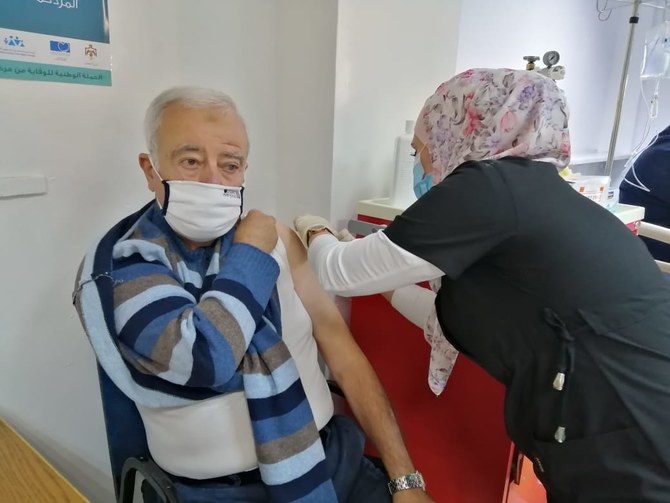
An elderly man receives a vaccination against COVID-19 in Salt, Jordan. (Raed Omari)
3 / 4
Pic 3: Patients are vaccinated against COVID-19 in Salt, Jordan on the first day of the kingdom’s inoculation campaign. (Raed Omari)
4 / 4
The first injections were given at hospitals and other health care facilities, after the authorities designated 29 vaccination centers across Jordan. (AP)
Short Url
Updated 13 January 2021
Follow

Jordan begins COVID-19 vaccination drive as physician, 87, gets first jab

  • Dawood Hanania urges Jordanians to follow suit to help country bring virus cases under control
  • Around 68,000 people will receive vaccine in campaign’s first phase

AMMAN: An 87-year-old former army physician on Wednesday received the first shot in Jordan’s coronavirus disease (COVID-19) vaccination program.

Retired Lt. Gen. Dawood Hanania was given his jab at 8 a.m. at a vaccination center in the Jubaihah neighborhood of the capital Amman, signaling the start of a mass immunization effort to curb the spread of the virus that has killed more than 4,000 people in Jordan.

Hanania, a former Royal Medical Services director, told national news agency Petra: “Jordanians are now en route out of the pandemic.” He said that after consulting with international research centers and had been “strongly” advised to take the vaccine.

In preparation for the rollout of its vaccination program, Jordan launched an online platform for people to register for jabs.

Brig. Gen. Mazen Faraiah, head of the department responsible for COVID-19-related issues at the National Center for Security and Crisis Management, said 68,000 people would receive the vaccine in the campaign’s first phase, adding that 201,144 had already registered for the jab.

Health officials are aiming to inoculate about 2 million of Jordan’s 10 million population through the nationwide vaccination drive.

“The campaign is progressing steadily and smoothly,” said Health Minister Nathir Obeidat, adding that around 5,000 people every day would receive shots at the country’s 29 vaccination centers. Previously the minister said that the elderly, doctors, and nurses would be first in line for the vaccine.

Obeidat recently pointed out that Jordan’s Prime Minister Bisher Al-Khasawneh and several other members of the government had received the China-UAE Sinopharm vaccine during its testing phase.

“The vaccines that have been bought for the vaccination campaign in the Kingdom are all safe and effective … I myself took the vaccine,” he said, urging more Jordanians to come forward.

Jordan received its first shipments of Sinopharm on Saturday and the Pfizer-BioNTech COVID-19 vaccine on Monday – the two vaccines so far approved by the Jordan Food and Drug Administration for emergency use.

Obeidat said that the amounts of contracted COVID-19 vaccines would be enough to treat 20 percent of the country’s population, and that there was no ceiling for ordering more if the demand was there. In December, he noted that the vaccine would be given free of charge to foreign residents as well as Jordanians.

Abu Ahmad, who is in his 70s and received the COVID-19 vaccine at a center in Salt city, about 15 km west of Amman, told Arab News: “I feel safer now after taking the shot. I want to live the remaining years of my life with no fear of the corona.”

Jordan has to date recorded 309,846 COVID-19 cases and 4,076 virus-related deaths.


Iraq begins closing Al-Hol camp, 19,000 citizens return home

Updated 8 sec ago
Follow

Iraq begins closing Al-Hol camp, 19,000 citizens return home

  • About 3,000 Iraqis still remain in Al-Hol
  • The camp currently houses around 60,000 people of various nationalities, most of them women and children linked to Daesh fighters

DUBAI: Iraq said it has begun dismantling the Al-Hol camp in northeast Syria, repatriating thousands of its citizens as part of efforts to prevent the site from being used to promote extremist ideology, state news agency INA reported on Wednesday.
The Ministry of Migration and Displacement said around 19,000 Iraqis returned from Al-Hol to their former areas of residence and were reintegrated into local communities, with no security incidents recorded.
Karim Al-Nouri, undersecretary at the ministry, said returnees were subjected to screening and vetting before their transfer to the Al-Amal Community Rehabilitation Center in Al-Jada’a, south of Mosul in Iraq.
“The Ministry of Migration and Displacement is not concerned with security aspect,” Al-Nouri said, adding terrorism cases are handled separately by judiciary.
He said senior Daesh militants recently transferred to Iraq were brought from prisons run by the US-backed Syrian Democratic Forces (SDF), and not from Al-Hol camp.
The most recent group of returnees consists of 281 families, marking the 31st batch received by Iraq so far.
Officials described Al-Hol as a potential security threat, saying the camp has been exploited in the past as a recruitment hub for Daesh and a center for spreading extremism.
The camp currently houses around 60,000 people of various nationalities, most of them women and children linked to Daesh fighters.
Iraqi returnees receive psychological, medical and social support at the Al-Amal center, with assistance from international organizations and the Iraqi health ministry, before returning to their communities, according to the ministry. Those found to have committed crimes are referred to courts.
Al-Nouri said about 3,000 Iraqis still remain in Al-Hol. He added Iraqi detainees are also held in other prisons in Syria, with their cases requiring follow-up by the Ministry of Foreign Affairs.