Lebanon begins new lockdown amid surge in coronavirus cases

1 / 3
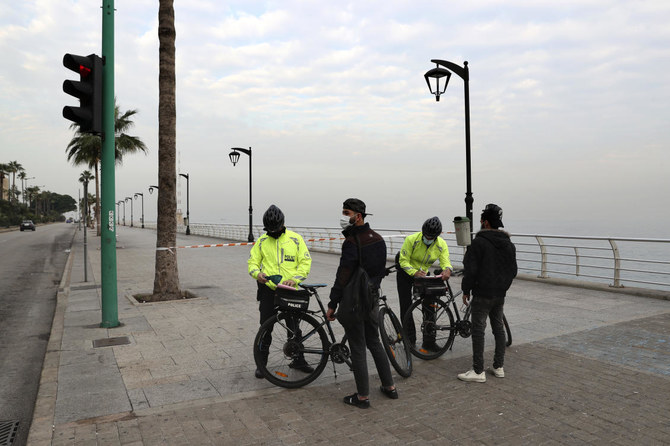
Police issue fines to civilians violating health safety measures on the waterfront promenade in Beirut, Lebanon, Thursday, Jan. 7, 2021. (AP)
2 / 3
A view of Beirut's waterfront promenade sits deserted as Lebanon starts a new lockdown amid a record post-holiday surge of new coronavirus cases on Thursday, Jan. 7, 2021. (AP)
3 / 3
A policeman books a driver for having violated the lockdown imposed by the authorities in a bid to slow the spread of the coronavirus, in the town of Antelias, east of the Lebanese capital Beirut, on January 7, 2021. (AFP)
Short Url
Updated 07 January 2021
Follow

Lebanon begins new lockdown amid surge in coronavirus cases

  • The lockdown in Lebanon is the third since the first case was reported in late February
  • As of Thursday, a daily 6 p.m. to 5 a.m. curfew takes effect that will last until Feb. 1

BEIRUT: Lebanon began a 25-day nationwide lockdown Thursday to limit the spread of the coronavirus as infections hit a record in the tiny Mediterranean nation and patients overwhelm the health care sector.
In Israel, the government prepared for a two-week shutdown as the country’s infection rate soars.
The lockdown in Lebanon is the third since the first case was reported in late February. It closes most businesses and limits traffic by imposing an odd and even license plate rule on alternating days. It also reduces the number of flights at the country’s only international airport.
As of Thursday, a daily 6 p.m. to 5 a.m. curfew takes effect that will last until Feb. 1.
On Wednesday, Lebanon broke its single-day record of new coronavirus infections on the eve of the lockdown with 4,166 cases reported in 24 hours.
It came after a holiday season in which tens of thousands of visitors flying into the country to celebrate Christmas and New Year’s. Lebanon also reported 21 new coronavirus deaths Wednesday, bringing the number of total coronavirus cases in the small Mediterranean country to nearly 200,000, with more than 1,500 deaths.
“The best way to limit the spread is to stay at home,” outgoing Health Minister Hamad Hassan told the local LBC TV station.
In Beirut’s commercial Hamra district, many shops were closed Thursday morning as police patrols drove by to make sure the lockdown was implemented. Police checkpoints fined motorists who violated the lockdown orders.
First responders in the country hit by a severe economic crisis say they have been transporting nearly 100 patients a day to hospitals that are now reporting near-full occupancy in beds and intensive care units.
Lebanon saw new infections begin to increase during the summer, following a massive explosion in Beirut’s port in August that shook the city and its heath sector, killing over 200 people and injuring 6,000. August’s numbers increased by over 300% from July as a result and have been climbing since.
The new lockdown comes as Lebanon was already struggling with an unprecedented economic and financial crisis that has caused it to default on debt and sent its local currency plunging, losing 80% of its value to the dollar.
The shortage of hard currency in Lebanon has severely curbed imports to the import-dependent country, including medicine and medical supplies. Many medicines are missing at pharmacies as the crisis worsens.
Israel’s government Thursday finalized a series of strict lockdown measures as the country’s infection rate has soared in recent weeks.
For two weeks starting Thursday night, Israeli schools and all non-essential businesses will shut down, gatherings will be restricted to five persons indoors and 10 outdoors, and movement and travel abroad restricted.
Israel has recorded over 466,000 cases of the coronavirus and at least 3,527 deaths, according to the health ministry. The number of serious COVID-19 cases has steadily risen in the past month, even as Israel started rolling out vaccines to high risk populations, including health care workers and the elderly.
Israeli Health Minister Yuli Edelstein wrote on Twitter on Thursday that the country had already vaccinated nearly 1.6 million citizens, over 17% of the population.
In Egypt, Coptic Orthodox Christians were barred from attending Mass on Christmas Eve as the country fights a surge in coronavirus cases.
The church canceled celebrations around the country and allowed only a limited number of clerics at Midnight Mass on the eve of Orthodox Christmas. Copts celebrate Christmas according to the Julian calendar, meaning it falls on Jan. 7.
Egypt has reported more than 145,000 confirmed coronavirus cases, including nearly 8,000 deaths. However, the actual number of COVID-19 cases in Egypt is thought to be far higher, mostly due to limited testing and uncounted patients treated at home or in private hospitals.


White House names some leaders with roles in next steps in Gaza, while Palestinian committee meets

Updated 14 sec ago
Follow

White House names some leaders with roles in next steps in Gaza, while Palestinian committee meets

  • Blair is a controversial choice in the Middle East because of his role in the 2003 invasion of Iraq, and Trump himself said last year that he wanted to make sure he was an “acceptable choice to everybody”
  • The plan’s second phase is now underway, though clouded by allegations of aid shortages and violence

CAIRO: The White House released the names of some of the leaders who will play a role in overseeing next steps in Gaza after the Palestinian committee set to govern the territory under US supervision met for the first time Friday in Cairo.
The committee’s leader, Ali Shaath, an engineer and former Palestinian Authority official from Gaza, pledged to get to work quickly to improve conditions. He expects reconstruction and recovery to take about three years and plans to focus first on immediate needs, including shelter.
“The Palestinian people were looking forward to this committee, its establishment and its work to rescue them,” Shaath said after the meeting, in a television interview with Egypt’s state-owned Al-Qahera News.
US President Donald Trump supports the group’s efforts to govern Gaza after the two-year war between Israel and Hamas. Israeli troops withdrew from parts of Gaza after the ceasefire took effect on Oct. 10, while thousands of displaced Palestinians have returned to what is left of their homes.
Now, there will be a number of huge challenges going forward, including the deployment of an international security force to supervise the ceasefire deal and the difficult process of disarming Hamas.
Under Trump’s plan, Shaath’s technocratic committee will run day-to-day affairs in Gaza under the oversight of a Trump-led “Board of Peace,” whose members have not yet been named.
White House names some officials to oversight boards
The White House said an executive board will work to carry out the vision of the Board of Peace.
The executive board’s members include US Secretary of State Marco Rubio, Trump envoy Steve Witkoff, Trump’s son-in-law Jared Kushner, former British Prime Minister Tony Blair, Apollo Global Management CEO Marc Rowan, World Bank President Ajay Banga, and Trump’s deputy national security adviser Robert Gabriel.
Nickolay Mladenov, a former Bulgarian politician and UN Mideast envoy, is to serve as the executive board’s representative overseeing day-to-day matters.
The White House also announced the members of another board, the “Gaza Executive Board,” which will work with Mladenov, the technocratic committee and the international stabilization force.
Witkoff, Kushner, Blair, Rowan and Mladenov will also sit on that board. Additional members include: Turkish Foreign Minister Hakan Fidan; Qatari diplomat Ali Al-Thawadi; Hassan Rashad, director of Egypt’s General Intelligence Agency; Emirati minister Reem Al-Hashimy; Israeli businessman Yakir Gabay; and Sigrid Kaag, the Netherlands’ former deputy prime minister and a Mideast expert.
Death of boy mourned in the West Bank
In the West Bank, friends and relatives gathered Friday to mourn the death of a 14-year-old Palestinian boy killed by Israeli forces.
The Palestinian Health Ministry, which confirmed his death, said Mohammad Na’san was the first child killed by the army in the occupied West Bank in 2026.
Residents said Israeli forces fired stun grenades and tear gas in an unprovoked attack. Israel’s military said in a statement that the incursion came after Palestinians had hurled rocks at Israelis and set tires aflame.
“There was gunfire directed at citizens and farmers, the most dangerous of which occurred during the storming of the village as people were leaving the mosques. The streets were crowded with the elderly, children, women, and elders, and they began firing relentlessly,” said Ameen Abu Aliya, head of the Al-Mughayyir village council.
The death was the latest episode of violence to hit Al-Mughayyir, a village east of Ramallah that has become a flashpoint in the West Bank. Much of the community’s agricultural land falls under Israeli military control.
Early this year, settlers and Israeli military bulldozers destroyed olive groves in the area, saying they were searching for Palestinian gunmen. A children’s park in Al-Mughayyir was also demolished.
In 2025, 240 Palestinians — including 55 children — were killed by Israeli forces or settlers in the West Bank, while Palestinians killed 17 Israelis — including one child — in the region, according to the United Nations.
Meanwhile, two children were killed Friday in Gaza, a 7-year-old girl and a 16-year-old boy. They were killed in Beith Lahiya, near the Yellow Line, and their bodies taken to Al-Shifa Hospital, the hospital said. No further details were immediately available.