

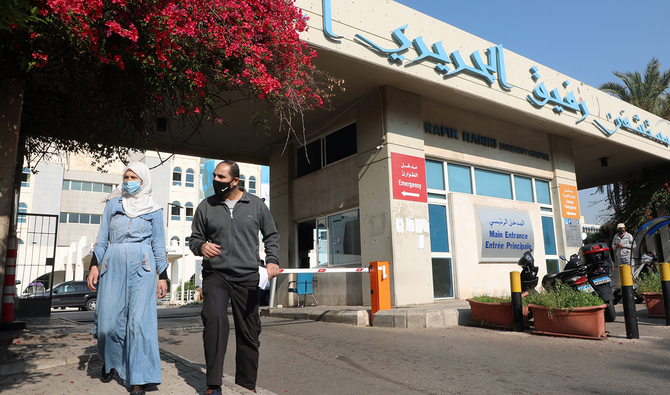

BEIRUT: Lebanon’s health system is on the brink of collapse as the country begins a 25-day nationwide lockdown to battle a record surge in coronavirus infections.
The lockdown starting on Thursday — the country’s fourth in just over 10 months — follows a dramatic spike in the infection rate, with 3,620 cases reported in a single day, the highest number since the outbreak began in late February, 2020.
Amid growing alarm at the deteriorating situation, health officials warned that hospitals are running out of beds and intensive care facilities are being overwhelmed.
Pharmacists also told Arab News that stocks of drugs and medicines required to treat coronavirus patients are running low because of the rising demand.
The daily curfew will last until Feb. 1, and will run from 6 p.m. until 5 a.m.
Health Minister Hamad Hassan warned that those who breach the lockdown will legal action as well as fines.
“The pandemic challenge has become a danger to the lives of Lebanese as hospitals are no longer able to provide beds,” he said.
Coronavirus cases more than doubled in Lebanon after the government relaxed preventive measures during the holiday season, hoping the move would deliver a boost to the country’s battered economy.
Around 3,000 new virus cases have been recorded each day for the past week, bringing the total since last February to almost 193,000, with almost 1,500 deaths.
Private hospitals have been urged to join the national response, with Maronite Patriarch Bechara Boutros Al-Rai calling on administrators to “prepare the necessary rooms and suites for coronavirus patients.”
However, several private hospitals in Lebanon claimed that the government was unwilling to pay money it already owed for the treatment of patients.
FASTFACT
Emergency wards are full, there is a shortage of COVID-19 medicines, and doctors are urging patients to stay home unless their situation is critical.
A number of doctors and nurses also complained that they were being overworked at the same time as the value of their income, which is in Lebanese pounds, declined.
Director of the Rafik Hariri University Hospital in Beirut, Dr. Firas Al-Abyad, said that he feared the situation would worsen.
“For the first time since the virus began spreading, more than 30 percent of the PCR tests conducted at the hospital in one day returned positive results. That means there will be higher numbers of cases in coming weeks.”
Assem Araji, head of the parliamentary health committee, described the situation as “very alarming,” saying that hospitals had run out of beds.
“If we want to reduce the number of cases, the lockdown must be strictly enforced,” he told Arab News.
President Michel Aoun this week announced that a contract had been signed with Pfizer for the purchase of COVID-19 vaccines.
Secretary-General of the Lebanese Red Cross, Georges Kettaneh, said that emergency teams were taking about 100 coronavirus patients to hospital every day.
Hospitals in Beirut and Mount Lebanon were full, including emergency wards. “There are also waiting lists,” he said.
Doctors urged patients through local television channels to avoid visiting hospital unless they suffer severe shortness of breath. Patients were advised to keep oximeters at home to monitor their oxygen levels.
Meanwhile, private and government laboratories have been overwhelmed by hundreds of people waiting for PCR tests.
Nurse Hussain Ayoub told Arab News that some people seeking tests wanted to travel abroad, but mostly it is “those who have been to New Year’s Eve parties and want reassurance after reports of an infection.”
Many factory owners have said that they will ignore caretaker Industry Minister Imad Hoballah’s order to shut down next Monday.
Professional unions also called on authorities to exempt them from complete closure and to avoid “punishing grassroots groups and low-income people.”
However, Araji said that medical and nursing staff are the largest segment affected by the virus, “and their fears for their health and the health of their families is valid.”
“Lebanon is in a state of general mobilization. There is a pandemic, and we have no option but to face it. Hospitals cannot relax and professional unions cannot violate decisions. Compliance with the lockdown must be unhesitating,” he said.
Pharmacist Samer Soubra told Arab News that stocks of antibiotics, vitamin C, cortisone and zinc used to treat patients are running low as pharmacies face growing pressure on already limited supplies.


