

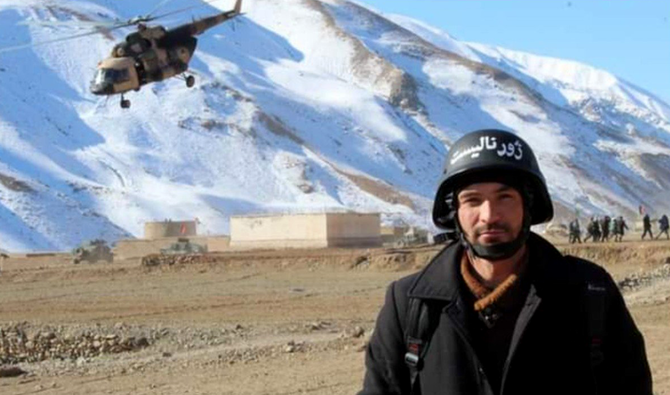
Afghan journalists decry lack of protection against attacks

Bismillah Adil Aimaq
Short Url
Updated 02 January 2021
Follow

Afghan journalists decry lack of protection against attacks

  • Bismillah Adil Aimaq, editor in chief of Sada-e-Ghor radio station, was shot dead by gunmen on Friday evening
  • Six journalists have been killed in Afghanistan in less than two months

KABUL: Afghan media workers on Saturday called on the government for more protection, a day after a sixth journalist was killed in the country in less than two months.

Bismillah Adil Aimaq, editor in chief of Sada-e-Ghor radio station, was shot dead by gunmen near Firoz Koh, the capital of Ghor province, on Friday. He recently told the authorities that his life was in danger after two assassination attempts last year.

“In the past two months six journalists and media workers have been murdered in targeted killings and continuation of this trend will mean the end of one of the main achievements of Afghanistan which is freedom of expression and media in the country,” the Afghan Journalists Safety Committee said in a statement on Saturday.

The committee called on the government to “seriously pursue the case of Mr. Adil’s killing and to come up with a clear answer to the media community in Afghanistan.”

In a protest against the lack of protection, Kabul Press Club announced on Saturday that its members would stop publishing government news for three days.

NAI, a media watchdog in Afghanistan, said the government must respond because Adil had complained to officials that his life was in danger.

Asila Ahmadzai, a senior journalist with local news agency Farhat, told Arab News that the surge in the number of killings of journalists has been a “shock to media in Afghanistan and reduced journalists’ confidence in government.”

“Some of them are thinking of abandoning this profession since the government fails to take action when a journalist files a case about a threat against him,” she said.

“The government has the responsibility to protect its nationals, especially when someone comes up and complains about threats,” leading journalist and activist Najiba Ayoubi said.

A spokesman for President Ashraf Ghani’s National Security Council, Rahmatullah Andar, said that the government had set up a unit for journalist protection and that Adil traveled to Ghor despite disapproval from authorities.

No group has claimed responsibility as of Saturday, but Ghani blamed the Taliban for the killing.

“The Taliban and other terrorist groups cannot suffocate the voice of journalists and media workers by launching such attacks,” he said in a statement on Friday night.

The Taliban could not be reached for comment, but the group had several times distanced itself from similar incidents.

“The killings of journalists have created a deep atmosphere of mistrust here because no one has taken credit for them,” Shafiq Haqpal, an analyst, said.

“The killers could be militants, spoilers of the peace, mafia, drug lords and officials because journalists have been exposing corruption cases both inside and outside the government,” he said.


UAE outlines approach to AI governance amid regulation debate at World Economic Forum

Updated 22 January 2026
Follow

UAE outlines approach to AI governance amid regulation debate at World Economic Forum

  • Minister of State Maryam Al-Hammadi highlights importance of a robust regulatory framework to complement implementation of AI technology
  • Other experts in panel discussion say regulators should address problems as they arise, rather than trying to solve problems that do not yet exist

DUBAI: The UAE has made changes to 90 percent of its laws in the past four years, Maryam Al-Hammadi, minister of state and the secretary-general of the Emirati Cabinet, told the World Economic Forum in Davos on Wednesday.

Speaking during a panel discussion titled “Regulating at the Speed of Code,” she highlighted the importance of having a robust regulatory framework in place to complement the implementation of artificial intelligence technology in the public and private sectors.

The process of this updating and repealing of laws has driven the UAE’s efforts to develop an AI model that can assist in the drafting of legislation, along with collecting feedback from stakeholders on proposed laws and suggesting improvements, she said.

Although AI might be more agile at shaping regulation, “there are some principles that we put in the model that we are developing that we cannot compromise,” Al-Hammadi added. These include rules for human accountability, transparency, privacy and data protection, along with constitutional safeguards and a thorough understanding of the law.

At this stage, “we believe AI can advise but still (the) human is in command,” she said.

Authorities in the UAE are aiming to develop, within a two-year timeline, a shareable model to help other nations learn and benefit from its experiences, Al-Hammadi added.

Argentina’s minister of deregulation and state transformation, Federico Sturzenegger, warned against overregulation at the cost of innovation.

Politicians often react to a “salient event” by overreacting, he said, describing most regulators as “very imaginative of all the terrible things that will happen to people if they’re free.”

He said that “we have to take more risk,” and regulators should wait to address problems as they arise rather than trying to create solutions for problems that do not yet exist.

This sentiment was echoed by Joel Kaplan, Meta’s chief global affairs officer, who said “imaginative policymakers” often focus more on risks and potential harms than on the economic and growth benefits of innovation.

He pointed to Europe as an example of this, arguing that an excessive focus on “all the possible harms” of new technologies has, over time, reduced competitiveness and risks leaving the region behind in what he described as a “new technological revolution.”