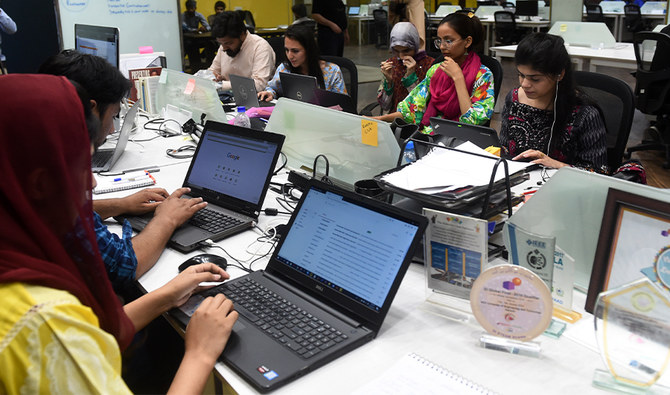
KARACHI: Pakistan’s improving global image and a maturing Information Technology (IT) sector are translating into export growth for information technology (IT) and related services, which surged by 39 percent to $763 million in the first five months of the current fiscal year, officials and industry insiders said.
Pakistan’s IT and IT-related services exports posted an increase of 51 percent, to $168 million, in the month of November 2020 alone, as compared to $111 million in the corresponding month of the last fiscal year, central bank data showed.
On an annual basis, Pakistan’s IT sector exports increased by 39 percent to $763 million in the July to November period of the current fiscal year as compared with $549 million in the same period last year. In the last fiscal year, IT related exporters were recorded at $1.4 billion.
Experts and industry officials say the growth in exports reflects the country’s improving global image as well as a maturing IT industry.
“The IT exports are on the rise because of the improving perception of Pakistan as a global player and surge in need based work during COVID-19,” said Badar Khushnood, a member of the government’s National e-Commerce Council. “Pakistani IT talent is also improving.”
Minister for Information Technology and Telecommunications Aminul Haque told media this month that the number of IT companies in Pakistan increased to 2,354 by the end of June compared to 1,762 in June 2018. He said Pakistan’s exports of information technology and enabled-services were expected to reach $1.2 billion by the end of the current fiscal year compared to $831.4 million a year earlier.
Najeeb Ghauri, Global CEO and Chairman of Netsol Technologies, told Arab News one of the reasons for growth was the maturity of the IT industry.
“[Pakistan’s] IT industry is 30 years in the making,” he said. “IT industry is on the move and is very bullish. Now we see very mature products and services being offered from Pakistan.”
Major IT related products coming out of Pakistan include customized software development across multiple industries, call centers, business process outsourcings (BPOs), consulting for IT services, system integrators and solution providers, global tech support centers, game development and mobile apps and creative services.
Some of Pakistan’s major IT players with global outreach are Afiniti, Netsol and KeepTruckin. Major services and BPO companies include Arbisoft, Systems Limited, Venture Dive, Techlogix, Infotech and TRG.
“Ninety percent of our exports are services based and very few global products are a part of the mix,” said Shehryar Hydri, an IT consultant and former secretary general of Pakistan Software Houses Association (P@SHA). “Most of the earnings are through remote teams, developers hired as consultants and offshore back offices for larger companies in the EU and North America.”
Pakistan’s ministry of commerce said in a statement issued last week that growth in the domestic market would push exports even further up in the coming quarters.
“The British American Tobacco (BAT) is going to set up its Business Shared Services organization hub— the BAT “Global Business Services” for Asia Pacific and Middle East Region— in Pakistan”, the commerce ministry said, saying this would act as a talent incubator and boost to Pakistan’s IT exports.
Many big companies already have highly organized offshore processing offices in Pakistan which are making software for them, Khushnood said.
Now, experts call for non-interventionist government policies to help the IT sector grow further.
“At the government level it’s a great help for the government to leave the IT industry alone without interference,” Ghauri said. “We have a tax holiday on export revenue. New zones are being established to encourage new investment and new players to come benefit from our high tech resources pool.”
IT sector players are largely optimistic about the future of Pakistan, saying current technology paradigm shifts and transformation are helping Pakistan become a key player and grab global IT opportunities.
The estimated size of the IT industry is $2.6 billion and its contribution to the national economy stands at 1.4 percent of GDP, while generating domestic revenue worth $1.2 billion, according to P@SHA.
“India is six times bigger than Pakistan and its IT exports are 60 times higher than Pakistan. Our exports should be at least 10 times our current size,” Khushnood said. “We have all the talent and potential to achieve the $5 billion mark”.


Pakistan’s IT exports surge 39% amid improved global image, sector maturity
https://arab.news/mhwe3
Pakistan’s IT exports surge 39% amid improved global image, sector maturity

- IT and related exports grew to $763 million in first five months of current fiscal year compared with $549 million last year
- The estimated size of the IT industry is $2.6 billion and its contribution to the national economy stands at 1.4 percent of GDP

Death toll in Pakistan wedding suicide blast rises to six
- Attack targeted members of local peace committee in Khyber Pakhtunkhwa’s Dera Ismail Khan
- Peace committees are community-based groups that report militant activity to security forces
PESHAWAR: The death toll from a suicide bombing at a wedding ceremony in northwestern Pakistan rose to six, police said on Saturday, after funeral prayers were held for those killed in the attack a day earlier.
The bomber detonated explosives during a wedding gathering in the Dera Ismail Khan district of Khyber Pakhtunkhwa province, injuring more than a dozen, some of them critically.
“The death toll has surged to six,” said Nawab Khan, Superintendent of Police for Saddar Dera Ismail Khan. “Police have completed the formalities and registered the case against unidentified attackers.”
“It was a suicide attack and the Counter Terrorism Department will further investigate the case,” he continued, adding that security had been stepped up across the district to prevent further incidents.
No militant group has claimed responsibility for the blast so far.
Khan cautioned against speculation, citing ongoing militancy in the area, and said the investigation was being treated with “utmost seriousness.”
The explosion targeted the home of a member of a local peace committee, which is part of community-based groups that cooperate with security forces and whose members have frequently been targeted by militants in the past.
Some media reports also cited a death toll of seven, quoting police authorities.
Emergency officials said several of the wounded were taken to hospital soon after the blast.
Militant attacks have intensified in parts of Khyber Pakhtunkhwa since the Taliban returned to power in neighboring Afghanistan in 2021, with Islamabad accusing Afghan authorities of “facilitating” cross-border assaults, a charge Kabul denies.


