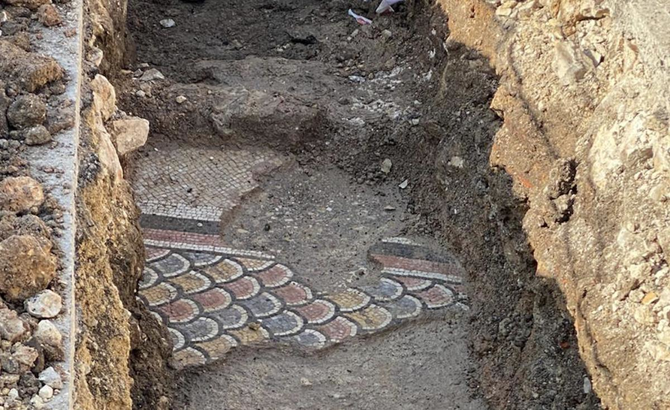
Workers uncover Roman mosaic in Baalbek market

Workers excavating a commercial market in Baalbek, northeast of Beirut, on Tuesday found a mosaic dating back to the historic city’s Roman occupation. (NNA)
Short Url
Updated 23 December 2020
Follow

Workers uncover Roman mosaic in Baalbek market

  • The two-meter-long artifact was uncovered under a municipality building by a team of workers from the Lebanese Organization for Studies and Training
  • The city’s mayor called on state authorities “to give Baalbek more care and attention”

BEIRUT: Workers excavating a commercial market in Baalbek, northeast of Beirut, on Tuesday found a mosaic dating back to the historic city’s Roman occupation between 60 B.C. and A.D. 300.
The two-meter-long artifact was uncovered under a municipality building by a team of workers from the Lebanese Organization for Studies and Training who were carrying out excavations to extend a drainage network.
A technical team from the Directorate General of Antiquities in Baalbek protected the colored mosaic with sand and special geotextile covering.
City Mayor Fouad Blog said: “Baalbek is one of the most important cities in Lebanon and, indeed, the world because of its archaeological monuments and riches dating back to the Phoenician, Roman, Greek, Byzantine, Arabic and Islamic eras.”
He called on state authorities “to give Baalbek more care and attention, and to meet our vision with a strategic plan to search for lost treasures, and highlight the cultural, human and civilizational value of the city.”
Baalbek was famous throughout the ages due to its location at the intersection of several major trading routes. The Romans built huge temples, the ruins of which are still perched on the edge of the city after an earthquake around 600 A.D. destroyed many landmarks. The Temple of Jupiter, one of the most imposing Roman sites, has only six of its original 54 columns remaining.
Dr. Jaafar Fadlallah, professor of archaeology, told Arab News: “The Lebanese should not be surprised by the antiquities that can be found in Baalbek. The extent of the ancient city is not known yet. No one knows where the graveyards of that era are located.”
He added: “The colored mosaic found on Tuesday indicates that the place was a huge hall within a Roman palace. Roman Baalbek was inhabited by many emperors, and it is rich with the distinctive architecture that surrounded the ancient temples.”
Fadlallah said that during the second half of the 20th century, the Department of Antiquities failed to stop people building on land that could be rich in antiquities.
During the civil war in the 1970s, people built on archaeological sites in violation of the law. Any excavation work “could reveal buried monuments,” he added.


UN rights chief Shocked by ‘unbearable’ Darfur atrocities

Updated 18 January 2026
Follow

UN rights chief Shocked by ‘unbearable’ Darfur atrocities

  • Mediation efforts have failed to produce a ceasefire, even after international outrage intensified last year with reports of mass killings, rape, and abductions during the RSF’s takeover of El-Fasher in Darfur

PORT SUDAN: Nearly three years of war have put the Sudanese people through “hell,” the UN’s rights chief said on Sunday, blasting the vast sums spent on advanced weaponry at the expense of humanitarian aid and the recruitment of child soldiers.
Since April 2023, Sudan has been gripped by a conflict between the army and the paramilitary Rapid Support Forces that has left tens of thousands of people dead and around 11 million displaced.
Speaking in Port Sudan during his first wartime visit, UN Human Rights commissioner Volker Turk said the population had endured “horror and hell,” calling it “despicable” that funds that “should be used to alleviate the suffering of the population” are instead spent on advanced weapons, particularly drones.
More than 21 million people are facing acute food insecurity, and two-thirds of Sudan’s population is in urgent need of humanitarian aid, according to the UN.
In addition to the world’s largest hunger and displacement crisis, Sudan is also facing “the increasing militarization of society by all parties to the conflict, including through the arming of civilians and recruitment and use of children,” Turk added.
He said he had heard testimony of “unbearable” atrocities from survivors of attacks in Darfur, and warned of similar crimes unfolding in the Kordofan region — the current epicenter of the fighting.
Testimony of these atrocities must be heard by “the commanders of this conflict and those who are arming, funding and profiting from this war,” he said.
Mediation efforts have failed to produce a ceasefire, even after international outrage intensified last year with reports of mass killings, rape, and abductions during the RSF’s takeover of El-Fasher in Darfur.
“We must ensure that the perpetrators of these horrific violations face justice regardless of the affiliation,” Turk said on Sunday, adding that repeated attacks on civilian infrastructure could constitute “war crimes.”
He called on both sides to “cease intolerable attacks against civilian objects that are indispensable to the civilian population, including markets, health facilities, schools and shelters.”
Turk again warned on Sunday that crimes similar to those seen in El-Fasher could recur in volatile Kordofan, where the RSF has advanced, besieging and attacking several key cities.
Hundreds of thousands face starvation across the region, where more than 65,000 people have been displaced since October, according to the latest UN figures.