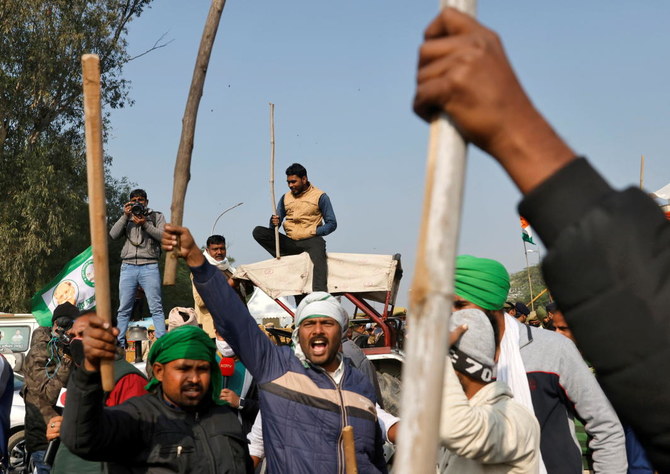
India’s Supreme Court suggests government delay farm laws

Nearly 60 percent of the Indian population depend on agriculture for their livelihoods. (Reuters)
Short Url
Updated 17 December 2020
Follow

India’s Supreme Court suggests government delay farm laws

  • Farmers have been blocking half a dozen major highways on the outskirts of New Delhi for three weeks

NEW DELHI: India’s Supreme Court on Thursday suggested that the government consider delaying implementation of new agricultural reform laws to restore a dialogue with tens of thousands of protesting farmers who say the legislation will drive down crop prices and devastate their earnings.
Chief Justice S.A. Bobde also deferred a proposal by the court to set up a mediation panel until justices receive the government’s response and hear arguments from lawyers representing the protesting farmers, possibly next week.
Attorney-General K.K. Venugopal said he will get back to the court after discussing the matter with the government.
The farmers have been blocking half a dozen major highways on the outskirts of New Delhi for three weeks and say they won’t leave until the government repeals what they call the “black laws” passed by Parliament in September.
In addition to blocking the movement of people, the massive protest has dealt a blow to manufacturing and business in northern India.
On Wednesday, justices on the court offered to set up a mediation panel after five rounds of talks between the government and farmers failed to end the impasse.
Protest leaders have rejected the government’s offer to amend some contentious provisions of the laws.
The protesting farmers say the laws will lead to the cartelization and commercialization of agriculture and make farmers vulnerable to corporate greed.
They fear the government will stop buying grain at minimum guaranteed prices and corporations will then push prices down. Prime Minister Narendra Modi’s government has said it is willing to pledge that guaranteed prices continue.
Nearly 60 percent of the Indian population depend on agriculture for their livelihoods.
The government insists the reforms will benefit farmers and says they will enable farmers to market their produce and boost production through private investment.
On Friday, a farmers’ group filed a petition with the Supreme Court seeking the repeal of the three laws. The Bharatiya Kisan Union, or Indian Farmers’ Union, argued that the laws were arbitrary because they were enacted without proper consultations with stakeholders.
A group of New Delhi lawyers has also filed a petition with the court seeking an order to the farmers to vacate the highways connecting northern states to the Indian capital.


US quits global organization dedicated to preventing violent extremism

Updated 5 sec ago
Follow

US quits global organization dedicated to preventing violent extremism

  • With other international agencies scaling back following mass US foreign aid cuts last year, GCERF said it now carries much of the global prevention burden alone, and that its $50 million annual budget had not risen to fill the growing gaps

GENEVA: A global organization dedicated to preventing violent extremism said on ​Friday the US had made a mistake in withdrawing its support while the risk of militant attacks surges in the Middle East and Africa’s Sahel.
The Global Community Engagement and Resilience Fund, which supports prevention programs across dozens of countries with communities vulnerable to extremism — appeared on Wednesday in a White House memo announcing a US pullout from 35 international agencies and 31 UN entities it said rejected US interests.
Dr. Khalid ‌Koser, head of ‌the Geneva-based GCERF, said the decision came ‌as ⁠a ​surprise and ‌without explanation and that it reflected a deeper ideological shift under US President Donald Trump’s administration away from multilateral prevention programs toward security-focused counterterrorism measures.
“I think it’s a mistake to take out that fundamental piece of prevention. But I don’t think this administration believes in prevention,” Koser told Reuters.
The White House did not immediately respond to a Reuters request for comment.
Koser said ⁠risks of extremist violence were higher than at any point since the 2011 Arab Spring ‌uprisings, citing as examples Afghanistan, the Sahel and ‍camps in northeast Syria that hold tens ‍of thousands of Daesh family members — and a new generation ‍at risk of radicalization after the Gaza war.
“If you don’t work on prevention, then in 10 years time, you’re going to have lots of terrorists and lots of problems.”
Further underlining a US repudiation of multilateral cooperation bodies under Trump’s “America ​First” policy, the White House also announced it was quitting the 30-nation Global Counterterrorism Forum.
The US helped establish GCERF’s program ⁠in northeast Syria that helps reintegrate families from former Daesh militant circles. Koser said that while GCERF’s work would go on, it was losing a major player in the US, and that Washington’s decision was perplexing given GCERF’s agenda remained relevant to US national interests.
With other international agencies scaling back following mass US foreign aid cuts last year, GCERF said it now carries much of the global prevention burden alone, and that its $50 million annual budget had not risen to fill the growing gaps.
The 2025 Global Terrorism Index issued by the Institute for Economics and Peace showed the ‌number of countries recording a terrorist attack increased from 58 to 66 in 2024, reversing nearly a decade of improvements.