

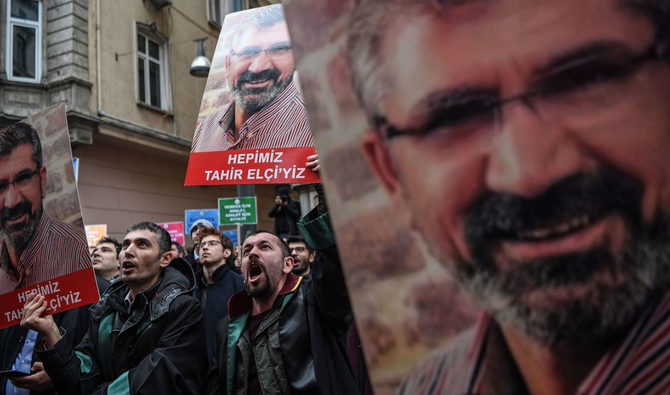

ANKARA: Kurdish lawyer and prominent human rights activist Tahir Elci’s murder remains unsolved five years after his death amid claims that intelligence neglect may have played a part in the killing.
Elci was a key figure in Turkey’s human rights movement and was also known globally for his efforts to represent human rights’ violations before the European Court of Human Rights.
Nov. 28 marks the fifth anniversary of his assassination while giving a press statement as the head of the Diyarbakir Bar Association in Turkey’s southeastern Kurdish-majority city in 2015 to protest armed clashes between security forces and the youth wing of the Kurdistan Workers’ Party (PKK).
At least 43 international lawyers and human rights organizations joined forces to demand justice for Elci and his family with a joint declaration on Nov. 27. “We are concerned that the prosecution, as well as the court before which this case is being heard, fails to respect fair trial rights. We are further troubled by the Turkish authorities’ continued violation of Turkey’s international legal obligations to carry out a prompt, effective, impartial and independent investigation into the death of one of its citizens and to ensure a fair trial by an impartial and independent tribunal for those accused of the killing of Tahir Elci,” they said.
His wife, Turkan Elci, wrote a song in Kurdish, “Hewar” (Cry), on the fifth anniversary of his death.
In an exclusive interview with Arab News, Turkan Elci said that the judicial process around her husband’s killing fitted with the general atmosphere of impunity in Turkey.
She said that the independence of the judiciary could only be ensured if it was not under the influence of the executive: “A judge must decide according to the principles of universal law, the constitution and the law, as well as according to his own conscientious opinion. But it is a very remote possibility for the Tahir Elci case.”
Elci’s lawyers continue to try to ensure that his case file, started only five years after the murder, is not closed and are calling for the identification of the real perpetrators as they believe this is no ordinary assassination.
Following his comments about the outlawed PKK, which he said was not a terror organization but an armed political movement, Elci faced a “lynching” campaign in the mainstream media up until his death.
A 13-second section of the video footage from police cameras is missing, although Elci was killed within that time frame. The police have also failed to locate the bullet that shot him.
Forensic Architecture, a London-based independent research group, examined footage of the murder and determined that the three police officers at the scene were the most likely suspects. If the three officers accused of killing Elci are convicted they will face two to nine years in prison.
According to Ayse Bingol Demir, a human rights lawyer and co-director of the Turkey Human Rights Litigation Support Project, ensuring a fair trial is extremely important for several reasons.
“First, Tahir Elci was a human rights lawyer who was killed while advocating ... for ending the violence in the Kurdish region. He was a prominent figure in the human rights community, especially known for his fight against impunity and systemic human rights violations committed by the state security forces,” she told Arab News.
For Demir, Elci’s killing in broad daylight — in the presence of the press and many others — and the failure of the judiciary to carry out an effective investigation into the incident, has had a severe impact not only on his family but the wider community in Turkey.
“Second, the main issue in this case is a violation of Tahir Elci’s right to life, one of the core rights under international human rights law. Tahir Elci’s family are entitled to the right to truth, access to justice, and an effective remedy for the violation they and their loved ones have been subject to,” she said.


