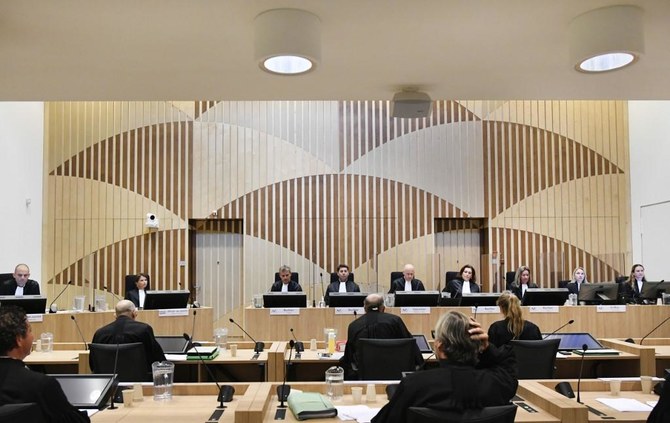
AMSTERDAM: Judges hearing the case against four defendants in the 2014 downing of Malaysia Airlines flight MH17 on Wednesday rejected a defense request for more time to investigate alternative scenarios into the crash in eastern Ukraine.
MH17 was flying from Amsterdam to Kuala Lumpur when it was shot down by a missile fired from territory held by pro-Russian rebels during fighting with Ukrainian government troops, international investigators say. All 298 people on board were killed, two-thirds of them Dutch nationals.
After years of collecting evidence, a Dutch-led international Joint Investigation team (JIT) last year said the missile launcher used to hit the civilian airplane came from a Russian army base just across the border.
The Dutch government holds Moscow responsible, and three Russians and a Ukrainian are on trial for murder. None of the suspects is in custody and only one is represented in court proceedings.
Russia has always denied involvement and has promoted a range of alternative theories, which the investigators rejected as unsupported by evidence.
Judge Hendrik Steenhuis said the defense had not provided a clear alternative scenario to investigate, while information on several other possible explanations was already part of the case file.
Steenhuis said witnesses who reported seeing the missile launcher on July 17, 2014, should be questioned again.
Judges also ruled that a new effort should be made to speak to the leader of Russia’s 53rd brigade, which has been identified by investigators as having transported the missile launcher.


![]()


Malaysia Airlines flight MH17 judges reject request to investigate alternative crash scenarios
Short Url
https://arab.news/phdmh
Malaysia Airlines flight MH17 judges reject request to investigate alternative crash scenarios
- MH17 was flying from Amsterdam to Kuala Lumpur when it was shot down by a missile fired from territory held by pro-Russian rebels


Culture being strangled by Kosovo’s political crisis
PRIZREN: Kosovo’s oldest cinema has been dark and silent for years as the famous theater slowly disintegrates under a leaky roof.
Signs warn passers-by in the historic city of Prizren that parts of the Lumbardhi’s crumbling facade could fall while it waits for its long-promised refurbishment.
“The city deserves to have the cinema renovated and preserved. Only junkies gathering there benefit from it now,” nextdoor neighbor butcher Arsim Futko, 62, told AFP.
For seven years, it waited for a European Union-funded revamp, only for the money to be suddenly withdrawn with little explanation.
Now it awaits similar repairs promised by the national government that has since been paralyzed by inconclusive elections in February.
And it is anyone’s guess whether the new government that will come out of Sunday’s snap election will keep the promise.
- ‘Collateral damage’ -
Cinema director Ares Shporta said the cinema has become “collateral damage” in a broader geopolitical game after the EU hit his country with sanctions in 2023.
The delayed repairs “affected our morale, it affected our lives, it affected the trust of the community in us,” Shporta said.
Brussels slapped Kosovo with sanctions over heightened tensions between the government and the ethnic Serb minority that live in parts of the country as Pristina pushed to exert more control over areas still tightly linked to Belgrade.
Cultural institutions have been among the hardest-hit sectors, as international funding dried up and local decisions were stalled by the parliamentary crisis.
According to an analysis by the Kosovo think tank, the GAP Institute for Advanced Studies, sanctions have resulted in around 613 million euros ($719 million) being suspended or paused, with the cultural sector taking a hit of 15-million-euro hit.
- ‘Ground zero’ -
With political stalemate threatening to drag on into another year, there are warnings that further funding from abroad could also be in jeopardy.
Since February’s election when outgoing premier Albin Kurti topped the polls but failed to win a majority, his caretaker government has been deadlocked with opposition lawmakers.
Months of delays, spent mostly without a parliament, meant little legislative work could be done.
Ahead of the snap election on Sunday, the government said that more than 200 million euros ($235 million) will be lost forever due to a failure to ratify international agreements.
Once the top beneficiary of the EU Growth Plan in the Balkans, Europe’s youngest country now trails most of its neighbors, the NGO Group for Legal and Political Studies’ executive director Njomza Arifi told AFP.
“While some of the countries in the region have already received the second tranches, Kosovo still remains at ground zero.”
Although there have been some enthusiastic signs of easing a half of EU sanctions by January, Kurti’s continued push against Serbian institutions and influence in the country’s north continues to draw criticism from both Washington and Brussels.
- ‘On the edge’ -
Across the river from the Lumbardhi, the funding cuts have also been felt at Dokufest, a documentary and short film festival that draws people to the region.
“The festival has had to make staff cuts. Unfortunately, there is a risk of further cuts if things don’t change,” Dokufest artistic director Veton Nurkollari said.
“Fortunately, we don’t depend on just one source because we could end up in a situation where, when the tap is turned off, everything is turned off.”
He said that many in the cultural sector were desperate for the upcoming government to get the sanctions lifted by ratification of the agreements that would allow EU funds to flow again.
“Kosovo is the only one left on the edge and without these funds.”
Signs warn passers-by in the historic city of Prizren that parts of the Lumbardhi’s crumbling facade could fall while it waits for its long-promised refurbishment.
“The city deserves to have the cinema renovated and preserved. Only junkies gathering there benefit from it now,” nextdoor neighbor butcher Arsim Futko, 62, told AFP.
For seven years, it waited for a European Union-funded revamp, only for the money to be suddenly withdrawn with little explanation.
Now it awaits similar repairs promised by the national government that has since been paralyzed by inconclusive elections in February.
And it is anyone’s guess whether the new government that will come out of Sunday’s snap election will keep the promise.
- ‘Collateral damage’ -
Cinema director Ares Shporta said the cinema has become “collateral damage” in a broader geopolitical game after the EU hit his country with sanctions in 2023.
The delayed repairs “affected our morale, it affected our lives, it affected the trust of the community in us,” Shporta said.
Brussels slapped Kosovo with sanctions over heightened tensions between the government and the ethnic Serb minority that live in parts of the country as Pristina pushed to exert more control over areas still tightly linked to Belgrade.
Cultural institutions have been among the hardest-hit sectors, as international funding dried up and local decisions were stalled by the parliamentary crisis.
According to an analysis by the Kosovo think tank, the GAP Institute for Advanced Studies, sanctions have resulted in around 613 million euros ($719 million) being suspended or paused, with the cultural sector taking a hit of 15-million-euro hit.
- ‘Ground zero’ -
With political stalemate threatening to drag on into another year, there are warnings that further funding from abroad could also be in jeopardy.
Since February’s election when outgoing premier Albin Kurti topped the polls but failed to win a majority, his caretaker government has been deadlocked with opposition lawmakers.
Months of delays, spent mostly without a parliament, meant little legislative work could be done.
Ahead of the snap election on Sunday, the government said that more than 200 million euros ($235 million) will be lost forever due to a failure to ratify international agreements.
Once the top beneficiary of the EU Growth Plan in the Balkans, Europe’s youngest country now trails most of its neighbors, the NGO Group for Legal and Political Studies’ executive director Njomza Arifi told AFP.
“While some of the countries in the region have already received the second tranches, Kosovo still remains at ground zero.”
Although there have been some enthusiastic signs of easing a half of EU sanctions by January, Kurti’s continued push against Serbian institutions and influence in the country’s north continues to draw criticism from both Washington and Brussels.
- ‘On the edge’ -
Across the river from the Lumbardhi, the funding cuts have also been felt at Dokufest, a documentary and short film festival that draws people to the region.
“The festival has had to make staff cuts. Unfortunately, there is a risk of further cuts if things don’t change,” Dokufest artistic director Veton Nurkollari said.
“Fortunately, we don’t depend on just one source because we could end up in a situation where, when the tap is turned off, everything is turned off.”
He said that many in the cultural sector were desperate for the upcoming government to get the sanctions lifted by ratification of the agreements that would allow EU funds to flow again.
“Kosovo is the only one left on the edge and without these funds.”
Latest updates


© 2025 SAUDI RESEARCH & PUBLISHING COMPANY, All Rights Reserved And subject to Terms of Use Agreement.