ISLAMABAD: The French Ministry of Europe and Foreign Affairs on Sunday issued a strong rebuke to a tweet by Pakistan’s minister for human rights, Shireen Mazari, in which the minister compared certain measures in President Emmanuel Macron’s newly issued ‘Charter of Republican Values’ to racism in Nazi Germany.
On Wednesday, Macron unveiled the charter and asked Muslim leaders in France to agree to its instructions as part of a broad clampdown on Islamic extremism. The French President gave the French Council of the Muslim Faith 15 days to work with the interior ministry.
As part of the charter that seeks to prevent ‘radicalization’ in the wake of three recent militant attacks in France, there are restrictions on home-schooling among other measures. An identification number is to be assigned to all children of school-going age under the law, to ensure they are attending school.
Coverage of the charter was widely interpreted on social media as saying identification numbers would be issued exclusively to Muslim children, and drew the ire of numerous Pakistanis on Twitter.
The human rights minister too referred to an incorrect quotation from the charter in an article by online news platform ‘The Muslim Vibe,’ which has since then been retracted and clarified.
On Saturday, Mazari tweeted, “Macron is doing to the Muslims what the Nazis did to the Jews-- Muslim children will get ID numbers (other children won’t) just as jews were forced to wear the yellow star on their clothes for identification.”
In response to Mazari, the French foreign affairs ministry issued a statement that was tweeted by the French embassy in Pakistan, calling the minister’s words “insulting...blatant lies, loaded with an ideology of hatred and violence.”
The strongly worded statement, a deviation from standard diplomatic norms, asked Pakistan to “return to the path of dialogue based on respect.”
On Sunday evening, Mazari tweeted a message from the French ambassador clarifying that the Muslim Vibe article she had referenced earlier had been rectified.
“...As the article I had cited has been corrected by the relevant publication, I have also deleted my tweet on the same,” Mazari said on Twitter.
Sunday’s heated exchange is the latest in rising Pakistan-France tensions. Last week, massive protests in Pakistan called for the expulsion of the French ambassador and the boycotting of French goods.
Last month, in the wake of new violence that erupted amid Macron’s defence of caricatures of the Prophet Muhammad (peace be upon him), Prime Minister Imran Khan wrote a letter slamming what he termed the French President’s ‘anti-Muslim’ stance.


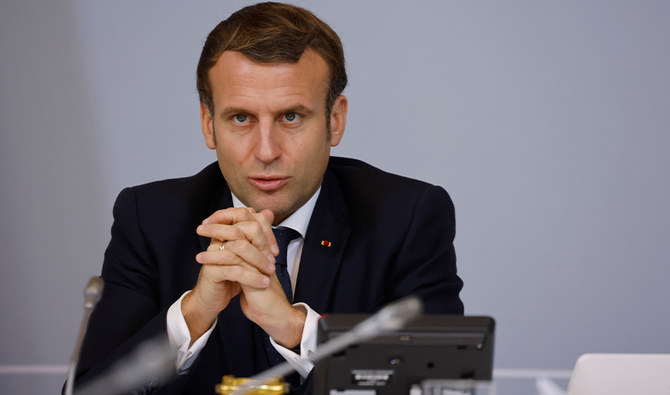
France issues strong condemnation to Pakistani minister’s 'insulting' tweet
https://arab.news/9mqkw
France issues strong condemnation to Pakistani minister’s 'insulting' tweet

- Coverage of Macron’s charter was widely understood as saying an ID number would be issued exclusively to Muslim children
- Pakistan’s human rights minister compared France's new laws to anti-semitism in Nazi Germany in a tweet that has since been deleted

Pakistan says inflation to remain within 5-6 percent range in January
- Current account projected to remain in deficit, says Finance Division in monthly economic outlook
- Pakistan suffered a financial crisis in 2023, marked by inflation of 38 percent, depleted forex reserves
KARACHI: Inflation is expected to remain within the 5-6 percent range in January, Pakistan’s Finance Division said in its monthly economic outlook report on Tuesday, saying that the country’s economy is well positioned to sustain growth momentum in FY2026.
Consumer Price Index (CPI) inflation was recorded at 5.6 percent year-on-year (YoY) basis in December 2025 as compared to 6.1 percent in November 2025 and 4.1 percent in December 2024.
“Inflation is expected to remain within the range of 5.0-6.0 percent in January,” the Finance Division said.
“On the external front, the current account is projected to remain in a deficit; however, robust remittance inflows and steady performance in IT and services exports are likely to cushion external pressures.”
The report said that the “positive trajectory” of the economy reflects the impact of the government’s prudent policies, ongoing structural reforms and easing of monetary conditions due to subsiding inflationary pressures.
Earlier, Pakistan’s finance ministry adviser Khurram Schehzad said S&P Global Market Intelligence’s latest macroeconomic forecast for Pakistan broadly aligns with projections issued by the State Bank of Pakistan, signaling easing inflation, manageable external balances and a gradual recovery in economic growth.
The assessment came amid stabilizing macroeconomic indicators after Pakistan went through a prolonged financial crisis marked by record inflation of 38 percent, depleted foreign exchange reserves and repeated balance-of-payments pressures, culminating in emergency support from the International Monetary Fund.
Tighter monetary policy, fiscal consolidation and external financing have since helped stabilize prices and ease pressure on the external account, prompting more measured assessments from international credit rating agencies.
“S&P’s projections broadly align with SBP’s outlook, with slight differences on growth and the current account but a shared assessment of easing inflation and gradual economic improvement,” Schehzad said in a statement.
According to S&P, inflation is expected to average 5.1 percent in 2026 and edge up slightly to 5.6 percent in 2027, staying within the SBP’s projected range of 5 percent to 7 percent over the next two years.
On the external front, S&P forecast a current account deficit of 0.5 percent of gross domestic product in 2026, broadly in line with the central bank’s expectation that the deficit will remain between 0 percent and 1 percent of GDP in the fiscal year.
Economic growth is projected to strengthen gradually, with S&P forecasting real GDP growth of 3.5 percent in fiscal year 2026, rising to 4.4 percent the following year. The SBP has projected growth of 3.75 percent to 4.75 percent for FY26.
Both S&P and SBP projections echo the government’s assessment that macroeconomic conditions are stabilizing, as Pakistan seeks to attract foreign investment and push toward export-led growth.


