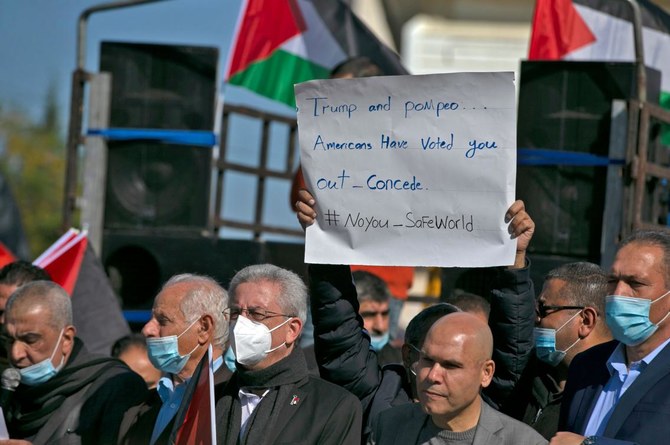
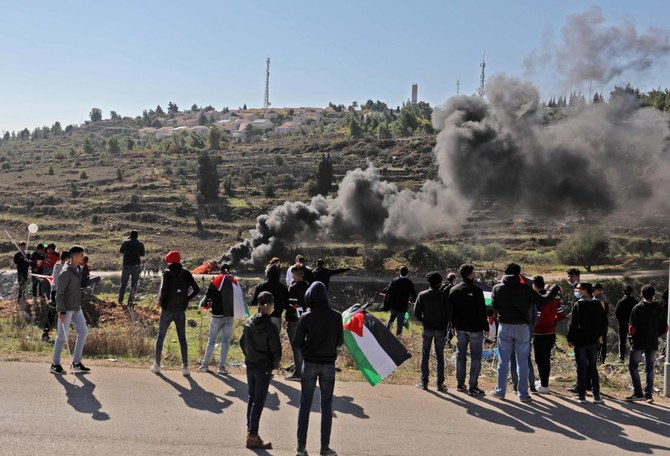
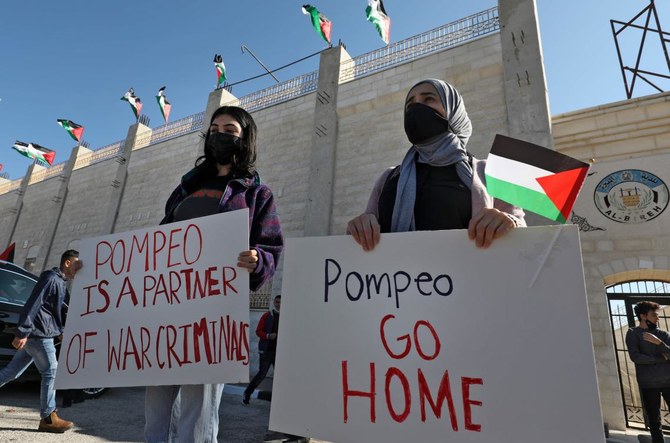
AMMAN: A group of US citizens from Al-Bireh in Palestine have protested against US Secretary of State Mike Pompeo’s visit to Psagot, an Israeli settlement.
Former Al-Bireh mayor Abdel Jawwad Saleh was part of the protests, and told Arab News that the settlement “was built on citizens rightfully owned private property.”
The American-Palestinian group said in an open letter to Pompeo obtained by Arab News that they are the “legal property owners and titleholders of the land where the Israeli settlement of Psagot is built.”
The land was initially confiscated by the Israeli army for security purposes and later handed over to Israeli settlers.
Saleh, the 89-year old former mayor, lost seven dunums as part of Israeli settlement efforts. He directed harsh criticism at Pompeo, saying: “This is the land of our forefathers that your friends stole. You may drink the wine of this settlement but its grapes are the blood of Palestinians.”
The outgoing Trump-era official made an unprecedented and controversial visit to a Psagot winery that last year renamed one of their brands after Pompeo in a “show of gratitude.”
The American-Palestinian group said they “will not stop efforts to return our private property.” They also labeled Pompeo “a secretary of state not fit for office,” adding that they will pursue legal action and “hold him accountable for his actions that are facilitating the theft of private property of US citizens abroad.”
Anis F. Kassim, publisher of the Palestine Yearbook, told Arab News that Pompeo’s visit to Psagot is “an act of aggression against Palestinian rights.”
He said: “By endorsing the settlement structure and apartheid system that Israel is building in historical Palestine, the US is endorsing robbery of Palestinian land.”
Kassim called the US action “repugnant” to customary and conventional international law. “The Hague regulations and Geneva Conventions prohibit pillage by an occupying power,” he said.
In addition to the West Bank settlement visit, Pompeo plans to travel to the occupied Golan Heights that Israel annexed in 1981. In a deeply controversial move last year, the Trump administration formally recognized Israeli sovereignty over the occupied region.
Oraib Rantawi, director of the Amman-based Al-Quds Center for Political Studies, told Arab News that Pompeo’s visit is a “continuation of an attempt to normalize and legitimize settlements,” and could lead to the US “recognizing the annexation of larger settlements.”
Rantawi labeled the Trump administration’s visit as “part of gifts to the Israelis and their Zionist supporters in the US.”
Jordanian political activist Zaid Nabulsi said that the Golan Heights are “Syrian occupied and Syrian territory, regardless of what US officials say or do.”
Suhail Khalileh a settlement expert, said that the actions of any country that contravene international law and UNSC resolutions would normally be ignored.
“Khalifeh said that during the Biden era much of these actions will be referred.
“We feel that there is a huge campaign going on between the US and Palestine on the political progressive level as well as on the level of universities and municipalities.”
Ali Abunimah, one of the founders of the BDS movement, also commented on attempts by Pompeo to link the movement to antisemitism.
“This desperate tactic is a last gasp effort from a defeated administration to give Israel’s apartheid regime a parting gift. It will in no way affect the determination of Palestinians to campaign and struggle for their rights,” he told Arab News.


![]()
![]()
![]()
![]()

US-Palestine nationals denounce Pompeo visit

Short Url
https://arab.news/yubuq
US-Palestine nationals denounce Pompeo visit
- Pompeo made a controversial visit to a Psagot winery that last year renamed one of their brands after him
- The American-Palestinian group said they “will not stop efforts to return our private property”


Latest updates


© 2026 SAUDI RESEARCH & PUBLISHING COMPANY, All Rights Reserved And subject to Terms of Use Agreement.