

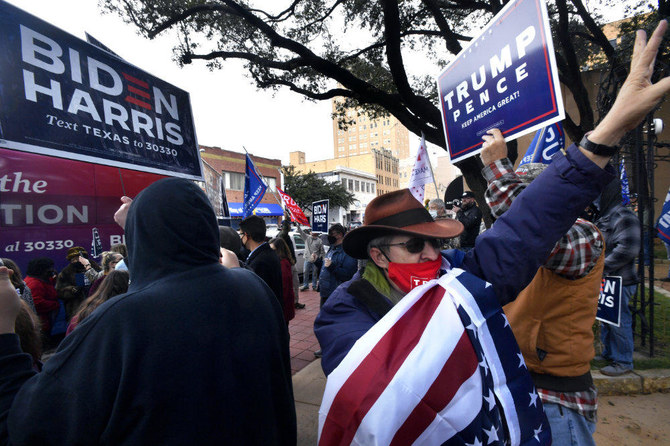
FBI probing Trump caravan confrontation with Biden campaign bus in Texas

Supporters President Donald Trump come face-to-face with Biden-Harris campaigners during a Democratic ticket stop at Vera Minter Park in Abilene, Texas, on Oct. 28, 2020.(Ronald W. Erdrich/The Abilene Reporter-News via AP)
Short Url
Updated 02 November 2020
Follow

FBI probing Trump caravan confrontation with Biden campaign bus in Texas

  • Trump explicitly embraced the action and denounced the FBI for investigating
  • Says the Texas protesters were trying to “protect” the Biden bus

WASHINGTON: The FBI said on Sunday it was investigating an incident in which a convoy of vehicles flying flags in support of President Donald Trump’s re-election bid surrounded a bus carrying campaign staff for Democratic challenger Joe Biden on a Texas highway.
Friday’s incident — captured on video that was retweeted by Trump on Saturday with the message, “I LOVE TEXAS!” — prompted the Biden campaign to cancel at least two of its Texas events as Democrats accused the president of encouraging supporters to engage in acts of intimidation.
Video footage showed a swarm of pickup trucks and SUVs bearing pro-Trump flags surrounding the Biden campaign bus as it traveled north along Interstate 35 between San Antonio and Austin.
The Biden campaign said the Trump caravan tried to force the bus to slow down and to run it off the road.
One video clip aired on CNN showed a Trump-flagged pickup swerve into the side of another vehicle traveling just behind the bus. The Texas Tribune newspaper reported that the sideswiped vehicle was being driven by a Biden campaign staffer.
During a rally in Michigan, Trump explicitly embraced the action, saying that the Texas protesters were trying to “protect” the Biden bus.

Trump himself tweeted a video of the incident late Saturday, saying, “I LOVE TEXAS.”

And he later slammed the investigation on Twitter, insisting “these patriots did nothing wrong.
“Instead, the FBI & Justice should be investigating the terrorists, anarchists, and agitators of ANTIFA, who run around burning down our Democrat run cities and hurting our people!” he said.
Democratic officials said the bus, carrying state congressional candidate Wendy Davis, stopped its journey and canceled two planned events and a news conference, citing “safety concerns.”
“We’ve never had anything like this — at least we’ve never had a president who thinks it’s a good thing,” Biden told supporters in Philadelphia Sunday.
He added that the president’s son, Donald Trump Jr, made a video urging backers to “keep it up,” and find where Biden running mate Kamala Harris is and greet her the same way.
“Folks, that’s not who we are. We are so much better than this,” Biden said.
According to the Biden campaign, staff aboard the bus called emergency-911 to report the incident, and local law enforcement responded to the calls and assisted the bus in reaching its destination.
Neither Biden nor his running mate, Senator Kamala Harris, was aboard the bus. The Texas Tribune reported that its passengers included Democratic US House of Representatives candidate and former Texas state Senator Wendy Davis.
“FBI San Antonio is aware of the incident and investigating,” special agent Michelle Lee, a spokeswoman for the Federal Bureau of Investigation in San Antonio, told Reuters in an email. “No further information is available at this time.”

Close race in Texas
The highway confrontation came as polls showed an unexpectedly tight race between Biden and Trump in Texas, which has long been a Republican stronghold.
“Rather than engage in productive conversation about the drastically different visions that Joe Biden and Donald Trump have for our country, Trump supporters in Texas instead decided to put our staff, surrogates, supporters and others in harm’s way,” Biden’s Texas campaign spokesman, Tariq Thowfeek, said in a statement. “We’ll see you on November 3rd.”
Texas Republican Party Chairman Allen West, in a statement, dismissed media reports of the incident as “more fake news and propaganda,” adding: “Prepare to lose ... stop bothering me.”
Speaking about the Texas bus incident on the campaign trail on Sunday in Philadelphia, Biden called Trump’s endorsement of such actions abnormal and divisive, saying: “We’ve never had anything like this. At least we’ve never had a president who thinks it’s a good thing.”
Commenting during a campaign stop of his own in Michigan on Sunday, Trump said: “Did you see our people yesterday? They were protecting his bus.”
Texas was not the only place where “Trump trains” of supporters forming vehicle convoys have caused consternation. Video footage on social media on Sunday showed vehicles flying pro-Trump flags blocking traffic on the Whitestone Bridge over the East River in New York City’s Bronx borough. 


Cuba’s president says no current talks with the US following Trump’s threats

Updated 11 sec ago
Follow

Cuba’s president says no current talks with the US following Trump’s threats

  • Cuba was receiving an estimated 35,000 barrels a day from Venezuela before the US attacked, along with some 5,500 barrels daily from Mexico and roughly 7,500 from Russia, according to Jorge Piñón of the Energy Institute

HAVANA: Cuban President Miguel Díaz-Canel said Monday that his administration is not in talks with the US government, a day after President Donald Trump threatened the Caribbean island in the wake of the US attack on Venezuela.
Díaz-Canel posted a flurry of brief statements on X after Trump suggested that Cuba “make a deal, BEFORE IT IS TOO LATE.” He did not say what kind of deal.
Díaz-Canel wrote that for “relations between the US and Cuba to progress, they must be based on international law rather than hostility, threats, and economic coercion.”
He added: “We have always been willing to hold a serious and responsible dialogue with the various US governments, including the current one, on the basis of sovereign equality, mutual respect, principles of International Law, and mutual benefit without interference in internal affairs and with full respect for our independence.”
His statements were reposted by Cuban Foreign Minister Bruno Rodríguez on X.
A key lifeline severed
On Sunday, Trump wrote that Cuba would no longer live off oil and money from Venezuela, which the US attacked on Jan. 3 in a stunning operation that killed 32 Cuban officers and led to the arrest of President Nicolás Maduro.
Cuba was receiving an estimated 35,000 barrels a day from Venezuela before the US attacked, along with some 5,500 barrels daily from Mexico and roughly 7,500 from Russia, according to Jorge Piñón of the Energy Institute at the University of Texas at Austin, who tracks the shipments.
On Monday, Mexican President Claudia Sheinbaum once again declined to provide data on current oil shipments or say whether such shipments would increase when Venezuelan supplies end. She insisted that the aid “has been ongoing for a long time; it’s not new.”
Sheinbaum said Mexico’s fuel supply to Cuba is not a concern for her country because “there is enough oil” — even though production of state-owned oil company Petróleos Mexicanos is steadily declining. She reiterated that her government is willing to facilitate dialogue between the US and Cuba if both agree.
Even with oil shipments from Venezuela, widespread blackouts have persisted across Cuba given fuel shortages and a crumbling electric grid. Experts worry a lack of petroleum would only deepen the island’s multiple crises that stem from an economic paralysis during the COVID-19 pandemic and a radical increase in US sanctions following the first Trump administration, which aim to force a change in Cuba’s political model.
The communist government has said US sanctions cost the country more than $7.5 billion between March 2024 and February 2025, a staggering sum for an island whose tourism revenue reached some $3 billion annually at its peak in the previous decade.
The crisis also has triggered a large wave of migration primarily to the United States, where Cubans enjoyed immigration privileges as exiles. Those privileges were curtailed before Trump closed US borders.
‘They didn’t even bring Cuban coffee’
The situation between the US and Cuba is “very sad and concerning,” said Andy S. Gómez, retired dean of the School of International Studies and senior fellow in Cuban Studies at the University of Miami.
He said he sees Díaz-Canel’s latest comments “as a way to try and buy a little bit of time for the inner circle to decide what steps it’s going to take.”
Gómez said he doesn’t visualize Cuba reaching out to US officials right now.
“They had every opportunity when President (Barack) Obama opened up US diplomatic relations, and yet they didn’t even bring Cuban coffee to the table,” Gómez said. “Of course, these are desperate times for Cuba.”
Michael Galant, senior research and outreach associate at the Center for Economic and Policy Research in Washington, D.C., said he believes Cuba might be willing to negotiate.
“Cuba has been interested in finding ways to ease sanctions,” he said. “It’s not that Cuba is uncooperative.”
Galant said topics for discussion could include migration and security, adding that he believes Trump is not in a hurry.
“Trump is hoping to deepen the economic crisis on the island, and there are few costs to Trump to try and wait that out,” he said. “I don’t think it’s likely that there will be any dramatic action in the coming days because there is no rush to come to the table.”
Cuba’s president stressed on X that “there are no talks with the US government, except for technical contacts in the area of ​​migration.”
As tensions remained heightened, life went on as usual for many Cubans, although some were more concerned than others.
Oreidy Guzmán, a 32- year-old food delivery person, said he doesn’t want anything bad to happen to Cubans, “but if something has to happen, the people deserve change.”
Meanwhile, 37-year-old homemaker Meilyn Gómez said that while she doesn’t believe the US would invade Cuba, she was preparing for any possible outcome under Trump: “He’ll find entertainment anywhere.”
The current situation is dominating chatter among Cubans on the island and beyond.
“Cuban people talk and talk,” said 57-year-old bartender Rubén Benítez, “but to be honest, eleven, eight or nine million will take to the streets to defend what little we have left.”