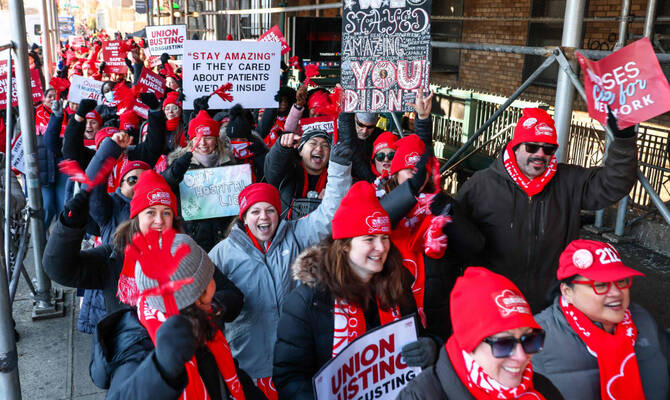
NEW YORK: Thousands of nurses in New York City went on strike Monday after negotiations through the weekend yielded no breakthroughs in disputes with three major hospital systems over staffing, benefits and other issues.
“Nurses on strike! ... Fair contract now!” nurses shouted on a picket line outside NewYork-Presbyterian Hospital’s campus in Upper Manhattan. Others picketed at hospitals in the Mount Sinai and Montefiore systems, where a 2023 nursing strike fed off pandemic-era frustrations and led to a deal to boost staffing and pay.
“And now, it’s how they’re treating us: They don’t want to give us a fair contract, and they don’t want to give us safe staffing, and now they’re trying to roll back on our benefits,” emergency department nurse Tristan Castillo said Monday outside Mount Sinai West.
About 15,000 nurses are involved in the strike, according to their union, the New York State Nurses Association. The hospitals remained open, hiring droves of temporary nurses to try to fill the labor gap.
The strike involves private, nonprofit hospitals, not city-run ones. But the walkout, which the union casts as lifesaving essential workers fighting hospital executives who make millions of dollars a year, could be a significant early test of Mayor Zohran Mamdani’s new administration.
The democratic socialist campaigned on a pro-worker platform and struck a similar note while visiting nurses on the NewYork-Presbyterian picket line Monday.
“These executives are not having difficulty making ends meet,” said Mamdani, who extolled nurses’ work and said they were seeking “dignity, respect and the fair pay and treatment that they deserve. They should settle for nothing less.”
Some other Democratic city and state politicians also visited striking nurses, while New York Gov. Kathy Hochul sent state health officials to the hospitals to keep watch over patient care. She called in a statement for the sides to negotiate a deal that “recognizes the essential work nurses do.”
The strike, which comes during a severe flu season, could potentially force the hospitals to transfer patients, cancel procedures or divert ambulances, though the medical centers insisted they were prepared and committed to meet patients’ needs. The walkout could also put a strain on other city hospitals if patients avoid the medical centers hit by the strike.
The nurses’ demands vary by hospital, but staffing levels are a top issue. The union says hospitals have given nurses unmanageable workloads.
Nurses also want better security measures in the workplace, citing incidents such as an episode last week when a man with a sharp object barricaded himself in a Brooklyn hospital room and was then killed by police.
The union also wants limitations on hospitals’ use of artificial intelligence.
The hospitals say that they’ve improved staffing in recent years and that the union’s demands overall are too costly.
Mount Sinai said the union was making “extreme economic demands.” Montefiore spokesperson Joe Solmonese said the union was pressing ”$3.6 billion in reckless demands,” including exorbitant raises.
The union didn’t immediately respond to a question about its salary proposal and current wage levels. According to the hospitals, unionized registered nurses now average $165,000 a year at Montefiore, $162,000 at Mount Sinai, and $163,000 at NewYork-Presbyterian’s Columbia University Irving Medical Center; none of the numbers includes benefits.
Montefiore says the union’s asks would raise the average to $220,000 in three years. Mount Sinai says the average there would hit $275,000.
After the nurses gave notice Jan. 2 of the looming strike, the hospitals vowed to “do whatever is necessary to minimize disruptions” and said they were prepared to deliver care no matter how long the strike lasts. Mount Sinai said in a statement Monday it had lined up 1,400 temporary nurses.
New York-Presbyterian accused the union of staging a strike to “create disruption.”
“We’re ready to keep negotiating a fair and reasonable contract that reflects our respect for our nurses and the critical role they play, and also recognizes the challenging realities of today’s health care environment,” the hospital said.
Each medical center is negotiating with the union independently. Several other private hospitals in and near New York City reached deals in recent days to avert a possible strike.
The three-day strike in 2023 resulted in a deal raising pay 19 percent over three years at Mount Sinai and Montefiore. The pact also included staffing improvements, though the union and hospitals now disagree about how much progress has been made, or whether the hospitals are retreating from staffing guarantees.
The sides also dispute whether the hospitals are trying to reduce health benefits. Mount Sinai, for instance, says its proposals would cut costs without changing coverage.

Thousands of nurses go on strike at several major New York City hospitals
Short Url
https://arab.news/yk2az
Thousands of nurses go on strike at several major New York City hospitals
- The democratic socialist campaigned on a pro-worker platform and struck a similar note while visiting nurses on the NewYork-Presbyterian picket line Monday
UK govt bans pro-Palestinian march over alleged Iran support
- The UK government has banned an annual pro-Palestinian march planned for Sunday which London police claim is organized by a group “supportive of the Iranian regime“
LONDON: The UK government has banned an annual pro-Palestinian march planned for Sunday which London police claim is organized by a group “supportive of the Iranian regime.”
Interior minister Shabana Mahmood said late Tuesday she had approved the rare police request to prevent “serious public disorder” if the Al-Quds Day march and counter-protests had gone ahead.
It is the first time a protest march has been banned since 2012 but a static demonstration will be permitted, according to London’s Metropolitan police.
Mahmood said she was “satisfied” a ban was “necessary” due to “the scale of the protest and multiple counter-protests, in the context of the ongoing conflict in the Middle East.”
The minister added that she expected to see “the full force of the law applied to anyone spreading hatred and division.”
The Islamic Human Rights Commission (IHRC), an NGO which organizes the annual Al-Quds Day march, said it “strongly condemns” the decision, which it called “politically charged.”
“We are seeking legal advice and this decision will not go unchallenged,” it added, accusing the Met of having “brazenly abandoned their sworn principle of policing without fear or favor.”
It said the London force “unashamedly regurgitate Zionist talking points about the IHRC “without a shred of evidence.”
The group describes the day and march as an “international demonstration ... in support of Palestinians and all the oppressed around the world.”
- ‘Unique risks’ -
Al-Quds day, which takes its name from the Arabic for Jerusalem, originated in Iran in 1979 in support of the Palestinian people, and is now marked annually in various countries, notably in the Muslim world. It aims to protest Israel’s occupation of east Jerusalem.
But the Met’s Assistant Commissioner Ade Adelekan said it was “uniquely contentious having originated in Iran and in London is organized by the Islamic Human Rights Commission.”
He claimed that the organization was “supportive of the Iranian regime.”
“The threshold to ban a protest is high and we do not take this decision lightly,” Adelekan said.
He noted the Met has “a proven track record” of permitting free speech and protest rights at dozens of major pro-Palestinian and other demonstrations in recent years.
“But in our assessment this march raises unique risks and challenges,” he said.
“We must consider the likely high numbers of protesters and counter protesters coming together and the extreme tensions between different factions.
“We have taken into consideration the likely impact on protests of the volatile situation in the Middle East, with the Iranian regime attacking British allies and military bases overseas.”
The ban on the march and any associated counter-protest marches is valid for a month from Wednesday.
Interior minister Shabana Mahmood said late Tuesday she had approved the rare police request to prevent “serious public disorder” if the Al-Quds Day march and counter-protests had gone ahead.
It is the first time a protest march has been banned since 2012 but a static demonstration will be permitted, according to London’s Metropolitan police.
Mahmood said she was “satisfied” a ban was “necessary” due to “the scale of the protest and multiple counter-protests, in the context of the ongoing conflict in the Middle East.”
The minister added that she expected to see “the full force of the law applied to anyone spreading hatred and division.”
The Islamic Human Rights Commission (IHRC), an NGO which organizes the annual Al-Quds Day march, said it “strongly condemns” the decision, which it called “politically charged.”
“We are seeking legal advice and this decision will not go unchallenged,” it added, accusing the Met of having “brazenly abandoned their sworn principle of policing without fear or favor.”
It said the London force “unashamedly regurgitate Zionist talking points about the IHRC “without a shred of evidence.”
The group describes the day and march as an “international demonstration ... in support of Palestinians and all the oppressed around the world.”
- ‘Unique risks’ -
Al-Quds day, which takes its name from the Arabic for Jerusalem, originated in Iran in 1979 in support of the Palestinian people, and is now marked annually in various countries, notably in the Muslim world. It aims to protest Israel’s occupation of east Jerusalem.
But the Met’s Assistant Commissioner Ade Adelekan said it was “uniquely contentious having originated in Iran and in London is organized by the Islamic Human Rights Commission.”
He claimed that the organization was “supportive of the Iranian regime.”
“The threshold to ban a protest is high and we do not take this decision lightly,” Adelekan said.
He noted the Met has “a proven track record” of permitting free speech and protest rights at dozens of major pro-Palestinian and other demonstrations in recent years.
“But in our assessment this march raises unique risks and challenges,” he said.
“We must consider the likely high numbers of protesters and counter protesters coming together and the extreme tensions between different factions.
“We have taken into consideration the likely impact on protests of the volatile situation in the Middle East, with the Iranian regime attacking British allies and military bases overseas.”
The ban on the march and any associated counter-protest marches is valid for a month from Wednesday.
© 2026 SAUDI RESEARCH & PUBLISHING COMPANY, All Rights Reserved And subject to Terms of Use Agreement.


