


NEW YORK: For the past month, life seemed to be slowly but surely edging toward normality for restaurants in Manhattan’s East Village neighborhood. For outdoor dining, streets were lined with makeshift cubicles, tables separated by plexiglass out of an abundance of caution and lights were strung over the tent-shaped patios.
It looked almost festive: Chatter filled the air as New Yorkers took to eating outside, happy to break the monotony of the past months and hoping, with their patronage, to save the remaining local businesses, 30 percent of which had already closed shop for good due to the coronavirus disease (COVID-19) pandemic.
But all it took was one day of heavy rain for the now-familiar desolation to descend on the streets again, a harbinger of a coming winter during which many are expecting an even deeper economic pain to unfold. As of last month, indoor dining was allowed, with contact tracing being implemented on all premises, but many New Yorkers still do not feel safe enough to dine in closed spaces.
In the home stretch before Election Day, the COVID-19 specter remains omnipresent.
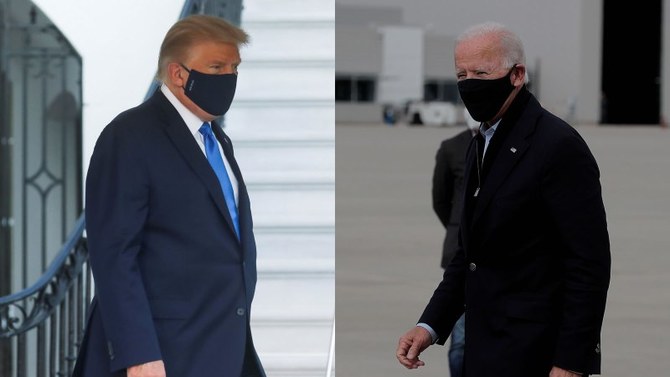
President Trump, trailing in the polls, is sticking to a whirlwind schedule of rallies, attended by thousands, some wearing masks and practicing social distancing but many not. Trump brushed aside worries about the virus and simply promised to vanquish it, moving on to talk about economic growth under his watch.
His rival, former Vice President Joe Biden, is heavily focused on tackling COVID-19, vowing to prioritize science and refusing to run “on the false promises of being able to end this pandemic by flipping a switch.”
Over the summer, as New York’s infection rates dipped to lows unseen in most states since, it appeared the former world epicenter of the pandemic had cracked the code to containment.
Now, with the US smashing its own daily case record for the third time in a week, no state has been immune from the latest surge sweeping the nation.
The 71,000 new cases per day that the US averaged over the past week were the most in any seven-day stretch since the crisis started.
As colder weather moves in and the holidays hit, Dr. Anthony Fauci, the nation’s top infectious disease expert, warned that if these trends did not change, there would be a “whole lot of pain in this country with regard to additional cases and hospitalizations and deaths.”
In New York, the numbers have been creeping up again. The total number of hospitalizations is the highest since June, topping 1,000 for the fourth day in a row. Back in early September, that number was 410. The highest total was 18,825 on April 12.
Twelve people were confirmed to have died from the virus yesterday.
Governor Andrew Cuomo has enforced a new lockdown plan to deal with the alarming rise in infections in so-called micro-clusters of the city and state, which are now targeted for further restrictions.
“Because we’re so aggressive, every time we see the virus pop up, we run and hit it down,” said Cuomo, touting his micro-cluster strategy. “It’s like Whack-A-Mole.”
This strategy appears to have been working. Despite recent upticks, the Empire State has the nation’s second-lowest infection rate, according to data from Johns Hopkins University.
Cuomo also announced that California has been added to New York State’s travel advisory, bringing the total number of states on the list to 41, which constitutes around 90 percent of the US.
The advisory requires individuals who have traveled to New York from areas with significant community spread to quarantine for 14 days.
For his part, Mayor Bill de Blasio urged New York City residents to avoid holiday travel unless it is “absolutely necessary.” He expressed concerns over the recent growth of the city’s seven-day rolling positivity average.
Today, it hit 1.92 percent, and while that is low compared with other major American cities, it is still the highest average for New York in months — and dangerously close to the 2-percent threshold de Blasio said could lead to the closure of indoor dining across the city.
“Big picture here is there has been a danger of a full-blown second wave in New York City. We still have to keep a vigilant eye on that,” the mayor said. “We do fear more and more [COVID-19] coming in from outside. [We] must be really strong at this moment.”
Earlier this month, Cuomo announced that he was limiting attendance at houses of worship, closing schools and shuttering nonessential businesses in six parts of the state where infections have spiked.
The decision to reinstate restrictions was met with protests, some of which turned violent. In Brooklyn’s Hasidic neighborhood, some viewed the lockdowns as anti-Semitic.
Several class-action lawsuits have been filed against the state of New York, Governor Cuomo and other public officials, by large groups of restaurant owners, gym owners, and small performing arts venues, all seeking to overturn executive orders from Cuomo that have barred those businesses from opening.
But the Democratic governor has been adamant that the return of restrictions is the way to go.
“This is not rocket science,” Cuomo said. “It’s a virus. When you reduce congregate activity and people wear masks… you stop the spread of the virus. That’s how it works. That’s how it’s always worked. You just have to do it.”


