

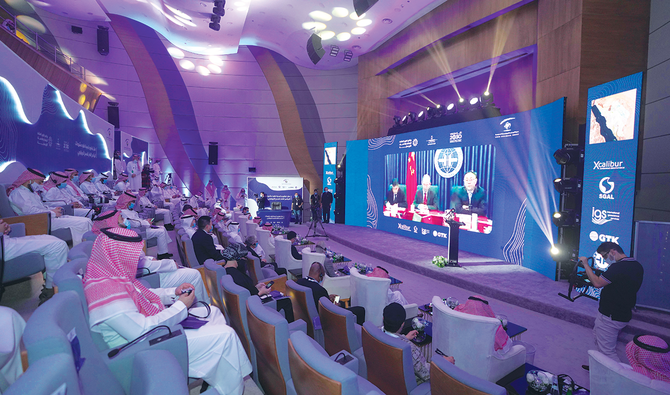
Saudi Geological Survey signs contracts worth over $530m

The program takes a three-pronged approach that includes advanced atmospheric geophysical surveys, multicomponent geochemical surveys and production of detailed geological maps. (SPA)
Short Url
Updated 19 October 2020
Follow

Saudi Geological Survey signs contracts worth over $530m

  • Six-year long program will help boost the Kingdom’s mining sector

RIYADH: The Saudi Geological Survey (SGS) on Sunday signed several contracts with international organizations and consultants to carry out projects related to the geological survey general program.

It is one of the largest geological surveys in the world, with the budget for all its stages amounting to SR2 billion (over $530 million).

The signing ceremony was held under the auspices of Saudi Minister of Industry and Mineral Resources Bandar Alkhorayef and was attended by Investment Minister Khalid Al-Faleh, Transport Minister Saleh Al-Jasser, foreign envoys and representatives of the international firms awarded the contracts.

Alkhorayef said signing these contracts marks the beginning of the Kingdom’s massive data collection efforts. “It is the first step toward making the mining sector the third pillar” of the Saudi industrial landscape, he said.

The minister said the program will ensure gathering more reliable and accurate data about the Kingdom’s mineral resources, which will help the relevant authorities tap into the vast mineral wealth and lay a solid foundation for a sustainable national economy.

The program takes a three-pronged approach that includes advanced atmospheric geophysical surveys, multicomponent geochemical surveys and production of detailed geological maps.

Providing details about the contract in a statement, the SGS said one of the contracts includes a technical partnership deal with a consortium including International Geoscience Services Co. and Geological Survey of Finland.

A multicomponent geochemical survey contract for the Arabian Shield has been awarded to China Geological Survey. It is aimed at collecting and analyzing more than 110,000 samples of valley sediments and heavy metals in the Arabian Shield over the next 6 years.

Dr. Zhong Ziran, China’s vice minister for geological survey, said that the contract marked the beginning of a great cooperation between Saudi Arabia and China.

The SGS awarded the contract for advanced aerial geophysical survey contract for Sector No. 1 of the Arabian Shield to Sander Geophysics Ltd.

Under the deal, the company will collect and analyze geophysical data, produce various digital geophysical maps, and identify rock formations and evidence of mineralization in the region.

The program currently aims to survey nearly 600,000 sq. km. of the mineral-rich Arabian Shield region.

The other three contracts were awarded to Xcalibur Airborne Geophysics to carry out advanced aerial geophysical survey of sectors 2 and 3 of the Arabian Shield.

Simon Bush, CEO of Xcalibur, said: “It gives me great pleasure to work with the Saudi Geological Survey.”

All these programs seek to boost the contribution of the mining sector to the Kingdom gross domestic product and create 220,000 new jobs.


Saudi POS transactions see 20% surge to hit $4bn: SAMA

Updated 05 December 2025
Follow

Saudi POS transactions see 20% surge to hit $4bn: SAMA

RIYADH: Saudi Arabia’s total point-of-sale transactions surged by 20.4 percent in the week ending Nov. 29, to reach SR15.1 billion ($4 billion).

According to the latest data from the Saudi Central Bank, the number of POS transactions represented a 9.1 percent week-on-week increase to 240.25 million compared to 220.15 million the week before.

Most categories saw positive change across the period, with spending on laundry services registering the biggest uptick at 36 percent to SR65.1 million. Recreation followed, with a 35.3 percent increase to SR255.99 million. 

Expenditure on apparel and clothing saw an increase of 34.6 percent, followed by a 27.8 percent increase in spending on telecommunication. Jewelry outlays rose 5.6 percent to SR354.45 million.

Data revealed decreases across only three sectors, led by education, which saw the largest dip at 40.4 percent to reach SR62.26 million. 

Spending on airlines in Saudi Arabia fell by 25.2 percent, coinciding with major global flight disruptions. This followed an urgent Airbus recall of 6,000 A320-family aircraft after solar radiation was linked to potential flight-control data corruption. Saudi carriers moved swiftly to implement the mandatory fixes.

Flyadeal completed all updates and rebooked affected passengers, while flynas updated 20 aircraft with no schedule impact. Their rapid response contained the disruption, allowing operations to return to normal quickly.

Expenditure on food and beverages saw a 28.4 percent increase to SR2.31 billion, claiming the largest share of the POS. Spending on restaurants and cafes followed with an uptick of 22.3 percent to SR1.90 billion.

The Kingdom’s key urban centers mirrored the national decline. Riyadh, which accounted for the largest share of total POS spending, saw a 14.1 percent surge to SR5.08 billion, up from SR4.46 billion the previous week. The number of transactions in the capital reached 75.2 million, up 4.4 percent week-on-week.

In Jeddah, transaction values increased by 18.1 percent to SR2.03 billion, while Dammam reported a 14 percent surge to SR708.08 million.

POS data, tracked weekly by SAMA, provides an indicator of consumer spending trends and the ongoing growth of digital payments in Saudi Arabia. 

The data also highlights the expanding reach of POS infrastructure, extending beyond major retail hubs to smaller cities and service sectors, supporting broader digital inclusion initiatives. 

The growth of digital payment technologies aligns with the Kingdom’s Vision 2030 objectives, promoting electronic transactions and contributing to the nation’s broader digital economy.