

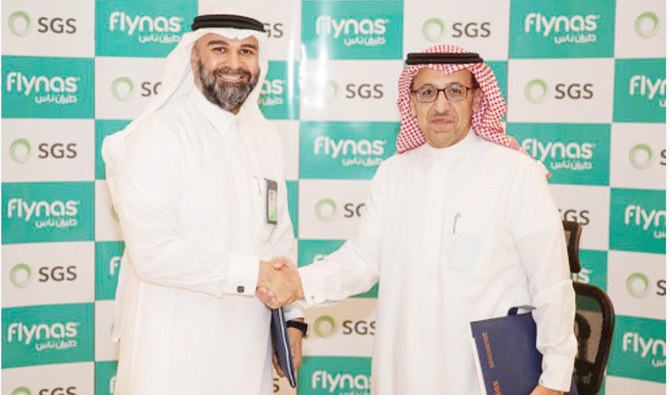
SGS signs ground handling contract with Flynas

The agreement was signed by Saudi Ground Services Company Chief Executive Officer Capt. Fahd Cynndy and Bandar Al-Muhanna, chief executive of Flynas.
Short Url
Updated 05 January 2020
Follow

SGS signs ground handling contract with Flynas

The Saudi Ground Services Company (SGS), a provider of ground handling services across all airports in the Kingdom, has signed a contract worth SR1 billion ($267 million) with Flynas, the Saudi low-cost carrier, to provide ground handling services to domestic and international flights.
Under the five-year agreement, which came into effect on Jan. 1, SGS will provide ramp and passenger services to keep pace with the expansionary flight plans of Flynas at all 28 airports in the Kingdom.
The company expects the deal to enhance business sustainability, boost cash flows, and positively impact its financial results as of the first quarter of 2020.
Commenting on the agreement, SGS Chief Executive Capt. Fahd Cynndy said: “The Saudi Ground Services Company is always proud to provide ground handling services to domestic and international airlines, and today we are pleased to sign a deal with the national carrier Flynas, our success partner, to increase the operational strategy of Flynas at all airports in the Kingdom.”
He added: “The new contract is an essential part of our strategy to continue serving direct and indirect customers — airlines, passengers and logistics providers.”

The Saudi Ground Services Company is always proud to provide ground handling services to domestic and international airlines, and today we are pleased to sign a deal with the national carrier Flynas.

Capt. Fahd Cynndy, SGS Chief Executive

Bandar Al-Muhanna, chief executive of Flynas, expressed his happiness over the signing of the contract with the largest ground services providers in the Kingdom to serve guests, starting from the booking of tickets until the end of the travel journey.
Al-Muhanna added: “The Saudi Ground Services Company has the operational readiness to keep pace with the expansion plans of Flynas over the next five years.”
Flynas operates more than 1,200 flights a week to 35 domestic and international destinations on its fleet of 30 aircraft. Meanwhile, the Saudi Ground Services Company in 2019 provided ground handling services to more than 46,000 flights of Flynas at all airports across the Kingdom. Their activities range from face-to-face passenger services through seamless execution of the hundreds of complex behind-the-scenes operations that keep aircraft flying on-time, to keeping passengers and their possessions together.



PwC Middle East and Sirar by stc’s CISO500 program advances cyber leadership

Updated 15 February 2026
Follow

PwC Middle East and Sirar by stc’s CISO500 program advances cyber leadership

The fifth edition of the CISO500 program ran from Feb. 8-12. Delivered in partnership between PwC Middle East and Sirar by stc, the program featured five intensive days of rich discussions and hands-on practical experiences, aimed at strengthening leadership capabilities in cybersecurity and keeping pace with rapid technological transformation.

The program is designed to develop the capabilities of executive cybersecurity leaders and enhance their strategic role in supporting organizations’ digital transformation. It equips participants to address contemporary challenges in the cyber landscape and expand their influence within decision-making ecosystems.

Yasser Al-Swailem, CEO of Sirar by stc, said that the program represents an important step toward strengthening the readiness of cyber leaders in the region. He noted that the CISO500 program is a fundamental pillar in the journey toward building a secure and trusted Saudi cyberspace aligned with national ambitions. He added that investing in national cybersecurity leadership is no longer optional but a strategic necessity for ensuring sustainable digital development. The program reflects a commitment to empowering national talent to lead the digital security landscape according to the highest global standards.

He further emphasized that such initiatives contribute to strengthening digital security ecosystems and enabling organizations to confidently and sustainably address future challenges.

Samer Omar, cybersecurity and digital trust leader at PwC Middle East, added: “CISO500 is a long-term investment in Saudi leadership. Over the past year, we’ve seen how bringing together senior Saudi cybersecurity professionals in a structured executive environment accelerates capability, builds confidence and deepens collaboration. As the program enters its second year, our focus remains on equipping Saudi CISOs with the strategic perspective and technical depth required to secure the Kingdom’s digital ambitions.”

The program addressed a range of advanced topics, including common cyber transformation pitfalls, mechanisms for securing enterprise digital transformation, and cybersecurity budgeting and financial governance. These topics enhanced leaders’ ability to translate cyber risks and security investments into financial indicators that support executive decision-making.

It also covered the latest technological developments, particularly artificial intelligence, emerging technologies, quantum computing, and the protection of critical and operational infrastructure. Emphasis was placed on the importance of security governance for AI technologies and strengthening enterprise-wide risk management perspectives associated with them.

The program adopted an interactive learning methodology combining strategic discussions, collaborative work, and creative practical exercises, contributing to a deeper understanding of concepts and enabling their translation into applicable organizational practices.

Abdullah Al-Asmari, global cybersecurity director at the Saudi Research and Media Group and one of the program participants, said that the experience added significant strategic and practical value: “The program provided a rich experience that strengthened the leadership perspective of cybersecurity, particularly in linking technical practices with strategic and financial dimensions within the organization. It also offered valuable space for exchanging expertise on emerging technologies such as AI and quantum computing, and the challenges of securing critical infrastructure. This experience enhances cyber leaders’ ability to adopt a more influential role in supporting digital transformation and enabling decision-making based on a comprehensive understanding of risk and value.”

He added that the program facilitated the exchange of insights on emerging challenges and strengthened the ability to align cybersecurity with institutional objectives and executive decision requirements.

Participants said that the program constituted a valuable professional and knowledge-driven experience that enhanced the readiness of cyber leaders to keep pace with rapid digital transformation, reinforcing cybersecurity’s role as a strategic enabler that supports innovation while preserving business trust, reliability, and sustainability.