

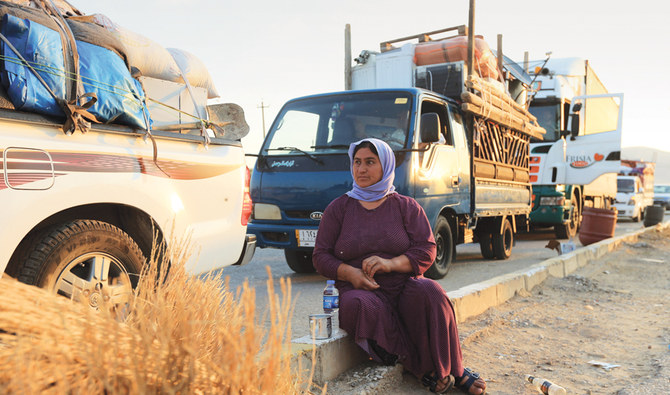

DOHUK/IRAQ: The Yazidis of northern Iraq, an ancient religious minority brutally persecuted by Daesh, want nothing more than peace, security and a better life in their home town of Sinjar — but they want it on their terms.
Many there distrust a new security and reconstruction plan unveiled this week by the Baghdad government and Kurdish regional authorities which hailed it as a “historic” agreement.
“The deal could pacify Sinjar — but it might also make the situation even worse,” said Talal Saleh, a Yazidi in exile in nearby Kurdistan.
The Yazidis have suffered since Daesh marauded into Sinjar in 2014, one of the extremist group’s conquests that shocked the West into military action to stop it.
Daesh viewed the Yazidis as devil worshippers for their faith that combines Zoroastrian, Christian, Manichean, Jewish and Muslim beliefs.
It slaughtered more than 3,000 Yazidis, enslaved 7,000 women and girls and displaced most of its 550,000-strong community.
Since Daesh was driven out of Sinjar by US-backed Kurdish forces in 2015, the town and its surrounding areas are controlled by a patchwork of armed groups including the Iraqi Army, Shiite militia, and Yazidi and Kurdish militants with different loyalties.
The government plan would enforce security and allow the return of tens of thousands of Yazidis afraid to go back because of a lack of security and basic services, according to the office of Iraqi Prime Minister Mustafa Al-Kadhimi.
But many Sinjar natives feel the plan is vague, dictated by Baghdad and the Kurdish capital of Irbil. They say it has not included them and entails security reforms that could mean more division and violence.
SPEEDREAD
Yazidis distrust a new security and reconstruction plan unveiled this week by the Baghdad government and Kurdish regional authorities which hailed it as a ‘historic’ agreement.
“The PKK and their Yazidi allies are not just going to leave Sinjar without a fight,” Saleh said.
The security arrangements include booting out the PKK, a Kurdish separatist group that has fought a decades-long insurgency in Turkey and bases itself in northern Iraq.
It would also drive out PKK “affiliates,” an apparent reference to a Yazidi force of hundreds of fighters.
Escape
The PKK with Yazidi volunteers helped thousands of Yazidis escape the Daesh onslaught to Syria after the Iraqi Army fled many areas of Nineveh province and Irbil’s peshmerga forces retreated. The peshmerga returned to help recapture Sinjar with US air support.
The PKK is under attack by Turkish forces in Iraq and exists uneasily alongside the peshmerga and the Iraqi Army.
The army and the Popular Mobilization Forces (PMF), Iraq’s state paramilitary body dominated by Shiite militias, would oversee the ejection of the PKK, according to a copy the plan seen by Reuters.
Some locals fear this could split up families where siblings sometimes belong to different militias, forces and groups. The Yazidis also have their own force in the PMF, separate to the Yazidi PKK affiliate.
“There are about six political groups in Sinjar now. Brothers belonging to the same family each join different parties,” said Akram Rasho, another displaced Yazidi in Kurdistan. Baghdad and Irbil defend the plan. “This is a good step to solve problems,” said Kurdistan government spokesman Jotiar Adil. Sinjar has also been caught up in a territorial dispute between Baghdad and Irbil since a failed Kurdish bid for full independence in 2017.
Under the plan for Sinjar, the Baghdad and Irbil governments would choose a new mayor and administrators and appoint 2,500 new local security personnel.
Supporters of the PKK suspect those would include returning Yazidis affiliated with the peshmerga.
At a demonstration against the deal in Sinjar on Sunday, Yazidi tribal leader Shamo Khadida shouted, “Sinjar belongs to its people and we are the people.”
Others distance themselves from the politics and simply want to see delivery of services on the ground.
“If actual efforts are made to improve our situation, the people of Sinjar will find agreement,” said Rasho.


