
NEW YORK CITY: Claims by the Houthi militia of a blockade on Yemeni ports and airports are “part of a campaign of misinformation,” Saudi Arabia told the UN Security Council on Thursday.
It came as the Kingdom renewed its call for the international community to enforce Security Council resolutions relating to Yemen and freedom of navigation in the Red Sea.
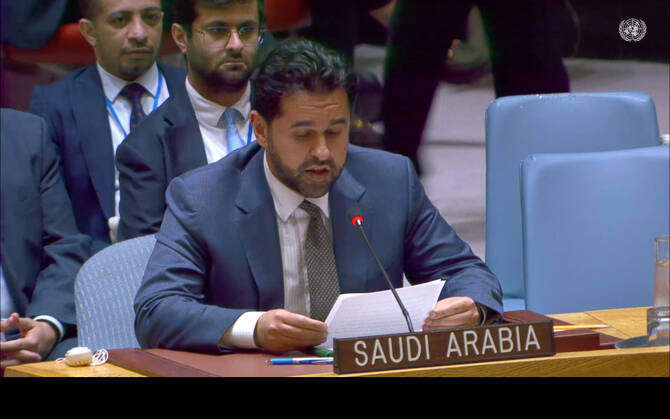
Faisal Meshari T. Almadi, minister plenipotentiary and head of the Security Council and Political Affairs Division at Saudi Arabia’s mission to the UN, was speaking during a Security Council session to discuss the peaceful settlement of disputes, which was convened by the Democratic Republic of the Congo.
He said the meeting took place “at a time when the entire world is experiencing rapidly evolving challenges and growing tensions that have cast a shadow over regional and international security and stability.”
Recent developments in the Middle East, including “the closure of major crossings and straits involved in supplying the world with energy, goods and essential resources” underscored the need to strengthen dialogue, diplomacy and “updated mechanisms for international mediation” suited to the current realities, Almadi added.
Saudi Arabia regards dialogue, mediation and preventive diplomacy as essential tools for the prevention, containment and resolution of conflicts, he said. He cited the need to build trust between disputing parties, address the root causes of tensions, and respect state sovereignty and territorial integrity as “indispensable pillars for achieving sustainable peace in the region.”
He highlighted the Kingdom’s Vision 2030 plan for national development and diversification as a reflection of the country’s conviction that “development and innovation and the creation of opportunities represent the best path toward stability and avoiding conflict.”
Almadi reiterated the Kingdom’s position on the need to establish peace in Yemen and end the suffering of “the brotherly Yemeni people,” adding that Saudi Arabia had backed all UN-led peace efforts since the start of the crisis in the country, including a road map approved by the Yemeni government.
He said the Houthis refused to accept this road map and had instead become “embroiled in a regional conflict to advance its malicious agenda,” which was deepening the suffering of the Yemeni citizens under their control.
He called on the international community to enforce Security Council resolutions, “primarily Resolution 2216 on Yemen and Resolution 2722 concerning the rights and freedom of navigation in the Red Sea.”
Almadi noted that the Coalition to Restore Legitimacy in Yemen’s Joint Forces Command had announced it would take “all necessary operational decisive measures,” in accordance with international law and the UN Convention on the Law of the Sea, to protect international shipping in Bab Al-Mandab Strait.
He rejected Houthi claims that Yemeni ports and airports have been closed, and described the militia’s narrative of a blockade “misleading,” “false” and without any basis in fact. More than 300 commercial vessels carrying food, goods, fuel and construction materials entered the ports of Hodeidah, Saleef and Ras Isa in the first half of this year, he said, while the Houthis had rejected all initiatives for the resumption of flights to and from Sanaa airport, most recently a Jordanian proposal.
Houthi actions had led to the closure of Sanaa International Airport and the destruction of a Yemenia aircraft, Almadi added, while coalition forces have started to implement measures designed to protect vessels transiting Bab Al-Mandab Strait.
He described the Houthi threats to shipping as a clear violation of international law that “qualify as maritime piracy,” and warned that allowing attacks to continue without deterrent measures would only encourage more, undermine regional stability, and threaten the principle of freedom of maritime navigation as a pillar of the international order.
Almadi called on the international community to condemn the Houthis for targeting commercial vessels and to take all necessary steps to prevent further violations.
He said Saudi Arabia renewed its commitment to support for international efforts to strengthen peace and security, and to working with the UN and regional and international partners “to build a Middle East that is more secure, stable and prosperous.”