

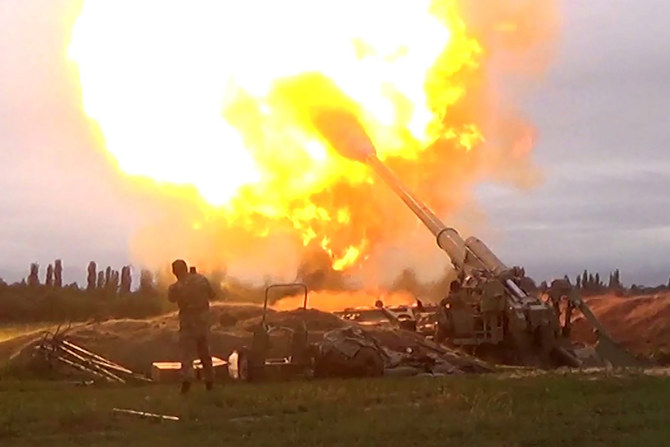

NEW YORK CITY: As the death toll continues to climb in the latest violence between Armenia and Azerbaijan over the separatist territory of Nagorno-Karabakh, diplomatic efforts to find a solution to the decades-old rivalry have intensified.
Russia, France, and the US — co-chairs of the OSCE Minsk Group created in 1992 to encourage a negotiated resolution to the conflict — have called for an immediate cease-fire and a return to negotiations without delay.
Russia has offered to host talks between the foreign ministers of the warring countries, insisting there is no alternative to “political and diplomatic methods” for resolving the crisis.
The UN Security Council has issued a similar call to urgently resume talks without preconditions, backing an earlier appeal by UN Secretary-General Antonio Guterres to de-escalate the conflict and return to meaningful negotiations.
“Armenia never refused to sit for peaceful negotiations,” said Mher Margaryan, Armenia’s permanent representative to the UN, in an interview with Arab News. “But it doesn’t seem to be the intention of Azerbaijan to follow the calls for peace.”
At the onset of the coronavirus disease (COVID-19) pandemic, Guterres made an appeal for a global cease-fire to help stem the spread of the virus.
“Azerbaijan not only refused to unconditionally support the secretary-general’s appeal, but also resorted to a large-scale military intervention,” added Margaryan.
“The (Azerbaijani) offensive comes amid a global crisis caused by the COVID-19 pandemic, when the international community is focused on fighting the disease.
“Azerbaijan has decided to take advantage of these global vulnerabilities caused by the pandemic. So, this is not just an attack against Armenians but (also) an attack against the basic norms of humanity, an attack against what the UN stands for.”
French President Emmanuel Macron’s office said he and his Russian counterpart Vladimir Putin “also shared their concern regarding the sending of Syrian mercenaries by Turkey to Nagorno-Karabakh.”
Margaryan said Armenia was very concerned by the alleged involvement of foreign fighters. “These foreign mercenaries are actually being recruited and transported with the support and encouragement of Turkey. We have to name the names: (The Turks) have been a very destructive element in this conflict. They need to be encouraged to stop.”
The envoy said Azerbaijan’s actions, “while they took the world by surprise,” had been preceded by ”years of dangerous rhetoric, hate speech and Armeniaphobia, embraced and promulgated at the highest political level.”
“The leadership of Azerbaijan has been promoting hate crimes and glorifying hate criminals. At the same time, they have been spending billions of dollars to acquire deadly offensive weaponry and openly threatening the people of Armenia and Nagorno-Karabakh with promises to use force.”
This much was clear, Margaryan said, from the Azerbaijan president’s recent speech at the 75th session of the UN General Assembly. “It was not only a textbook manifestation of a hate speech but also — we have come to realize now — (a) declaration of war against the people of the Nagorno-Karabakh with a clear genocidal intent.”
Margaryan believes the people of Nagorno-Karabakh “have all the rights to live in their ancestors’ historical land without fear of foreign collision.”
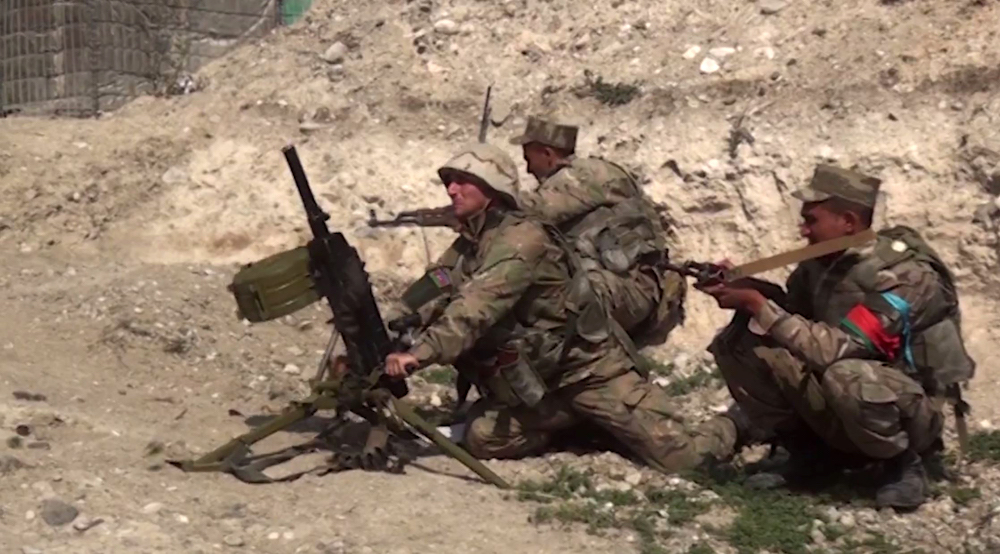
An image grab taken from a video made available on the official web site of the Azerbaijani Defence Ministry on September 28, 2020, allegedly shows Azeri troops conducting a combat operation during clashes between Armenian separatists and Azerbaijan in the breakaway region of Nagorno-Karabakh. (AFP/Azerbaijani Defence Ministry)
He added: “At the core of the (Karabakh) issue is the right to self-determination which is enshrined in the UN Charter, and they have exercised this right by way of a referendum back in December 1991 in accordance with the applicable Soviet laws at the time, and also international law.”
Nagorno-Karabakh broke away from Azerbaijan during the 1991-94 war, which left 30,000 people dead and displaced more than 1 million others. However, it has never been internationally recognized as an independent republic.
“Armenia as a guarantor of the security of the people of Karabakh will take every measure to defend their inalienable rights. Armenians around the world are very strongly united on this matter,” Margaryan said.
“We as Armenians cannot allow another genocide to be perpetrated against the Armenian population in the course Azerbaijan’s military aggression (that is) encouraged and supported by Turkey.”
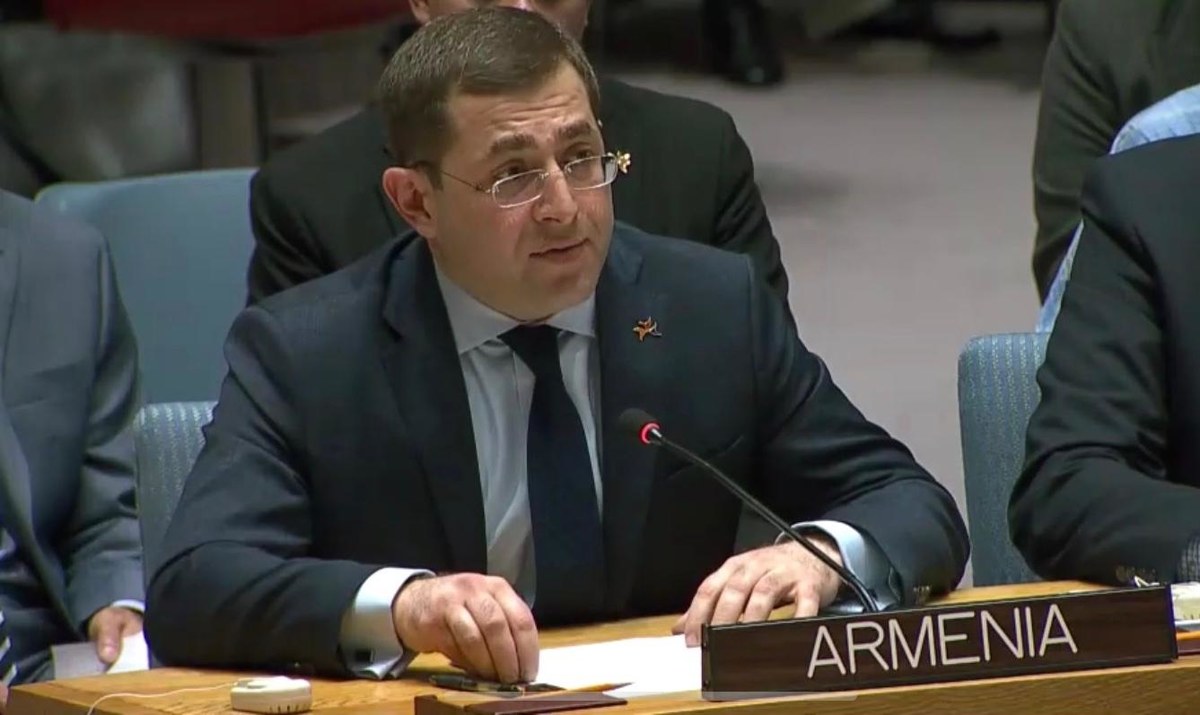
Mher Margaryan, Armenia’s permanent representative to the UN. (Screenshot)
Ankara’s “expansionist and imperialistic policies” were an attempt to sow instability in the region, he said.
“While it is hard to say who is benefiting from this war, those who instigated this conflict (are) very well known not only to the expert community, not only with us who mediate in this conflict, but to the larger international society as well,” Margaryan said.
“The international community should send a stronger message to those engaged from the outside and encourage Azerbaijan itself to come to its senses and stop military aggression.”
The resumption of this “frozen conflict” — which dates back to the collapse of the Soviet Union — has raised concerns about stability in the South Caucasus, a corridor for pipelines carrying oil and gas to world markets, and has even raised fears that regional powers Russia and Turkey could be drawn in.
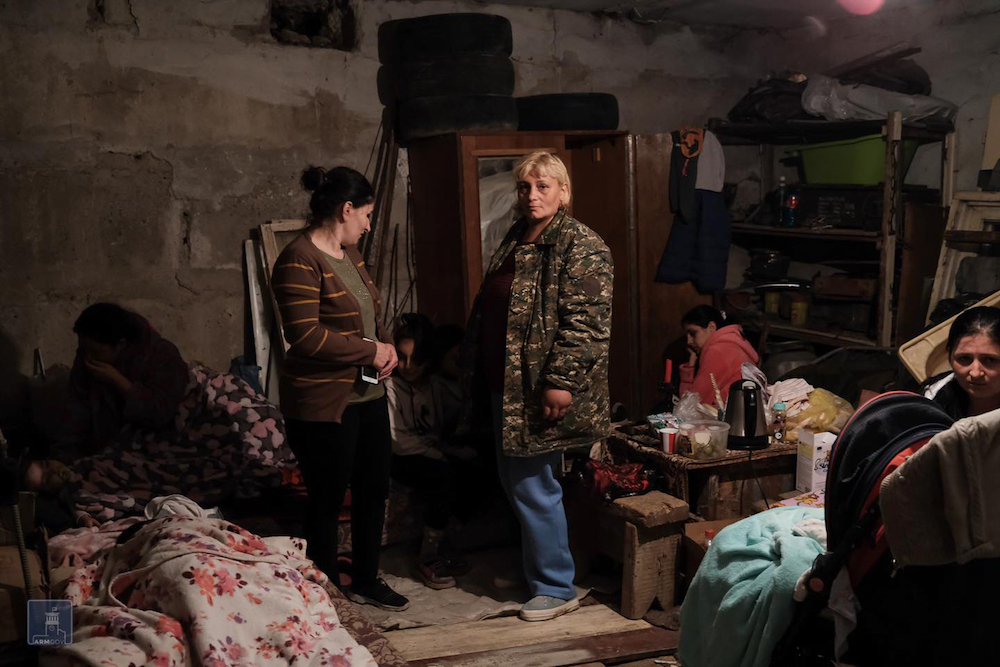
This handout picture provided by the Armenian Foreign Ministry on September 28, 2020 shows women in a bomb shelter in Nagorny Karabakh's main city of Stepanakert. (AFP)
“What we are observing now is already a large-scale escalation with the use of the heaviest weaponry in their arsenal,” Margaryan said.
“It should come as no surprise that if the aggression continues then it might have a dangerous spillover effect. If Azerbaijan and Turkey are not contained, the consequences can have a devastating impact on the entire region and beyond.
“Azerbaijan and Turkey must come to their senses and heed the call of the international community to commit to peace and good faith,” he added.
The US, which co-chairs the OSCE Minsk Group, has not considered Nagorno-Karabakh a foreign policy priority since 2001.
“We hope (Karabakh) is on the (American) list of priorities and we hope that the group’s co-chair countries will continue to have a unified position as to the principles of the resolution of the conflict,” Margaryan said.
He directed the same message at the Azerbaijan President (Ilham Aliyev) that Nikol Pashinyan, Armenia’s prime minister, has been emphasizing since he came to power in 2018.
“The message to the Azeri president is: Any solution to this long-standing conflict must be acceptable to the people of Armenia, NK and Azerbaijan. And it should be without prejudice to all people who are concerned,” Margaryan added.
“So, the international community should use all means (to have) external actors withdrawn from the conflict zone.”
----------------------
Twitter: @EphremKossaify


