

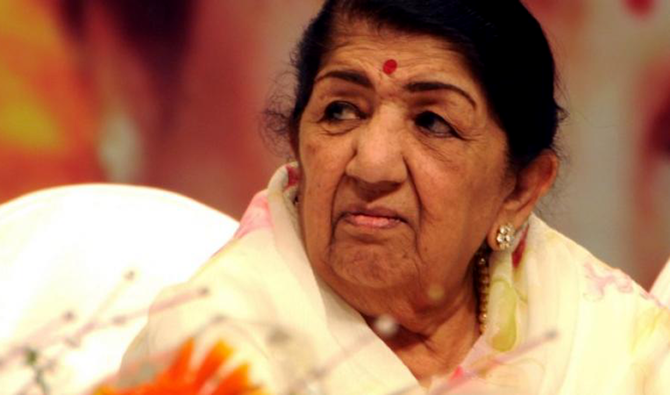

PATNA, India: On Monday, as Lata Mangeshkar turns 91, India’s most accomplished and acclaimed playback singer says she will “continue to sing until her last breath.”
“Even today, I feel like a student of music. I have so much to learn when I compare myself to the great musicians of our country. I will sing until my last breath. There is no retirement for an artist,” Mangeshkar said during an exclusive interview with Arab News.
Born in 1929 in Indore, Madhya Pradesh, Mangeshkar moved to Mumbai, Maharashtra with her family and four siblings — Meena Mangeshkar, Asha Bhosle, Usha Mangeshkar and Hridaynath Mangeshkar — in 1945.
After recording her first Hindi song for a film titled Aap Ki Seva Mein in 1947, she gained prominence when, at the age of 20, she regaled audiences with Aayega Aanewala in the film Mahal two years later.
“Then there was Pyar Kiya Toh Darna Kya from Mughal-e-Azam. Audiences would throw coins on the screen when that song came on,” she said.
To date, in a career spanning 75 years, she has recorded more than 30,000 songs in 35 Indian and foreign languages — including Malaysian, English and Nepalese — and earned a Bharat Ratna, India’s highest civilian award, in the process.
But remind her about her achievements, and she shrugs it off with habitual modesty.
“There have been many talented singers before and after me (such as) Noor Jehanji, Shamshad Begumji, Geeta Duttji before me, and my sister Asha who were all extremely talented. Among the contemporary voices, I like Alka Yagnik, Shreya Ghosal and Sunidhi Chauhan,” she said.
Nearly 60 biographies have been written about the legendary singer, but she has not authored any herself. The platform where she does unleash her creative writing skills is Twitter.
With more than 14.6 million followers since her social media debut in 2010, the nonagenarian says she turns to Twitter to “stay in touch with friends” and has rarely forgotten to commemorate a colleague’s death or birth anniversary with a tweet on occasion.
“It’s the least we can do. We owe it to the entertainment industry. Earlier, we could pick up the phone and talk to one another. The only option I have is to meet them on social media,” she said.
And while there are no “fixed hours” for her time spent on the social media platform, she tweets when she has “something to say.”
“Otherwise, I stay away. Social media is addictive, and I advise more personal contact than virtual,” she added.
While the coronavirus outbreak and ensuing lockdown across India since March this year meant restriction on movement, Mangeshkar said that it did not derail her offline schedule.
After a “severe” lung infection last year, and based on doctor’s orders, she now leads a quiet, secluded life at her home in South Mumbai.
“The doctors have severely curtailed all my activities, including movie-watching,” she said, adding that she enjoys listening to music, as long as they are not her songs.
“I don’t listen to my songs. If I did, I’d find a hundred mistakes in my singing. Even in the past, once I finished recording a song, I was done with it,” she said.
This, however, was not the case for several Indian actresses, from Madhubala in the 1950s to Sridevi in the 1980s, who insisted on Mangeshkar singing for their onscreen personas.
The supreme songstress has sung for five generations of Bollywood heroines, but ask her which actress did most justice to her voice on-screen and she replies after a pause: “That’s a tough one because each heroine brought something special to my songs. But I’d have to go with Nutan. She was a singer herself, and when she emoted my songs, she sang along. The way she performed on Mann Mohana Bade Jhothe (Seema) is exemplary. Jaya Bachchan is also one of my favorites. I think the way she emoted to Bahon Mein Chale Aao (Anamika) added a lot to the song’s enduring popularity.”
And her career-defining song?
“It would have to be Ae Mere Watan Ke Logon (a patriotic song). No matter where I go, people ask about it, and some even ask me to sing it for them,” she said, before considering the question of her “lasting legacy” to the world.
“I honestly don’t know, but if I’ve received so much love for so long, I must’ve done something right.”
Borrowing a few lines from one of her popular songs, she seals off her birthday advice with a message for her fans: “Light one lamp to another and let the love flow. We are going through the worst possible phase in the history of civilization due to the coronavirus. Be kind and generous to those who are less privileged than you. Now is the time to stop being tight-fisted.”




