French ex-president Sarkozy loses challenge to cash-from-Libya case

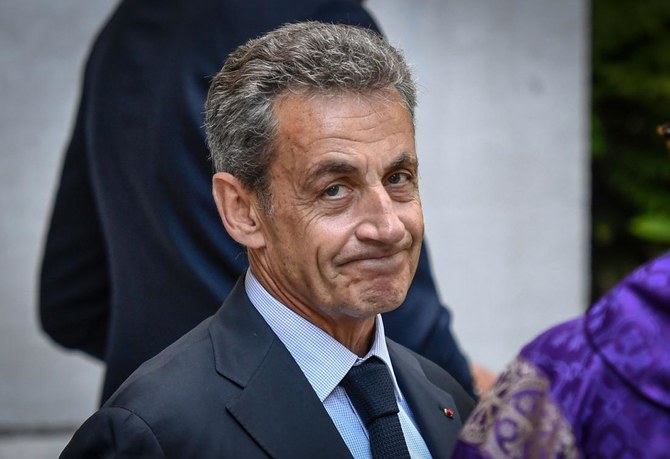
Former French President Nicolas Sarkozy leaves the funeral mass of late French Justice minister Pascal Clement at Saint Peter’s in Neuilly-sur-Seine, June 25, 2020. (AFP)
Short Url
Updated 24 September 2020
Follow

French ex-president Sarkozy loses challenge to cash-from-Libya case

  • Sarkozy has been accused by former members of Qaddafi’s regime of taking millions from the late Libyan dictator
  • Sarkozy, who quit politics after a failed comeback bid for the presidency in 2017, has accused the Paris judiciary of hounding him

PARIS: Former French president Nicolas Sarkozy lost his bid Thursday to throw out an inquiry into claims he used Libyan cash for his 2007 presidential campaign, a ruling that could require him and several associates to stand trial.
A Paris appeals court upheld the validity of the investigation, launched in 2012 after reports that Sarkozy accepted millions of euros from the regime of former strongman Muammar Qaddafi.
Sarkozy, 65, has denied the allegations. His lawyer declined to comment after the hearing on whether he would appeal the decision to France’s top criminal court.
But the failed legal challenge means the inquiry by two anti-corruption judges can continue, though it remains uncertain if they will eventually seek a trial.
Sarkozy has been accused by former members of Qaddafi’s regime that he took millions from the slain Libyan dictator, some of it delivered in cash-stuffed suitcases, in his successful 2007 presidential run.
The investigation began after the Mediapart published a document in 2012, allegedly signed by Libya’s intelligence chief, purporting to show that Qaddafi agreed to give Sarkozy up to 50 million euros ($58 million at current exchange rates).
Judges are also investigating claims by a French-Lebanese businessman, Ziad Takieddine, who said he delivered suitcases carrying a total of five million euros from the Libyan regime to Sarkozy’s chief of staff in 2006 and 2007.
Also charged in the case is Alexandre Djouhri, a businessman known to be close with several top rightwing politicians, who is suspected of acting as a middleman for the cash transfers.
The former president was charged in 2018 with taking bribes, concealing the embezzlement of Libyan public funds and illegal campaign financing.
Two of his former ministers, Claude Gueant and Eric Woerth, are among several others who have also been charged in the case.
“I think the judges proved they were able to resist all sorts of pressure being put on them,” said Vincent Brengarth, a lawyer for the Sherpa anti-corruption NGO, one of the civil parties in the case.
The allegations that Sarkozy took money from Qaddafi — whom he welcomed to Paris with pomp and ceremony shortly after his election victory — are the most serious to emerge from several investigations that have dogged him since he left office.
The claims first emerged in 2011, as France and Britain were preparing a NATO-backed intervention to support rebels seeking to end Qaddafi’s tyrannical 41-year rule.
Besides the claims of cash-stuffed suitcases, investigators suspect that Sarkozy’s campaign got cash from the 2009 sale of a villa on the French Riviera to a Libyan investment fund managed by Bashir Saleh, Qaddafi’s former chief of staff.
Djouhri is suspected of being the owner of the villa, which was sold at an inflated price to mask the alleged funds from Libya.
It is not the only legal headache for Sarkozy, who has enjoyed renewed popularity since retiring, with his memoirs seeing strong sales.
He has also been charged in two other cases, one relating to fake invoices devised to mask overspending on his failed 2012 re-election campaign, and another for alleged influence peddling involving a top judge.
He is set to go on trial in the second case on October 5, when he will become France’s first ex-president in the dock for corruption.
Sarkozy, who quit politics after a failed comeback attempt for the 2017 presidential vote, has accused the Paris judiciary of hounding him.


‘A den of bandits’: Rwanda closes thousands of evangelical churches

Updated 22 December 2025
Follow

‘A den of bandits’: Rwanda closes thousands of evangelical churches

  • A 2018 law introduced new rules on health, safety, and financial disclosures, and requires all preachers to have theological training
  • Observers say the real reason for the closures comes down to control, noting that even those who complied with the law had been shut down 
  • President Kagame has described the church as a relic of the colonial period, a chapter of its history with which the country is still grappling


KIGALI: Grace Room Ministries once filled giant stadiums in Rwanda three times a week before the evangelical organization was shut down in May.
It is one of the 10,000 churches reportedly closed by the government for failing to comply with a 2018 law designed to regulate places of worship.
The law introduced new rules on health, safety, and financial disclosures, and requires all preachers to have theological training.
President Paul Kagame has been vocal in his criticisms of the evangelical churches that have sprouted across the small country in Africa’s Great Lakes region.
“If it were up to me I wouldn’t even reopen a single church,” Kagame told a news briefing last month.
“In all the development challenges we are dealing with, the wars... our country’s survival — what is the role of these churches? Are they also providing jobs? Many are just thieving... some churches are just a den of bandits,” he said.
The vast majority of Rwandans are Christian according to a 2024 census, with many now traveling long and costly distances to find places to pray.
Observers say the real reason for the closures comes down to control.
Kagame’s government is saying “there’s no rival in terms of influence,” Louis Gitinywa, a lawyer and political analyst based in Kigali, told AFP.
The ruling party “bristles when an organization or individual gains influence,” he said, a view also expressed to AFP by an anonymous government official.

‘Deceived’ 

The 2018 law requires churches to submit annual action plans stating how they align with “national values.” All donations must be channelled through registered accounts.
Pastor Sam Rugira, whose two church branches were shut down last year for failing to meet fire safety regulations, said the rules mostly affected new evangelical churches that have “mushroomed” in recent years.
But Kagame has described the church as a relic of the colonial period, a chapter of its history with which the country is still grappling.
“You have been deceived by the colonizers and you let yourself be deceived,” he said in November.
The closure of Grace Room Ministries came as a shock to many across the country.
Pastor Julienne Kabanda, had been drawing massive crowds to the shiny new BK Arena in Kigali when the church’s license was revoked.
The government had cited unauthorized evangelical activities and a failure to submit “annual activity and financial reports.”
AFP was unable to reach Kabanda for comment.

‘Open disdain, disgust’ 

A church leader in Kigali, speaking to AFP on condition of anonymity, said the president’s “open disdain and disgust” for churches “spells tough times ahead.”
“It is unfair that even those that fulfilled all requirements are still closed,” he added.
But some say the clampdown on places of worship is linked to the 1994 Rwandan genocide in which around 800,000 people, mostly ethnic Tutsis, were slaughtered.
Ismael Buchanan a political science lecturer at the National University of Rwanda, told AFP the church could sometimes act as “a conduit of recruitment” for the Democratic Forces for the Liberation of Rwanda (FDLR), the Hutu militia formed in exile in DR Congo by those who committed the genocide.
“I agree religion and faith have played a key role in healing Rwandans from the emotional and psychological wounds after the genocide, but it also makes no sense to have a church every two kilometers instead of hospitals and schools,” he said.
Pastor Rugira meanwhile suggested the government is “regulating what it doesn’t understand.”
It should instead work with churches to weed out “bad apples” and help them meet requirements, especially when it comes to the donations they rely on to survive, he said.