

Wave of pro-Palestinian campus protests in US meets forceful response

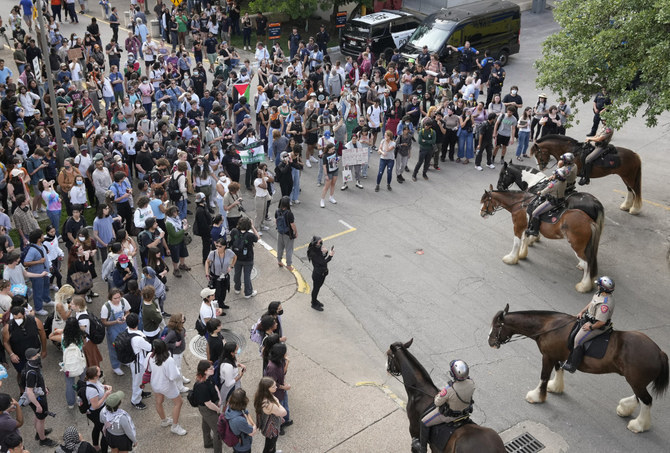
Pro-Palestinian protesters face off with mounted state troopers at the University of Texas on April 24, 2024, in Austin, Texas. (Austin American-Statesman via AP)
Short Url
Updated 26 April 2024
Follow

Wave of pro-Palestinian campus protests in US meets forceful response

  • Fresh clashes between police and students opposed to Israel’s war in Gaza broke out on Thursday
  • Questions abound over forceful methods being used to shut down intensifying protests

NEW YORK: Fresh clashes between police and students opposed to Israel’s war in Gaza broke out on Thursday, raising questions about forceful methods being used to shut down protests that have intensified since mass arrests at Columbia University last week.

Over the past two days, law enforcement at the behest of college administrators have deployed Tasers and tear gas against students protesters at Atlanta’s Emory University, activists say, while officers clad in riot gear and mounted on horseback have swept away demonstrations at the University of Texas in Austin.
At Columbia, the epicenter of the US protest movement, university officials are locked in a stalemate with students over the removal of a tent encampment set up two weeks ago as a protest against the Israeli offensive.
The administration, which has already allowed an initial deadline for an agreement with students to lapse, has given protesters until Friday to strike a deal.
Other universities appear determined to prevent similar, long-running demonstrations to take root, opting to work with police to shut them down quickly and in some cases, with force.
Overall, more than 530 arrests have been made in the last week across major US universities in relation to protests over Gaza, according to a Reuters tally. University authorities have said the demonstrations are often unauthorized and called on police to clear them.



Police officers arrest a demonstrator during a pro-Palestinian protest against the war in Gaza at Emory University on April 25, 2024, in Atlanta, Georgia. (AFP)

At Emory, police detained at least 15 people on its Atlanta campus, according to local media, after protesters began erecting a tent encampment in an attempt to emulate a symbol of vigilance employed by protesters at Columbia and elsewhere.
The local chapter of the activist group Jewish Voice for Peace said officers used tear gas and Tasers to dispense the demonstration and take some protesters into custody.
Video footage aired on FOX 5 Atlanta showed a melee breaking out between officers and some protesters, with officers using what appeared to be a stun gun to subdue a person and others wrestling other protesters to the ground and leading them away.
“Several dozen protesters trespassed into Emory University’s campus early Thursday morning and set up tents,” the school wrote in response to an emailed request for comment. It described the protesters as “activists attempting to disrupt our university,” but did not comment directly on the reports of violence.
Atlanta police did not immediately respond to inquiries about the number of protesters who were detained or about reports over the use of tear gas and stun guns.
Similar scenarios unfolded on the New Jersey campus of Princeton University where officers swarmed a newly-formed encampment, video footage on social media showed.
Boston police earlier forcibly removed a pro-Palestinian encampment set up by Emerson College, arresting more than 100 people, media accounts and police said. The latest clashes came a day after police in riot gear and on horseback descended on hundreds of student protesters at the University of Texas at Austin and arrested dozens of them.
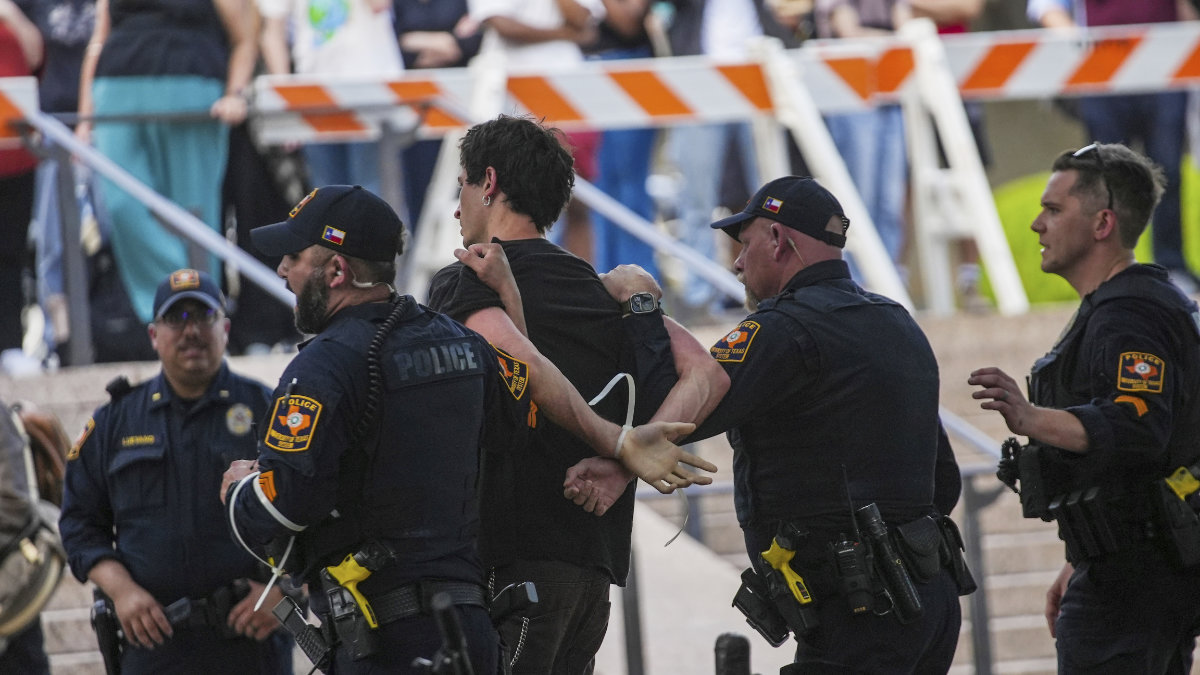


Police arrest a protester at the University of Texas on April 24, 2024, in Austin, Texas. (Austin American-Statesman via AP)

But prosecutors on Thursday dropped charges against most of the 60 people taken into custody, mostly on misdemeanor charges of criminal trespassing and disorderly conduct, and said they would proceed with only 14 of those cases.
In dropping the charges, the Travis County district attorney cited “deficiencies in the probable cause affidavits.”

‘Alarming reports’
Human Rights Watch and the American Civil Liberties Union have condemned the arrest of protesters and urged authorities to respect their free speech rights.
But some Republicans in Congress have accused university administrators of allowing Jewish students to be harassed, putting increasing pressure on schools to tightly control any demonstrations and to block any semi-permanent encampment.
US Education Secretary Miguel Cardona on Thursday said his department was closely monitoring the protests, including what he called “very alarming reports of antisemitism.”
In response, activist groups have strongly denied that the protests are antisemitic. Their aim is to pressure universities from divesting from companies that contribute to the Israeli military actions in Gaza, they say.
Even so, protest leaders have acknowledged that hateful rhetoric has been directed at Jewish students, but insist that people who tried to infiltrate and malign their movement are responsible for any harassment.
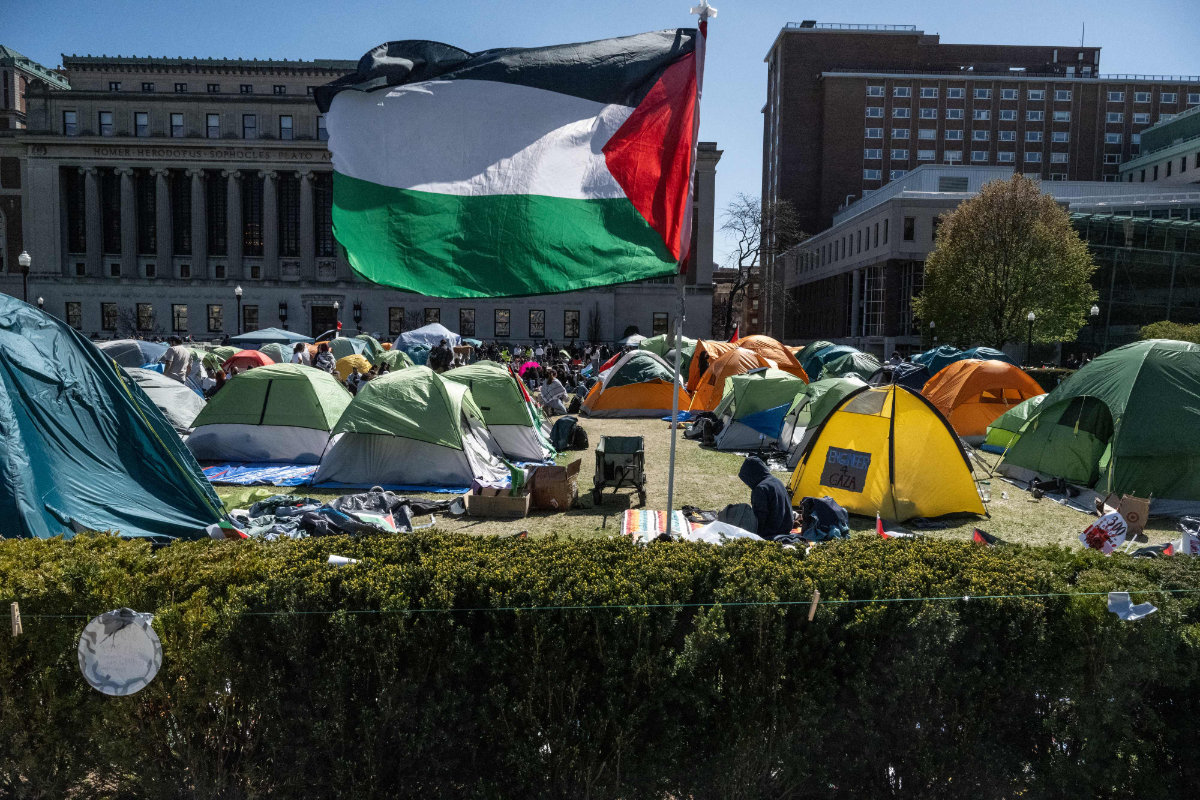


Columbia University students participate in an ongoing pro-Palestinian encampment on their campus in New York City on April 25, 2024, following last week's arrest of more than 100 protesters. (Getty Images/AFP)

Friday deadline at Columbia
At Columbia, officials have given protesters until 4 a.m. on Friday to reach an agreement with the university on dismantling dozens of tents set up on the New York City campus in a protest that started a week ago.
An initial deadline of midnight Tuesday came and went without an agreement, but administrators extended it for 48 hours, citing progress in the talks.
The university already tried to shut the protest down by force. On April 18, Columbia President Minouche Shafik took the unusual move of asking police to enter the campus, drawing the ire of many rights groups, students and faculty.
More than 100 people were arrested and the tents were removed from the main lawn. But within a few days, the encampment was back in place, and the university’s options appeared to narrow.
Protesters have vowed to keep the protests going until their universities agree to disclose and divest any financial holdings that might support the war in Gaza, and grant amnesty to students suspended from school during the demonstrations.
Student protesters have also demanded that the US government rein in Israeli strikes on civilians in Gaza, which have killed more than 34,000 people, according to Palestinian health authorities. Israel is retaliating against an Oct. 7 Hamas attack that killed 1,200 people and led to 253 taken hostage, according to Israeli tallies.


African Union rejects ‘any recognition of Somaliland’ after Israel declaration

A man holds a flag of Somaliland in front of the Hargeisa War Memorial monument in Hargeisa on November 7, 2024. (AFP)
Updated 27 December 2025
Follow

African Union rejects ‘any recognition of Somaliland’ after Israel declaration

  • Egypt’s foreign ministry said its top diplomat had spoken with his counterparts from Turkiye, Somalia and Djibouti, who together condemned the move and emphasized “their full support for the unity, sovereignty and territorial integrity of Somalia”
  • Israel repeatedly hit targets in Yemen after the Gaza war broke out in October 2023, in response to Houthi attacks on Israel that the rebels said were in solidarity with Palestinians in the Gaza Strip

NAIROBI: The African Union on Friday said it “rejects any recognition of Somaliland” after Israel declared it viewed the breakaway Somali territory as a sovereign state.
In a statement issued by its head, Mahamoud Ali Youssouf, the AU called for African borders to be respected and said: “Any attempt to undermine the unity, sovereignty, and territorial integrity of Somalia... risks setting a dangerous precedent with far-reaching implications for peace and stability across the continent.”
The chief of the pan-African body, which counts Somalia as a member, said he “firmly rejects any initiative or action aimed at recognizing Somaliland as an independent entity” and stating that Somaliland “remains an integral part of the Federal Republic of Somalia.”

While, Somalia reacted angrily on Friday after Israel formally recognized its northern region of Somaliland as an “independent and sovereign state” — the first country to do so.
Somaliland, which declared independence from Somalia in 1991, has for decades pushed for international recognition, which has been the key priority for president Abdirahman Mohamed Abdullahi since he took office last year.
But a Somali foreign ministry statement warned that the decision was “deliberate attack” on its sovereignty that would undermine peace in the region. Several other countries also condemned Israel’s decision.
Israeli Prime Minister Benjamin Netanyahu’s office said he announced “the official recognition of the Republic of Somaliland as an independent and sovereign state,” making Israel the first country to do so.
“The declaration is in the spirit of the Abraham Accords,” Netanyahu’s office said, referring to several agreements between Israel and Arab countries brokered by US President Donald Trump during his first presidency to normalize ties with Israel.
It said Netanyahu had invited Abdullahi to visit.
Hailing Israel’s decision, Abdullahi said in a post on X that it marked the beginning of a “strategic partnership.”
“This is a historic moment as we warmly welcome” he said, affirming “Somaliland’s readiness to join the Abraham Accords,” he added.
In Hargeisa, the capital of Somaliland, crowds of people took to the streets to celebrate, many carrying the flag of the breakaway state, said sources.

- ‘Illegitimate actions’ -

Somalia’s foreign ministry said: “Illegitimate actions of this nature seriously undermine regional peace and stability, exacerbate political and security tensions, in the Horn of Africa, the Red Sea and Gulf of Aden, the Middle East and the wider region.”
Turkiye, a close ally of Somalia, also condemned the move.
“This initiative by Israel, which aligns with its expansionist policy... constitutes overt interference in Somalia’s domestic affairs,” it said in a foreign ministry statement.
Egypt’s foreign ministry said its top diplomat had spoken with his counterparts from Turkiye, Somalia and Djibouti, who together condemned the move and emphasized “their full support for the unity, sovereignty and territorial integrity of Somalia.”
In video showing Netanyahu speaking to Abdullahi by telephone, the Israeli leader said: “I want you to know that I am signing now as we speak Israel’s official recognition of the Somaliland,” adding that the new relationship would offer economic opportunities.
“I am very, very happy and I am very proud of this day and I want to wish you and the people of Somaliland the very, very best,” he said.
Netanyahu also said that he would communicate to Trump Abdullahi’s “willingness and desire to join the Abraham accords.”
A self-proclaimed republic, Somaliland enjoys a strategic position on the Gulf of Aden, has its own money, passports and army. But since its unilateral declaration of independence in 1991, it has grappled with decades of isolation.

- Strategic -

Analysts say matters of strategy were behind Israel’s drive to recognize Somaliland.
“Israel requires allies in the Red Sea region for many strategic reasons, among them the possibility of a future campaign against the Houthis,” said the Institute for National Security Studies in a paper last month, referring to Yemen’s Iran-backed rebels.
“Somaliland is an ideal candidate for such cooperation as it could offer Israel potential access to an operational area close to the conflict zone,” it said, adding there were also economic motives.
Israel repeatedly hit targets in Yemen after the Gaza war broke out in October 2023, in response to Houthi attacks on Israel that the rebels said were in solidarity with Palestinians in the Gaza Strip.
The Houthis have halted their attacks since a fragile truce began in Gaza in October.
Somaliland’s lack of international recognition has hampered access to foreign loans, aid and investment, and the territory remains deeply impoverished.
A deal between landlocked Ethiopia and Somaliland last year to lease a stretch of coastline for a port and military base enraged Somalia.
Israel has been trying to bolster relations with countries in the Middle East and Africa.
Historic agreements struck late in Trump’s first term in 2020 saw several countries including Muslim-majority United Arab Emirates and Morocco normalize relations with Israel, but wars that have stoked Arab anger, particularly in Gaza, have hampered recent efforts.