

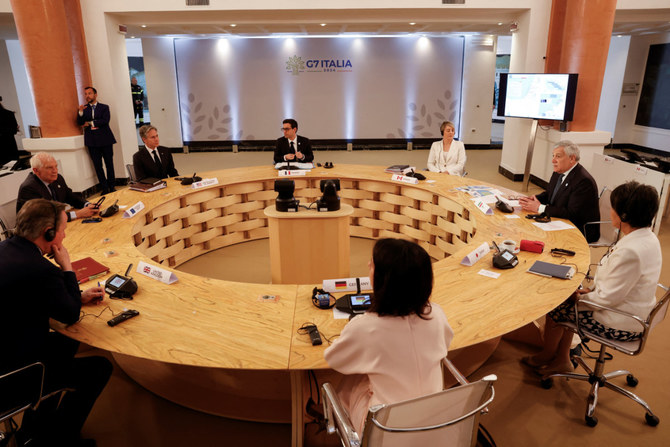
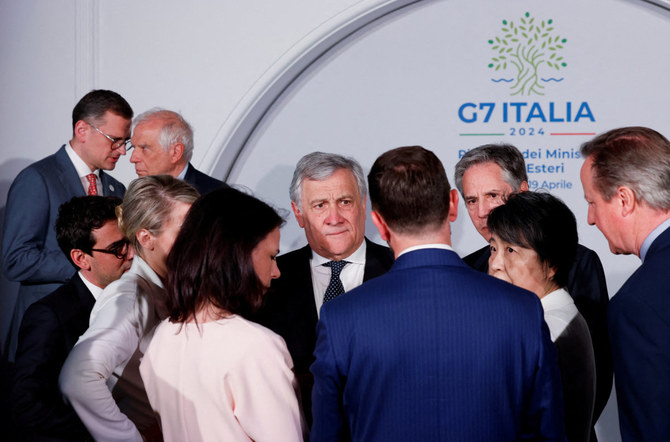

CAPRI, Italy: Ukraine warned foreign ministers from the Group of Seven (G7) major powers on Thursday they had to change strategy if they wanted Kyiv to withstand increasingly destructive Russian air assaults.
The G7 ministers meeting on the island of Capri acknowledged the need to get more air defense systems to Ukraine and applauded Ukrainian Foreign Minister Dmytro Kuleba as he joined them on the second day of their three-day gathering.
The G7, comprising Italy, Canada, France, Germany, Japan, Britain, the United States and European Union representatives, has been fiercely critical of Russia’s two-year long invasion of Ukraine.
However, military aid to Kyiv has slowed in recent months, with European partners apparently running low on ammunition and vital US funding blocked by Republicans in Congress.
Speaking to reporters as he arrived in Capri, Kuleba bemoaned the fact that while US, British and French forces had intervened on Saturday to help prevent Iranian missiles from hitting Israel, his own country lacked vital defenses.
“The strategy of our partners in Israel seems to be in preventing damage and death. ... In the last months, the strategy of our partners in Ukraine seems to be in helping (us) to recover from damage,” he said.
“So our job today is to find a way where our partners will design a mechanism, a way that will allow us also to avoid death and destruction in Ukraine.”
NATO Secretary General Jens Stoltenberg also took part in Thursday’s G7 meetings, telling reporters beforehand that the military alliance was actively seeking to send more air defense systems as quickly as possible.
“We are working at the possibility of (dispatching) more Patriot batteries to Ukraine. We are in dialogue with some specific countries,” he said.
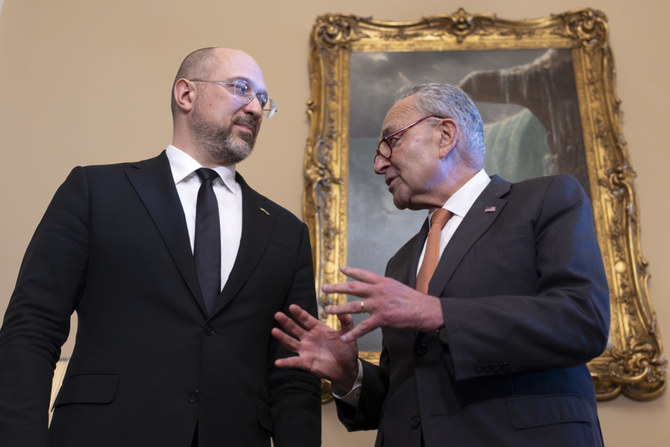
In Washington, Ukrainian Prime Minister Denys Shmyhal told reporters that Ukraine had asked for additional air defense equipment and another Patriot missile battery, adding that Kyiv was looking for a minimum of seven Patriot systems.
Shmyhal declined to say how many Patriot systems Ukraine had currently, saying that was classified information.
He said US and White House officials had assured the Ukrainian delegation that weapons would be supplied in a matter of weeks, not months, once a $60.8 billion US aid package for Ukraine was approved by Congress.
“We hope it will take days, but not more than weeks,” he said.
Domestic political wrangling has delayed delivery of the US aid, but the US House of Representatives might finally get to vote on the package this weekend, bringing some hope to G7 ministers.
Looking to Washington
Germany has already said it would hand over one Patriot system. European Union foreign policy chief Josep Borrell urged other EU nations to do likewise to help stave off concerted Russian attacks on vital Ukrainian infrastructure.
“Otherwise the electricity system of Ukraine will be destroyed. And no country can fight without having electricity at home, in the factories, online, for everything,” he told reporters in Capri.
“In these turbulent times, it is a hopeful sign that there are now signals from the Republicans in the US that support for Ukraine can be continued intensively,” German Foreign Minister Annalena Baerbock told a news conference.
Another key issue under review is how to use profits from some $300 billion of sovereign Russian assets held in the West to help Ukraine, as European Union member states hesitate over concerns about the legality of such a move.
“It’s important we try and get agreement. ... That’s what we’re discussing here. I’m in no doubt we will find a way, but we’re going to have to be creative. We’ll have to be flexible,” said British Foreign Secretary David Cameron.
Shmyhal told reporters in Washington that he had detailed discussions with US and G7 officials about how to use the frozen Russian assets, and he expected some results on that front this year.
Kuleba said he hoped to get immediate pledges this week on the delivery of more Patriot and SAMP/T air defense systems and also new Western sanctions targeting Iran’s production of armed drones, which are being exported to Russia.
Hours later, the United States and Britain announced they would introduce new sanctions on Iran targeting its drone program in retaliation for the April 13 strike on Israel.
But some G7 ministers also urged Israel not to exacerbate an already tense situation with a major retaliation of its own.
“Our appeal is always for prudence and de-escalation,” said Italian Foreign Minister Antonio Tajani. “We hope that Israel’s response, which will probably come, will be a targeted response and not something that provokes escalation.”


