

Keralites in Gulf take ‘vote flights’ to join India’s mammoth polls

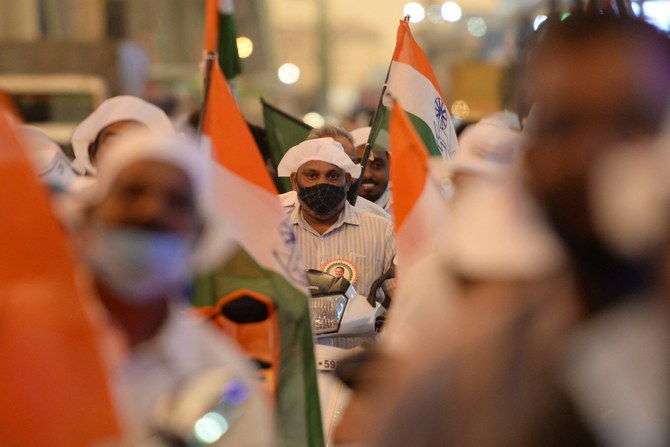
Supporters of United Democratic Front take part in a public rally ahead of the Kerala state legislative assembly elections in Kochi on March 29, 2021. (AFP)
Short Url
Updated 25 April 2024
Follow

Keralites in Gulf take ‘vote flights’ to join India’s mammoth polls

  • ‘Vote flights’ are special chartered flights bringing Keralites home to cast ballots
  • Kerala is the single main place of origin of Indian expats living in Gulf countries

NEW DELHI: Tens of thousands of Keralites working in Gulf countries are flying home to cast their ballots as the southern Indian state opens for voting on Friday in the world’s biggest general election.

India’s seven-phase polls started on April 19 and take place over the next six weeks, with more than 968 million people registered to vote.

Some states are completing the process in a day, and others have it spread out in several phases. Kerala is joining other 12 states, which according to the schedule go to the polls on April 26.

Indian nationals living overseas have been allowed to vote since 2011 and have to register with both the Election Commission of India and Indian embassies in their countries of residence. Their names will then appear on the voters’ list, but to cast their ballots, they still need to be physically present in their constituencies.

India has one of the world’s largest diasporas, especially in GCC countries, where at least 9 million Indian expats live and work. The southwestern coastal state of Kerala is the single main place of their origin. Some 3.5 million Keralites reside in Saudi Arabia, Oman, Kuwait, Qatar, Bahrain and the UAE.

“I think about 30,000 people have come from Saudi Arabia alone to vote. Not all of them have come on ‘vote viman’ (vote flights). Some have also come by regular flights,” said Iqbal Cheri, a marketing professional working in Dammam, who reached Kerala on Thursday.

Cheri referred to the flights that have been bringing citizens home to participate in Friday’s polls.

“They bring voters only and they are mostly chartered flights,” he said. “We have come here to vote and save our democracy and secularism. It’s an important election and we all need to vote to save the nation.”

His compatriot, Shareef Chola Paramdil, who works as a marketing head of a hospital in Dammam, said these election flights have been bringing Saudi Arabia-based Kerala voters home for the past few days.

“Last week, also three chartered flights came from Saudi Arabia,” he said.

“People who come on the chartered flights pay less compared to the regular flights, as group booking brings down the fare. Besides, these people don’t get more than a few days of leave. So, they come and cast their votes and leave the next day.”

There are 543 contested seats in the lower house of parliament. The party or coalition that wins at least 272 is going to form the government. The state of Kerala will contribute 20.

For Paramdil, the election is particularly important as a Muslim because incumbent Prime Minister Narendra Modi and his ruling Bharatiya Janata Party have been accused by the opposition and minority groups of marshaling majoritarian Hindu sentiment.

Critics say that India’s tradition of diversity and secularism has been under attack since Modi took power a decade ago and that his party has been fostering religious intolerance and discrimination.

“We want a government that does not discriminate in the name of religion, and we have been troubled by the politics of division that the government in Delhi has been practicing ever since it came to power in 2014,” Paramdil said.

Both Keralite Muslims and Hindus — like Gokul Padnabhan, a Kuwait-based professional in the oil and gas industry — see the election as an important exercise of their democratic rights.

“It’s very important to be here this time. That’s why I came for the vote,” Padnabhan said. “The vote will help us find the right person to rule us for the next five years.”

One of the organizations helping expat voters charter flights in Gulf countries is the Kerala Muslim Cultural Centre, an overseas wing of the Indian Union Muslim League.

“I feel around 100,000 people have come from the Gulf region to vote in this election,” said Ahamed Saju, head of the IUML’s student federation.

“Why they came is because this is a very crucial election this time ... Each and every vote is important. So, they thought that this time to protect our democracy, protect our constitution, protect our values and protect our secular credentials and the secular fabric of the country.”


Bangladesh mourns Khaleda Zia, its first woman prime minister

Updated 30 December 2025
Follow

Bangladesh mourns Khaleda Zia, its first woman prime minister

  • Ousted ex-premier Sheikh Hasina, who imprisoned Zia in 2018, offers condolences on her death
  • Zia’s rivalry with Hasina, both multiple-term PMs, shaped Bangladeshi politics for a generation

DHAKA: Bangladesh declared three days of state mourning on Tuesday for Khaleda Zia, its first female prime minister and one of the key figures on the county’s political scene over the past four decades.

Zia entered public life as Bangladesh’s first lady when her husband, Ziaur Rahman, a 1971 Liberation War hero, became president in 1977.

Four years later, when her husband was assassinated, she took over the helm of his Bangladesh Nationalist Party and, following the 1982 military coup led by Hussain Muhammad Ershad, was at the forefront of the pro-democracy movement.

Arrested several times during protests against Ershad’s rule, she first rose to power following the victory of the BNP in the 1991 general election, becoming the second woman prime minister of a predominantly Muslim nation, after Pakistan’s Benazir Bhutto.

Zia also served as a prime minister of a short-lived government of 1996 and came to power again for a full five-year term in 2001.

She passed away at the age of 80 on Tuesday morning at a hospital in Dhaka after a long illness.

She was a “symbol of the democratic movement” and with her death “the nation has lost a great guardian,” Bangladesh’s interim leader Muhammad Yunus said in a condolence statement, as the government announced the mourning period.

“Khaleda Zia was the three-time prime minister of Bangladesh and the country’s first female prime minister. ... Her role against President Ershad, an army chief who assumed the presidency through a coup, also made her a significant figure in the country’s politics,” Prof. Amena Mohsin, a political scientist, told Arab News.

“She was a housewife when she came into politics. At that time, she just lost her husband, but it’s not that she began politics under the shadow of her husband, president Ziaur Rahman. She outgrew her husband and built her own position.”

For a generation, Bangladeshi politics was shaped by Zia’s rivalry with Sheikh Hasina, who has served as prime minister for four terms.

Both carried the legacy of the Liberation War — Zia through her husband, and Hasina through her father, Sheikh Mujibur Rahman, widely known as the “Father of the Nation,” who served as the country’s first president until his assassination in 1975.

During Hasina’s rule, Zia was convicted in corruption cases and imprisoned in 2018. From 2020, she was placed under house arrest and freed only last year, after a mass student-led uprising, known as the July Revolution, ousted Hasina, who fled to India.

In November, Hasina was sentenced to death in absentia for her deadly crackdown on student protesters and remains in self-exile.

Unlike Hasina, Zia never left Bangladesh.

“She never left the country and countrymen, and she said that Bangladesh was her only address. Ultimately, it proved true,” Mohsin said.

“Many people admire Khaleda Zia for her uncompromising stance in politics. It’s true that she was uncompromising.”

On the social media of Hasina’s Awami League party, the ousted leader also offered condolences to Zia’s family, saying that her death has caused an “irreparable loss to the current politics of Bangladesh” and the BNP leadership.

The party’s chairmanship was assumed by Zia’s eldest son, Tarique Rahman, who returned to Dhaka just last week after more than 17 years in exile.

He had been living in London since 2008, when he faced multiple convictions, including an alleged plot to assassinate Hasina. Bangladeshi courts acquitted him only recently, following Hasina’s removal from office, making his return legally possible.

He is currently a leading contender for prime minister in February’s general elections.

“We knew it for many years that Tarique Rahman would assume his current position at some point,” Mohsin said.

“He should uphold the spirit of the July Revolution of 2024, including the right to freedom of expression, a free and fair environment for democratic practices, and more.”