

Onion price hike brings tears to Bangladeshi eyes

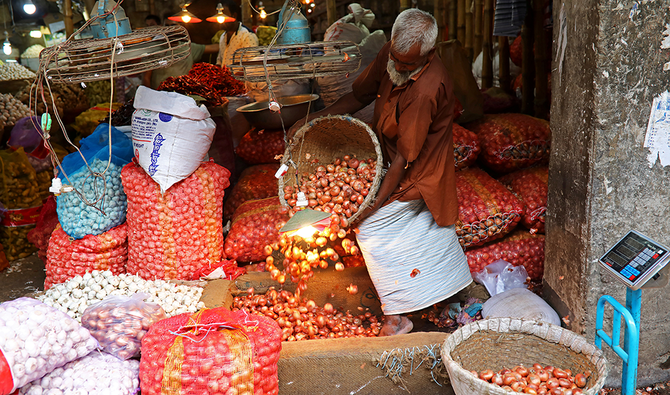
A man works at an onion wholesale market in the Kawran Bazar in Dhakaa, Bangladesh. (Reuters)
Short Url
Updated 17 September 2020
Follow

Onion price hike brings tears to Bangladeshi eyes

  • Dhaka desperate to beef up local stocks after India halts exports

DHAKA: Onions from the Netherlands? How about Myanmar?

Dhaka resident Masuma Begum said that she will buy the essential commodity from any part of the world a day after India placed a ban on its onion exports, leading to prices almost doubling in Bangladesh.

“Onions are a mandatory ingredient in our cuisine. It’s a part of our daily food habit,” Begum, 39, told Arab News.

She said the dramatic price increase had made it “difficult to buy even the minimum quantity of onions.”

Until Sunday, onions cost 50 cents per kilogram. By Wednesday, they were being sold at up to $1.2 per kilogram.

“My family needs around two kilograms of onions per week. If the current situation prevails, it will increase my expenses a lot. It’s an extra financial burden on our family of five,” Begum said. 

This isn’t the first time the high price of the commodity has led to tears of frustration for consumers and traders in the country.

A similar ban by India on Sept. 30 last year lifted prices to $3 per kilogram.

To maintain supplies, Bangladesh has started importing onions from Pakistan, Turkey and Egypt.

Assuring residents that “there is nothing to worry about,” Commerce Minister Tipu Munshi said on Wednesday that the country has 500,000 tons of onions in reserve.

“Within one month, we will normalize the supply chain. Already 1,300 tons of onion are being loaded on ships in Myanmar and will reach Bangladesh shortly,” Munshi told a press briefing.

He said that residents “will have to compromise with their onion demands for one month only.”

According to traders at the capital’s wholesale market in Shyambazar, around 80 percent of Bangladesh’s annual onion consumption is sourced from India.

“We prefer to import onions from India as it takes less time which results in minimum damage to the perishable goods,“ Wahid Hasan told Arab News.

 The trader said there was “enough supply” to meet everyone’s needs and blamed panic buying for the “artificial crisis.”

However, on Wednesday, anticipating a crisis in the onion market, Bangladeshi traders began importing from China, Egypt, Myanmar, the Netherlands, Pakistan and Turkey. 

“We have issued import permission for around 50,000 metric tons of onions. We don’t want to cause people to suffer,” Ashaduzzaman Bulbul, deputy director of the Chottogram Plant Quarantine Station, told Arab News. 

 “We hope the first lot of imported onions will reach our port from Myanmar soon,” he added. 

However, the Trading Corporation of Bangladesh, a wing of the Commerce Ministry that works to maintain supplies of essential commodities, said it had beefed up operations to control the market price.  “We have started selling onions at a reduced price through open market sales across the country. Every day, 276 trucks deliver the goods in different localities so that people can buy at an affordable price,” a spokesman told Arab News.

“Different sourcing channels from some other countries like Myanmar are also underway. People will get sufficient supply of onions in the market,” he added.


After accepting US deportees, South Sudan wanted sanctions relief for top official, documents show

Updated 57 min 57 sec ago
Follow

After accepting US deportees, South Sudan wanted sanctions relief for top official, documents show

  • In July, South Sudan became the first African country to receive third-country deportees from the US

JUBA: After agreeing to accept deportees from the United States last year, South Sudan sent a list of requests to Washington that included American support for the prosecution of an opposition leader and sanctions relief for a senior official accused of diverting over a billion dollars in public funds.
The requests, contained in a pair of diplomatic communications made public by the State Department this month, offer a glimpse into the kind of benefits that some governments may have sought as they negotiated with the US over the matter of receiving deportees.
In the documents, the US expresses “appreciation” to South Sudan for accepting the deportees and details the names, nationalities and crimes for which each individual was convicted.
In July, South Sudan became the first African country to receive third-country deportees from the US, Rwanda, Eswatini, Ghana and Equatorial Guinea have since received deportees.
The eight deportees to South Sudan included nationals of Mexico, Cuba, Vietnam, Laos, Myanmar and South Sudan itself.
Contentious deportations
They arrived in the South Sudanese capital of Juba after spending weeks on a US military base in Djibouti, where they were held after a US court temporarily blocked their deportation. Six of the eight men remain at a residential facility in Juba under the supervision of security personnel.
South Sudanese national Dian Peter Domach was later freed, according to the Ministry of Foreign Affairs, while Jesus Munoz-Gutierrez, a Mexican, was repatriated in September.
South Sudanese officials have not publicly said what long-term plan is in place for those still in custody. The third-country deportations were highly contentious, criticized by rights groups and others who expressed concern South Sudan would become a dumping ground.
Details of the deal between the US and South Sudan remain murky. It is still unclear what, if anything, South Sudan may have actually received or been promised. The documents only offer a glimpse into what the South Sudanese government hoped to get in return.
In other cases, Human Rights Watch said it saw documents showing the US agreed to pay Rwanda’s government around $7.5 million to take up to 250 deportees. The US will give Eswatini $5.1 million to take up to 160 deportees, according to the group.
For South Sudan, in one communication dated May 12 and marked confidential, South Sudan’s Ministry of Foreign Affairs raised eight “matters of concern which the Government of South Sudan believes merit consideration.” These ranged from the easing of visa restrictions for South Sudanese nationals to the construction of a rehabilitation center and “support in addressing the problem of armed civilians.”
Request to lift sanctions
But an eye-catching ask was for the lifting of US sanctions against former Vice President Benjamin Bol Mel as well as Washington’s support for the prosecution of opposition leader Riek Machar, the now-suspended first vice president of South Sudan who faces treason, murder and other criminal charges in a controversial case.
The allegations against Machar stem from a violent incident in March, when an armed militia with historical ties to him attacked a garrison of government troops. Machar’s supporters and some activists describe the charges as politically motivated.
Bol Mel is accused of diverting more than a billion dollars earmarked for infrastructure projects into companies he owns or controls, according to a UN report. He wielded vast influence in the government and was touted by some as Kiir’s likely successor in the presidency until he was dismissed and placed under house arrest in November.
Bol Mel was also viewed as a key figure behind the prosecution of Machar, one of the historical leaders of South Sudan’s ultimately successful quest for independence from Sudan in 2011.
Machar was Kiir’s deputy when they fell out in 2013, provoking the start of civil war as government troops loyal to Kiir fought forces loyal to Machar.
A 2018 peace agreement brought Machar back into government as the most senior of five vice presidents. His prosecution has been widely criticized as a violation of that agreement, and has coincided with a spike in violence that the UN says killed more than 1,800 people between January and September 2025.
The UN has also warned that a resurgence of fighting has brought the country “back to the edge of a relapse into civil war.” Machar is under house arrest in Juba while his criminal trial proceeds slowly.
In its communications with the US, South Sudan also asked for sanctions to be lifted over South Sudanese oil companies “to encourage direct foreign investments,” and for the US to consider investing in other sectors including fossil fuels, minerals and agriculture.
When asked if the US government had provided or promised South Sudan anything in return for accepting the deportees, a State Department official said, “In keeping with standard diplomatic practice, we do not disclose the details of private discussions.”
A spokesman for South Sudan’s Ministry of Foreign Affairs, Thomas Kenneth Elisapana, declined to comment.
US aid cuts
Despite accepting the US request to admit deportees, relations between the two governments have been strained in recent months.
In December, the US threatened to reduce aid contributions to the country, accusing the government of imposing fees on aid groups and obstructing their operations.
The US has historically been one of the largest donors to South Sudan, providing roughly $9.5 billion in aid since 2011. Over the years, South Sudan’s government has struggled to deliver many of the basic services of a state, and years of conflict have left the country heavily reliant on foreign aid.