

Bangladesh’s guava growers use river market to stay afloat

1 / 4
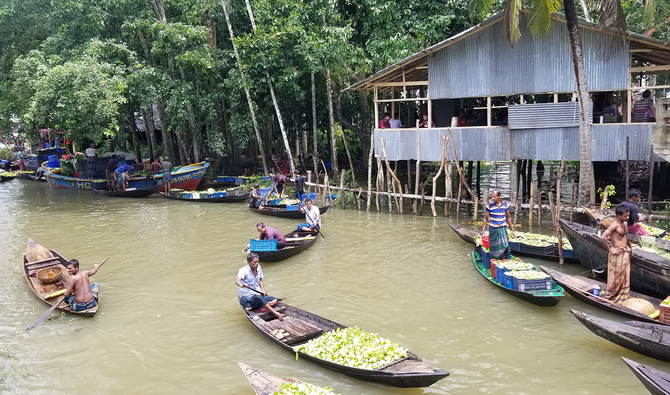
Floating guava market in Vimrul, Jhalakathi, a southern region district of Bangladesh, attracts fruit traders and tourists from across the country every day during monsoon season. (Photo by Shehab Sumon)
2 / 4
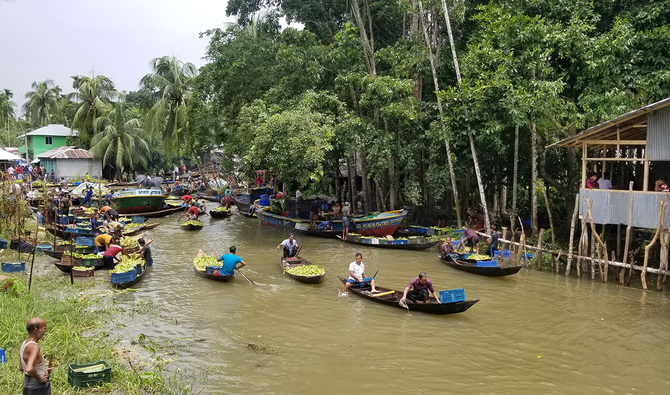
Floating guava market in Vimrul, Jhalakathi, a southern region district of Bangladesh, attracts fruit traders and tourists from across the country every day during monsoon season. (Photo by Shehab Sumon)
3 / 4
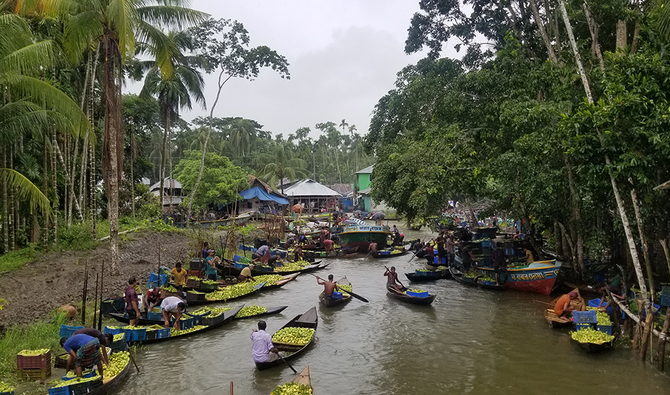
Floating guava market in Vimrul, Jhalakathi, a southern region district of Bangladesh, attracts fruit traders and tourists from across the country every day during monsoon season. (Photo by Shehab Sumon)
4 / 4
Floating guava market in Vimrul, Jhalakathi, a southern region district of Bangladesh, attracts fruit traders and tourists from across the country every day during monsoon season. (Photo by Shehab Sumon)
Short Url
Updated 13 September 2020
Follow

Bangladesh’s guava growers use river market to stay afloat

  • Country’s largest floating market is the main source of livelihood for thousands of traders

DHAKA: “Watch your step!” the signboard says in Bangla as guava traders lure customers to their boats, stacked neatly next to one another in several rows at a 150-year-old floating market in the Vimrul village of Bangladesh’s Jhalakathi District.

Here, more than 1,000 traders sell delicious varieties of the “goia” or guavas that are “plucked fresh from the trees” and sold at a fraction of the market price elsewhere.

“Growing guavas is one of our main sources of income as we can’t grow other crops due to the soil conditions. Also, customers know the guavas are organic and just plucked from the trees,” Kalipod Roy, a 57-year-old guava farmer from the nearby Shotodosh Kathi village, told Arab News.

And while there are other markets located in the Baukathi and Kuriana areas nearby, they are smaller in size and not as famous as the one in Vimrul, which is located 271 km from the capital Dhaka and is the largest source of guavas in the country. 

Roy said that selling the guavas at the market was “highly convenient” for most traders as transportation was “easy and always cheaper.”

Located in the southern part of Bangladesh where water vessels are the only means of transportation, the Vimrul market operates on a river connecting three canals, providing easy access to buyers from surrounding areas.

The Vimrul village has a population of about 1,500 people, 80 percent of whom are dependent on the cultivation of guava and hog pump, a sour-tasting fruit, for a livelihood.

According to Jhalakathi district’s agricultural department, about 1,600 farmers cultivate the fruit on 8,000 hectares of land in the villages of Shotodosh Kathi, Dumuria, Mira Kathi, Jogodishpur and Kapor Kathi, which are famous for guava cultivation due to the soil conditions.

It takes four months for the fruit to mature before it is ready for sale during the monsoon season from July to September.

“This floating guava market is part and parcel of the lives of people in this locality,” Gautam Roy, general secretary of the market, told Arab News. “Usually, they buy new clothes in this season as people have money in their hands. Most of the marriages and other ceremonies also take place in this season mainly due to sales at the floating guava market.”

During the three months of operation, traders work with clockwork precision to load the produce on to the wooden boats, check stock and compare the market rate before quoting the final price to the customer on board.

Time is of the essence as they are allowed to operate for only five hours every day, from 7 a.m. to noon, and buyers are short in supply — mainly due to the coronavirus and the size of the vessel, which allows for only two people to be on board at a time.  

The transactions are always in cash, with traders taking home in total nearly $13,000 at the end of each day.

Once they are done for the day, the leftover fruit is never discarded or taken back but sold at a throwaway price so as not to waste the produce.

However, neither the short trading hours nor the mode of selling act as a deterrent for the thousands of farmers at the floating market, several of whom are third-generation traders.

“I came to this floating market for the very first time as a child with my grandfather, who used to cultivate and sell guavas for a livelihood. After him, my father took over the business. Now both of them are no more, and I am at the helm of this family business,” Sirajul Islam, 49, said, adding that his family has been growing guavas for at least 80 years. 

The decades of experience have helped Islam to stay afloat despite the pandemic, he said.

After a nationwide lockdown was imposed in March to limit the spread of the outbreak, several businesses were forced to shut down.

But the high-quality and taste of his fruits ensured that “customers always came back for more.”

“I don’t use any artificial fertilizers for guava cultivation, only natural compost made of hyacinths. Artificial fertilizer may help me to grow more guavas, but it impacts the taste of the fruit. If my guavas have a good taste, I can sell them at a better price eventually,” he said. 

On an average, he produces about five tons of guavas every year. He said that the government could do more to support local farmers by providing financial assistance and training in the use of fertilizers and pesticides. 

“Currently, farmers are growing 9-10 tons of guava on each hectare of land,” Mohammad Fazlul Huq, deputy director of the district agriculture department, told Arab News. “We have deployed expert field officers at the grass-root level so that the farmers can avail themselves of instant support whenever needed. In some cases, experts from the agriculture department help the farmers control the pest attack and minimize the losses.” 

Another reason for the floating market’s popularity is the price of the guavas — cheaper than those sold across the country.

“I come here twice in a week to buy the fruits at a wholesale rate. Here the guavas are cheap and the best in quality,” Mohammad Zakir Hossain, a buyer from the capital who travels 271 km to shop at the market, told Arab News.

To ensure the prices stay competitive, traders at Vimrul market have access to free wifi for updates on the market prices in the adjoining districts and to be able to “connect with them buyers around the country,” Huq said.

He added that work was underway to grant bank loans at a low-interest rate to guava farmers “to help them continue production.”

The floating market is also a huge source of attraction for tourists from across the country, some of whom drive for several kilometers to “get their dose of green.”

“It’s amazing! It’s nothing but green all around. From all directions, boats are coming laden with guava . . . it is a beautiful scenario to watch the boats floating on the water with colorful fresh fruits,” Saiful Mahmud, a university student from Dhaka, told Arab News.


Coast Guard is pursuing another tanker helping Venezuela skirt sanctions, US official says

Updated 4 sec ago
Follow

Coast Guard is pursuing another tanker helping Venezuela skirt sanctions, US official says

  • US oil companies dominated Venezuela’s petroleum industry until the country’s leaders moved to nationalize the sector, first in the 1970s and again in the 21st century under Maduro and his predecessor, Hugo Chávez

WEST PALM BEACH, Florida: The US Coast Guard on Sunday was pursuing another sanctioned oil tanker in the Caribbean Sea as the Trump administration appeared to be intensifying its targeting of such vessels connected to the Venezuelan government.
The pursuit of the tanker, which was confirmed by a US official briefed on the operation, comes after the US administration announced Saturday it had seized a tanker for the second time in less than two weeks.
The official, who was not authorized to comment publicly about the ongoing operation and spoke on the condition of anonymity, said Sunday’s pursuit involved “a sanctioned dark fleet vessel that is part of Venezuela’s illegal sanctions evasion.”
The official said the vessel was flying a false flag and under a judicial seizure order.
The Pentagon and Department of Homeland Security, which oversees the US Coast Guard, deferred questions about the operation to the White House, which did not offer comment on the operation.
Saturday’s predawn seizure of a Panama-flagged vessel called Centuries targeted what the White House described as a “falsely flagged vessel operating as part of the Venezuelan shadow fleet to traffic stolen oil.”
The Coast Guard, with assistance from the Navy, seized a sanctioned tanker called Skipper on Dec. 10, another part of the shadow fleet of tankers that the US says operates on the fringes of the law to move sanctioned cargo. It was not even flying a nation’s flag when it was seized by the Coast Guard.
President Donald Trump, after that first seizure, said that the US would carry out a “blockade” of Venezuela. It all comes as Trump has ratcheted up his rhetoric toward Venezuelan President Nicolás Maduro.
This past week Trump demanded that Venezuela return assets that it seized from US oil companies years ago, justifying anew his announcement of a “blockade” against oil tankers traveling to or from the South American country that face American sanctions.
Trump cited the lost US investments in Venezuela when asked about his newest tactic in a pressure campaign against Maduro, suggesting the Republican administration’s moves are at least somewhat motivated by disputes over oil investments, along with accusations of drug trafficking. Some sanctioned tankers already are diverting away from Venezuela.
US oil companies dominated Venezuela’s petroleum industry until the country’s leaders moved to nationalize the sector, first in the 1970s and again in the 21st century under Maduro and his predecessor, Hugo Chávez. Compensation offered by Venezuela was deemed insufficient, and in 2014, an international arbitration panel ordered the country’s socialist government to pay $1.6 billion to ExxonMobil.
Maduro said in a message Sunday on Telegram that Venezuela has spent months “denouncing, challenging and defeating a campaign of aggression that goes from psychological terrorism to corsairs attacking oil tankers.”
He added: “We are ready to accelerate the pace of our deep revolution!”
Sen. Rand Paul, R-Kentucky, who has been critical of Trump’s Venezuela policy, called the tanker seizures a “provocation and a prelude to war.”
“Look, at any point in time, there are 20, 30 governments around the world that we don’t like that are either socialist or communist or have human rights violations,” Paul said on ABC’s’ “This Week.” ”But it isn’t the job of the American soldier to be the policeman of the world.”
The targeting of tankers comes as Trump has ordered the Defense Department to carry out a series of attacks on vessels in the Caribbean and eastern Pacific Ocean that his administration alleges are smuggling fentanyl and other illegal drugs into the United States and beyond.
At least 104 people have been killed in 28 known strikes since early September. The strikes have faced scrutiny from US lawmakers and human rights activists, who say the administration has offered scant evidence that its targets are indeed drug smugglers and that the fatal strikes amount to extrajudicial killings.
Trump has repeatedly said Maduro’s days in power are numbered. White House chief of staff Susie Wiles said in an interview with Vanity Fair published last week that Trump “wants to keep on blowing boats up until Maduro cries uncle.”
Sen. Tim Kaine, D-Virginia, told NBC’s “Meet the Press” on Sunday that Trump’s use of military to mount pressure on Maduro runs contrary to Trump’s pledge to keep the United States out of unnecessary wars.
Democrats have been pressing Trump to seek congressional authorization for the military action in the Caribbean.
“We should be using sanctions and other tools at our disposal to punish this dictator who is violating the human rights of his civilians and has run the Venezuelan economy into the ground,” Kaine said. “But I’ll tell you, we should not be waging war against Venezuela. We definitely should not be waging war without a vote of Congress.