

Virus closes door on 100k Bangladeshi migrants

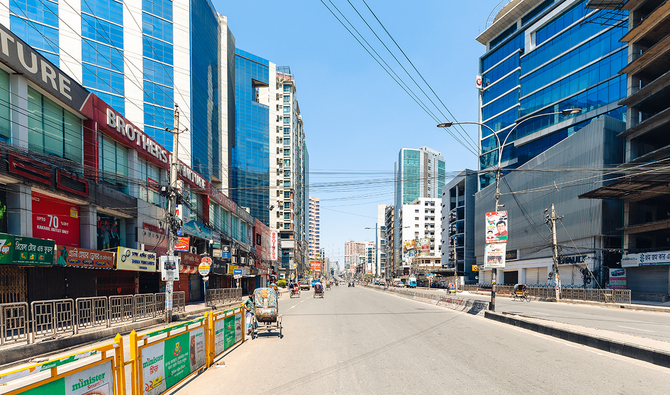
The abandoned streets of Dhaka after the lockdown and curfew for the prevention of the Coronavirus pandemic. (Shutterstock)
Short Url
Updated 20 August 2020
Follow

Virus closes door on 100k Bangladeshi migrants

  • Anxious workers face ruin after borrowing to fund move overseas

DHAKA: Mostak Ahmed had his bags packed and was ready to fly to Saudi Arabia in February this year after securing work in the Kingdom.

But six months on, the resident of Bangladesh’s Munshiganj district told Arab News on Wednesday that instead he is struggling to pay off money that he borrowed to finance his move.

“I borrowed $4,000 from a local organization at high interest and was set to fly to Saudi Arabia to work as a cleaner. But now I am repaying the loan instalments without earning a penny.

“I have had to borrow money from relatives. I don’t know how long I can survive like this,” Ahmed said.

He said the coronavirus pandemic has not only “crushed his dreams” of a better future abroad, but also left him without work at home.

Ahmed is among almost 100,000 aspiring Bangladeshi migrant workers stuck in limbo and facing an uncertain future due to the outbreak and travel bans imposed by most countries.

Bangladesh is one of the main labor sources for the Gulf and the Middle East, while more than 10 million workers are employed across the world.  

According to the Bangladesh Manpower Employment and Training Authority, the country sent more than 180,000 migrant workers to several countries between January and March this year, including 130,000 to Saudi Arabia — the destination of choice for Bangladeshi migrant workers.  

Many aspiring migrants said they had either sold their properties or borrowed money, hoping to repay the loan when they began working overseas. 

Abdul Hannan, a resident of the Noakhali district, said he sold the last piece of his ancestral land for $5,000 to secure work in the UAE. 

“My flight was supposed to be in the first week of April. But now everything is uncertain as my employer asked me to stay at home for few more weeks because the business is not going well,” Hannan told Arab News, adding that he is unsure what will happen “if ultimately I can’t fly to the UAE.”

He is not alone.

Shamim Ahmed Chowdhury Noman, secretary-general of the Bangladesh Association of International Recruiting Agencies, said more than 85,000 aspiring migrants are in a similar situation. 

“Most of these workers are facing severe hardship after arranging money to travel overseas. They can’t wait for an indefinite period shouldering a huge debt,” Noman told Arab News. 

He added that the best solution will be to refund workers to help ease their financial stress.

“These workers should be repaid the money if they can’t fly soon. But our members can’t do so as they have already spent the money. We have urged the government to provide soft loans for industry operators,” he said. 

The Bangladesh government said it is maintaining contact with host countries so aspiring migrants can begin work as soon as the pandemic is under control. 

Jahangir Alam, joint secretary of the Expatriates Welfare and Overseas Employment Ministry, told Arab News the response has been “positive.” 

“We are receiving positive responses from the UAE and Qatar regarding our migrants. We hope to receive a good response from Saudi Arabia as soon as they overcome the pandemic situation,” he added. 

Shariful Hasan, head of Bangladeshi NGO BRAC’s migration program, suggested the government take extraordinary measures to ease the plight of migrants.

“Those who have already paid money to join a job overseas should take priority as soon as the situation returns to normal,” he said. 

Bangladesh’s economy has taken a battering since the start of the pandemic with a fall in remittances, the second-largest source of revenue worth more than $18 billion last year.


Costa Rica’s Grynspan pledges reform in bid for UN chief job

Updated 3 sec ago
Follow

Costa Rica’s Grynspan pledges reform in bid for UN chief job

GENEVA: Rebeca Grynspan is upbeat about her chances of becoming the next head of the United Nations, which she insists must become more agile in tackling the world’s crises.
The Costa Rican former vice president said she wanted to rebuild global trust in the United Nations if she becomes its next secretary-general.
“We are very optimistic. I think that I am more than a viable candidate,” Grynspan said on Friday, her last working day before stepping aside as head of the UN trade and development agency UNCTAD to focus on her campaign.
The second term of current UN chief Antonio Guterres expires at the end of the year.
“My profile is right for this moment. I know the UN enough to reform it and enough to defend it,” she told the UN correspondents’ association ACANU.
“I have a lot of experience in my political life, taking decisions under a lot of stress and in complex situations. I have been in the highest positions in the UN.”
It is Latin America’s turn next for the top UN job and two other candidates are running: former Chilean president Michelle Bachelet, and Rafael Grossi, the Argentinian head of the International Atomic Energy Agency.
Founded in 1945, the UN has never had a woman secretary-general.
Grynspan, an economist, is not looking to be chosen on that basis.
“I don’t need any favors to be elected for the secretary-general; I just need people not to discriminate me for being a woman,” the 70-year-old said.
“If the competition will be fair, with no biases, I will make it. I have the CV; I have the merits.”

- Rebuilding trust -

Last month, Guterres warned that the UN was facing financial collapse and could run out of cash by July, with member states neither paying in full nor or time.
“The UN has to change,” said Grynspan.
There are far greater capacities in civil society and the private sector than in 1945, “and we need to be able to harness that: we don’t have to do everything in the UN.”
As for peace and security, “prevention and mediation are essential. But they need agility and flexibility from the structures of the UN. And I don’t think we have that right now.”
US President Donald Trump has slashed funding to some UN agencies and has repeatedly questioned the UN’s relevance and attacked its priorities, setting up his own “Board of Peace.”
“The UN is unique because it’s the only legitimate, universal organization,” said Grynspan.
“We need to rebuild trust with the member states. We need to regain the belief that the UN is useful to solve problems,” she said, vowing to bring her personal qualities to the task.
“I am able to reach to people not only with logic, but also with inspiration, optimism and hope,” she said.
“We need more of that too, because we need to connect again much more with people. We will need to conquer the hearts and minds again.”

- Leadership style -

The UNCTAD chief said her leadership style revolved around being “direct, honest, and evidence-based... There have to be reasons, not only emotions.”
Grynspan recounted that her parents, who were from Poland, “barely survived” World War II. Her maternal grandparents were killed in the Holocaust.
Her parents went “with nothing” to Costa Rica, a country that “allowed them to have a good life.”
“Costa Rica has taught me a lot. It’s a country that I not only love dearly, but I admire,” she said.
“I am not an impetuous person. I think things through. I have the serenity not to lose it under tension and under pressure. I consult. I hear. And I am brave. I take risks.”
rjm/ceg