

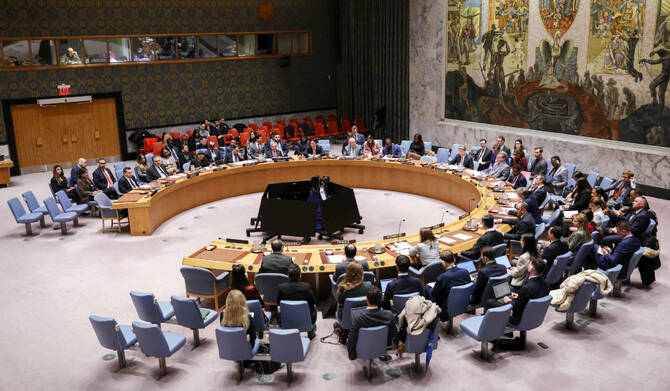

NEW YORK: Russia and China on Tuesday vetoed a UN Security Council resolution sponsored by Bahrain aimed at safeguarding navigation through the Strait of Hormuz, dealing a blow to international efforts to address rising tensions linked to Iran’s obstruction of the vital waterway.
The draft resolution received 11 votes in favor, with two against — Russia and China — and two abstentions, falling short due to the vetoes by the two permanent members.
The measure had been repeatedly diluted in a bid to secure consensus among council members. An initial proposal would have authorized the use of “all necessary means,” including potential military action, to ensure freedom of navigation.
However, opposition from veto-wielding members, including Russia, China, and France, forced successive revisions. References to offensive force were first removed, then replaced with language permitting only “defensive means,” before being stripped entirely of any authorization for action by the council.
The final text merely “strongly encouraged” states reliant on the Strait of Hormuz to coordinate defensive efforts to ensure maritime security, while also demanding that Iran halt attacks on commercial vessels and cease interference with navigation.
Bahrain’s Foreign Minister, Abdullatif Al-Zayani, underscored the global importance of the strait ahead of the vote, describing it as a critical artery for international trade and energy supplies.
He said that the Strait of Hormuz handles about 38 percent of global crude oil trade, 29 percent of liquefied petroleum gas, 19 percent of liquefied natural gas, and 20 percent of refined petroleum products. It also facilitates the transport of 30 percent of the world’s helium supplies, alongside essential goods such as food and pharmaceuticals.
“The council failed to shoulder its responsibility in relation to an illegal conduct that requires decisive action with no delay,” Al-Zayani said after the vote, expressing disappointment at the outcome.
He warned that inaction risks undermining the credibility of the Security Council and emboldening further violations, stressing that freedom of navigation in international waterways is protected under international law and cannot be obstructed by any state.
In March, the Security Council adopted a separate Bahrain-sponsored resolution condemning “egregious attacks” by Iran on Gulf nations, and calling for an immediate halt to strikes and interference with maritime traffic. That measure passed 13-0, with Russia and China abstaining.
Despite that earlier resolution, incidents in and around the Strait of Hormuz have continued, raising concerns over the security of global energy markets and supply chains.
Al-Zayani accused Iran of pursuing a pattern of escalation, including the use of ballistic missiles and drones against neighboring countries, as well as attempting to use the strait as leverage through economic pressure.
He warned that such actions threaten not only regional stability but also global food and medicine supplies, energy security, and international trade.
“The threat to close the Strait of Hormuz and using it as a pressure card before the world is not anything new,” he said. “It is a repeated conduct used by Iran for decades.”
US Ambassador Mike Waltz sharply criticized the vetoes, expressing support for Bahrain and Gulf states.
“The United States stands with Bahrain and Gulf states at this moment of reckoning,” Waltz said, adding that Russia and China had chosen to oppose them.
He accused Iran of “taking the Strait of Hormuz hostage” and, by extension, attempting to hold the global economy at risk.
“Well, colleagues, that may be its last act. We’ll see,” he added.
Gulf states have warned that failure to act decisively could embolden further disruptions in one of the world’s most critical maritime chokepoints.
Al-Zayani said that the Gulf region plays a central role in global economic stability, supplying energy, supporting supply chains, and serving as a key partner for developing nations.
He said that the failure to adopt the resolution does not legitimize attacks on shipping or diminish states’ rights under international law to defend maritime navigation.
“Failing to adopt this resolution does not protect civilian seafarers, does not secure global supply chains, and does not ensure the free flow of energy and trade,” he said.


