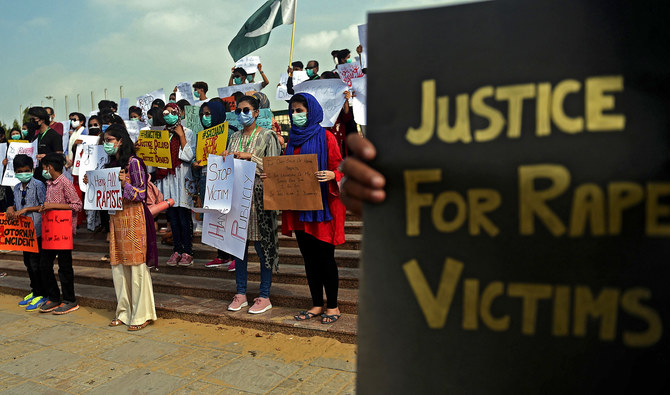
ISLAMABAD: It’s no surprise the Pakistani street wants faster, harsher justice for sexual crimes following the gang-rape of a woman on a highway last week that has caused uproar in the South Asian nation but rights advocates say the government should focus on strengthening the criminal justice system to ensure ‘certainty of punishment’ instead of making calls for public hangings and chemical castrations.
Last week, a mother of two was driving along a major highway near Lahore when her car ran out of fuel. As she waited for help along the road, at least two men arrived, dragged the woman out of her car and raped her at gunpoint, in front of her children.
In an interview aired on Monday, Prime Minister Imran Khan said he believed the culprits should be hanged publicly or chemically castrated.
Rights advocates and lawyers have cried foul at the suggestion, saying Pakistan needs better policing and prosecutions, not new laws or punishments that will trample fundamental rights in the government’s rush to be in tune with popular rage.
“In most countries that allow chemical castrations, these are only carried out in a regulated manner against perpetrators of child sexual abuse, in consultation with doctors and psychologists,” Reema Omer, legal adviser South Asia for International Commission of Jurists, told Arab News.
She said that the punishment is “often voluntary and a condition for such offenders to get parole.”
“Their objective is rehabilitation and preventing repeat offenses,” the lawyer said. “They are not viewed as exemplary punishment of all kinds of sexual offenses, which appears to be what the prime minister is considering for Pakistan.”
Rape is a criminal offense in Pakistan, with punishment ranging from up to 25 years in prison to the death penalty. No official data is available for the number of rape cases in the country, though experts estimate they are in the thousands each year.
In Pakistan, the conviction rate in rape cases is under three percent, according to the Karachi-based War Against Rape (WAR).
Omer said that every time a rape grabbed headlines in Pakistan, there was public outrage and an ‘erroneous focus’ on enhancing the sentence: “Even the most severe penalty won’t be a deterrent for such crimes if perpetrators know there is less than five percent chance they will be convicted,” she said.
If Pakistan enacts laws to make chemical castration of sexual abusers legal, it will join a small group of nations that allow such a punishment, including Indonesia, Poland, Russia, and Estonia, as well as some states in the United States. In 2011, South Korea became the first Asian country to use chemical castration as a punishment.
The procedure involves using a drug to reduce testosterone levels and affect the sex drive.
Sarah Zaman, former director at War Against Rape, said rape was prevalent in Pakistan because of “impunity” and systematic flaws in the criminal justice system that helped culprits escape accountable.
“We need to defeat the culture in our society that encourages such crimes instead of raising the punishments,” she told Arab News, adding that the government need to work on increasing conviction rates in rape cases.
“It’s ignorant, short-sighted and non-serious,” Zaman said when asked about the PM’s suggestion that rapists be chemically castrated. “Also, this won’t help reduce impunity to the criminals.”
Dr. Qibla Ayaz, chairman of the Council of Islamic Ideology, a body that advices the government on the compatibility of laws with Islam, said the council had recommended that the government establish special courts that could hear cases of heinous crimes like rape.
“Sufficient laws and strict punishments regarding rape already exist, and we just need to ensure their implementation to deter the crime,” he told Arab News.
Maliha Zia Lari, a human rights activist and lawyer, also suggested that the government focus on “certainty of the punishment” through cogent reforms in the criminal justice system.
“We need to understand that rape is a power offense and not a lust crime,” she said. “We need to change the patriarchal mindset to curb sexual violence against women.”


![]()

Rights advocates wary as Pakistan suggests public executions, chemical castration after gang-rape
Short Url
https://arab.news/jyv5z
Rights advocates wary as Pakistan suggests public executions, chemical castration after gang-rape
- Activists and legal experts urge government to strengthen criminal justice system, ensure ‘certainty of punishment’ rather than opt for stopgap solutions
- Council of Islamic Ideology says adequate laws and punishments regarding rape already exist and need to be implemented properly
Latest updates


© 2026 SAUDI RESEARCH & PUBLISHING COMPANY, All Rights Reserved And subject to Terms of Use Agreement.